Get Full Government Meeting Transcripts, Videos, & Alerts Forever!
Get email alerts on the Urban Design topic
No spam. Unsubscribe anytime.
Dallas committee hears overview of Urban Design Peer Review program and how recommendations are implemented
Summary
City staff briefed the Economic Development Committee on the Urban Design Peer Review Panel27s history, role and process; members asked about program outreach, how recommendations are tracked and whether the panel should review more city projects.
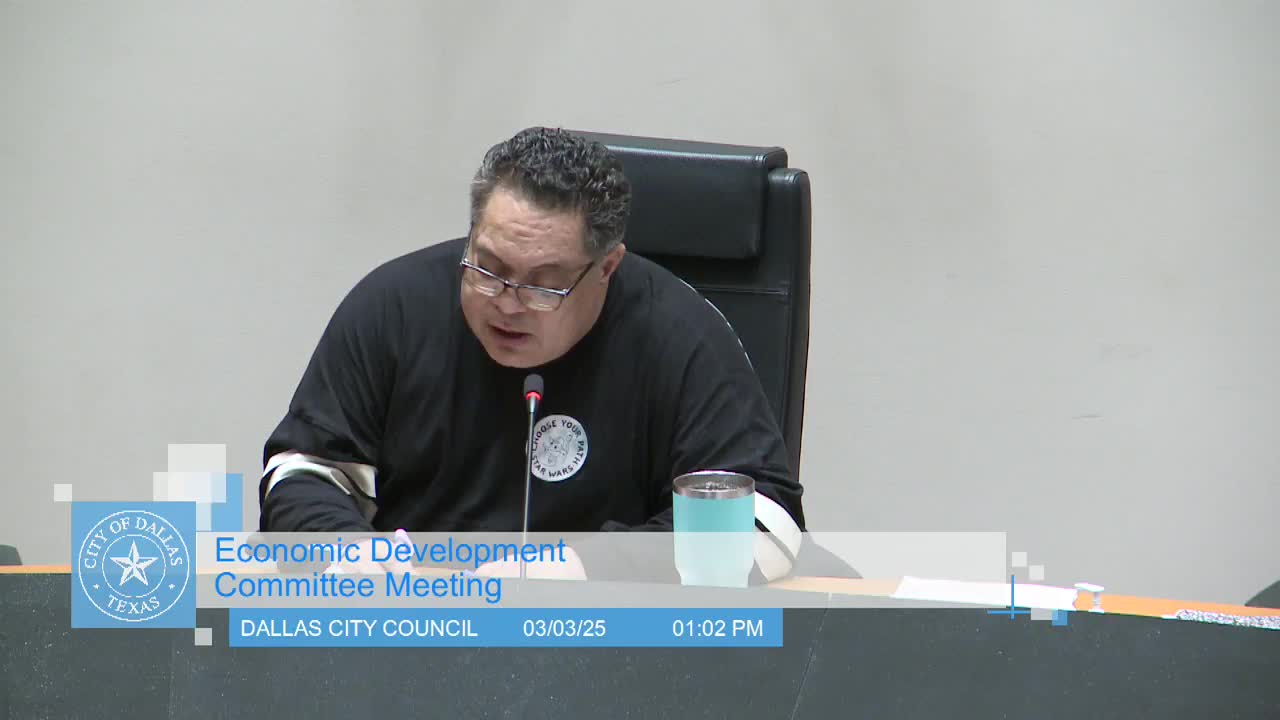
The City of Dallas Economic Development Committee received an overview of the Urban Design Peer Review program on March 3, 2025, during a briefing by Arturo Del Castillo, assistant director in the Planning and Development Department. Committee members and staff discussed how the panel operates, what projects it reviews, and how its recommendations are implemented.
The urban design peer review program, Del Castillo said, was established in February 2012 after a council-adopted action in the Downtown360 plan to provide consistent, advisory urban design guidance across TIF districts and to augment staff reviews. Del Castillo said the panel is advisory and has no authority over project approvals or development agreements. "It does not have any authority regarding project approvals or development agreements," he said.
The nut of the program, staff told the committee, is to provide timely, consistent design guidance for key projects. The panel reviews private development proposals in TIF districts that seek negotiated incentives and may also review city projects in current or former TIF districts at the discretion of city management. Applicants may also voluntarily submit projects for review. Panel recommendations are drawn from adopted city policies and TIF urban design guidelines and are intended to improve public realm activation, ground-floor uses, open space and walkability.
The panel meets monthly behind the committee chambers in a studio-style "crit" format: staff opens with project context and key issues, the design team presents, and the panel asks clarification questions before issuing recommendations. Del Castillo said staff takes notes during meetings, typically returns written recommendations to applicants within a day or two, and works with applicants to satisfy those recommendations. "Staff takes notes during the meeting and they return those recommendations to the applicant within a day or two," Del Castillo said.
Committee members pressed on several operational points. Councilmember Ridley asked whether private developers can be required to undergo the review; Del Castillo confirmed they cannot be required to do so. Robin Bentley (identified in the briefing as a city manager27s office representative) said the city generally asks developers to do the review prior to applying for incentives and that compliance with peer review recommendations is often included as a condition in incentive agreements. "For the ones that make it to an agreement, we virtually always include a requirement that they comply with the urban design peer review recommendations," Bentley said.
Members asked about the panel27s composition and effectiveness. Del Castillo described the panel as a volunteer body of at least nine members (a minimum of four architects, two landscape architects, one planner and two engineers) selected from a qualified pool and serving up to two four-year terms; staff said 63 projects have been reviewed since 2013. Councilmember West and others noted the panel27s focus on public realm outcomes such as walkability, and asked how often recommendations are implemented. Del Castillo said the city measured incorporation rates after the first 50 projects but has not updated that metric recently and offered to share the prior results; he estimated a "high majority" of recommendations are incorporated into final designs.
Members also asked whether the panel could or should review more city-owned capital projects. Staff said there is no formal size or budget threshold that currently triggers a review for city projects; reviews of city projects have been at management27s discretion. Several members suggested establishing criteria so that large or neighborhood-significant city projects would routinely undergo peer review.
The presentation closed with staff noting opportunities to use the panel on upcoming components of the Kay Bailey Hutchison Convention Center project, capital projects such as libraries and parks, and during the city27s development code update.
The committee did not take action on the briefing; members directed staff to consider metrics, outreach and possible thresholds for city project review.