Get Full Government Meeting Transcripts, Videos, & Alerts Forever!
Get email alerts on the Traffic Calming topic
No spam. Unsubscribe anytime.
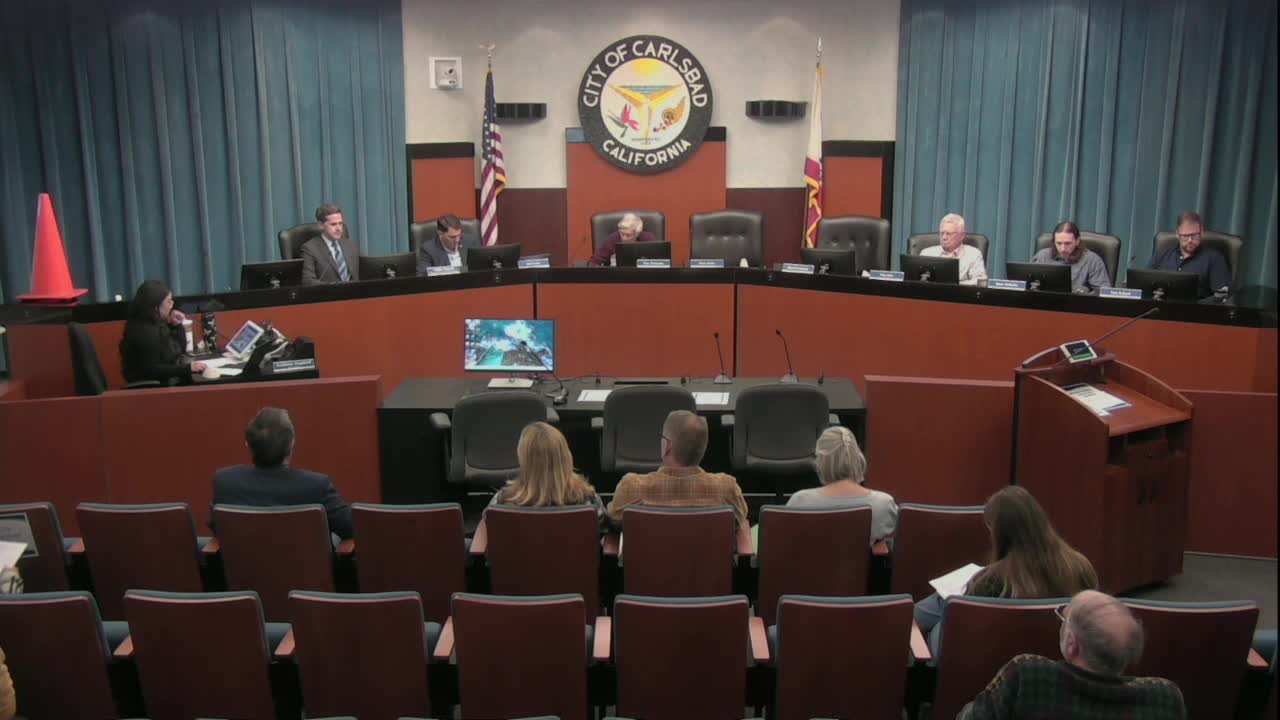
Commission approves exception to add three streets to Carlsbad residential traffic-calming Phase 2
Summary
The Traffic Safety and Mobility Commission voted to allow Ania/Aneo Way, La Gran Via and Madrilena Way to advance to Phase 2 of the Carlsbad Residential Traffic Management Program; the exception starts community outreach and a mail survey but does not guarantee construction.
The City of Carlsbad Traffic Safety and Mobility Commission voted to approve exceptions that will allow Ania (transcribed also as Aneo/Anil) Way, La Gran Via and Madrilena Way to enter Phase 2 of the Carlsbad Residential Traffic Management Program (CRTMP), the commission said March 3. The vote passed 5–0 with two commissioners absent.
City Traffic Engineer John Kim and Senior Engineer Miriam Jim told the commission the CRTMP is a three-phase program: Phase 1 is education and enforcement, Phase 2 is “cost-effective traffic calming measures” and Phase 3 is traditional, typically higher-cost traffic calming improvements. Kim said the program includes an exception process so streets that do not meet strict numerical eligibility can still advance for community consideration; granting the exception allows staff to begin Phase 2 outreach and design steps but “does not guarantee or imply that traffic calming measures on the subject street will be installed,” he said.
The staff presentation said temporary speed feedback signs were deployed on the streets as part of Phase 1. Those measurements showed the “critical speed” (the program’s 85th-percentile threshold) below the program threshold of 32 miles per hour, so the streets would not have automatically qualified. Staff said, however, they have received more than 25 letters and emails from residents between January and February requesting traffic-calming measures and held a community meeting on Feb. 26 where residents described consistent safety concerns.
Residents who spoke at the meeting told commissioners they regularly observe high speeds, near misses and drivers using the streets as a cut-through to avoid congestion on Levante Street. Matthew Pavetti, a resident, said the Phase 1 detection locations and methods can skew results and urged staff to review the raw data: “I’m just concerned that the data collected in the phase 1 study is not necessarily accurate.” Kathy Walters, a resident, told commissioners about children walking and using e-bikes and said the intersections at Madrilena and Ania/Aneo and Madrilena and La Gran Via “are dangerous for those kids.” David Gartstrom, a resident, urged adding stop signs at either Madrilena and Ania/Aneo Way or Rosio and Aneo Way: “There needs to be a stop sign either at Madrilena And Aneo Way or Rosio And Aneo Way, in my opinion.”
Commissioners asked technical questions about the speed survey method, and staff said they collect two weeks of data at each site—first week with the feedback sign’s display off (data-only) and second week with the display on—to capture both baseline speeds and short-term behavioral response. Kim explained the 32 mph threshold was established when the program was created in 2001, based on past collision data and enforcement practices: “32 seemed to be kind of where ... the police may enforce a speed limit on a 25 mile per hour zone,” he said. Staff told the commission that if the exception is granted they will hold neighborhood meetings, develop conceptual plans, and measure community support via a mailed survey before returning with a recommended implementation plan.
Outcome and next steps: The commission voted to approve the exceptions to allow Ania/Aneo Way, La Gran Via and Madrilena Way to enter CRTMP Phase 2. Staff said they will initiate community outreach and the Phase 2 process, which includes conceptual designs, a mailed community support survey, and further return visits to the commission before any installations are approved or constructed.
Because the exception does not guarantee construction, commissioners and residents emphasized the next steps: (1) staff will hold localized meetings with neighbors, (2) staff will prepare conceptual traffic-calming options (signing/striping, stop sign changes, small intersection changes or other low-cost devices), (3) a mailed survey will measure support, and (4) staff will return with implementation recommendations. Commissioners requested that future staff reports include more granular speed data—maximum speeds observed and the proportion of vehicles exceeding key thresholds—so the commission can better understand the small subset of vehicles traveling well above the 85th-percentile speeds.
The commission’s approval records the exception only; any specific physical traffic-calming measure (stop sign, pavement treatment, speed table, etc.) would be proposed later and require additional analysis, outreach and commission action.