Get Full Government Meeting Transcripts, Videos, & Alerts Forever!
Get email alerts on the Planning And Zoning topic
No spam. Unsubscribe anytime.
Bellaire holds public hearing on proposed Chapter 24 zoning and sign ordinance changes
Summary
City Council held a public hearing on proposed amendments to Chapter 24 (Planning and Zoning), focusing on edits driven by the comprehensive plan, changes to the Urban Village Downtown district, sign regulations and definitions related to community homes; council set written‑comment deadline and anticipated final deliberation on March 17.
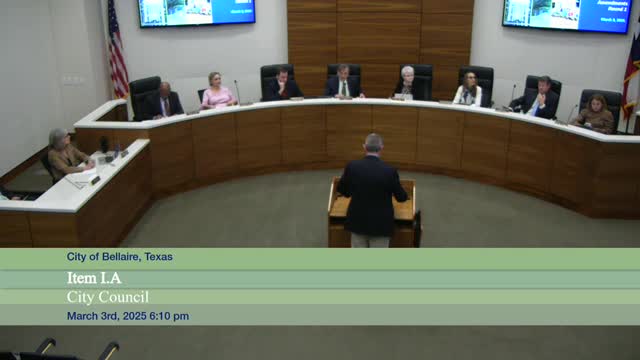
City Council of the City of Bellaire held a public hearing in March 2025 on proposed text amendments to Chapter 24 of the city code, which covers planning and zoning. The measure, initiated after the city adopted a new comprehensive plan, would reorganize the chapter, make editorial updates, change several zoning‑district regulations in the Urban Village Downtown (UBD) area, and rewrite sign rules to comply with federal content‑neutrality requirements.
The proposal was introduced by Travis Tanner, director of development services, and presented in detail by Gary Mitchell of Kennedy Collaborative. Mitchell told council the package contains three categories of changes: editorial reorganization, substantive zoning‑district regulation changes, and sign‑regulation updates. He said staff proposed removing a minimum building‑height requirement in the UBD and reducing the maximum lot or site coverage in much of UBD while increasing permitted coverage for some institutional uses on residential lots (schools, private clubs, places of worship). He also described a possible limited allowance for drive‑in/drive‑through facilities on properties with frontage along major corridors (Bissonnet, South Rice and Bellaire Boulevard) while retaining a ban elsewhere in the UBD to preserve walkability.
Mitchell said the proposed sign changes were prompted by recent U.S. Supreme Court guidance requiring content neutrality and by state changes limiting local regulation of building materials. He described efforts to consolidate repetitive ordinance text into single sections, add tables and graphics for clarity, and to add administrative review authority for straightforward site plan elements. He said the Planning & Zoning Commission recommended the package after its December 2024 public hearing and a January vote recommending approval to council.
Residents and other members of the public provided oral comment at the hearing and the mayor read one written submission into the record. Speakers at the hearing voiced particular concern about a proposed numeric limit on “stake” yard signs in residential districts (a proposed cap of 10 was discussed). Several residents argued a fixed cap could unintentionally limit nonpolitical speech (birthday or celebration signs) and could be difficult to enforce; others said political signs are protected by state law and would remain exempt. Michelle Arnold, who identified herself as a long‑time disability advocate, asked whether state law requires the city to allow “group homes” and urged caution; city staff and legal counsel explained state law protects certain community or residential care homes and the proposal clarifies definitions rather than creates new allowances.
City staff said the public hearing presentation was limited to 15 minutes and that oral comments were limited to five minutes per speaker; written comments would be accepted through noon on Thursday, March 13 for inclusion in the council’s packet ahead of anticipated final deliberation on Monday, March 17, 2025. Councilmembers and staff discussed splitting the package for council consideration — moving forward promptly on editorial and zoning‑district text changes while deferring the sign‑regulation section for additional review — and several members urged extra scrutiny of the sign rules because sign policy tends to generate extensive public debate.
City staff said several related amendments remain in future phases, including upcoming zoning classification changes and further work on the Urban Village and mixed‑use districts to follow this spring and summer.
Ending: Council closed the public hearing at the meeting’s conclusion and confirmed the written‑comment deadline and the anticipated March 17 date for final deliberation and any vote on the proposed amendments.