Get Full Government Meeting Transcripts, Videos, & Alerts Forever!
Get email alerts on the Charter Government Structure topic
No spam. Unsubscribe anytime.
Charter Review Committee recommends Grove City Council pursue charter amendments on form of government
Summary
The Grove City Charter Review Committee recommended the council pursue amendments to the city charter to address the city’s form of government, presenting three options and saying most committee members favored a change. Council did not take a formal vote and will consider next steps at an upcoming retreat.
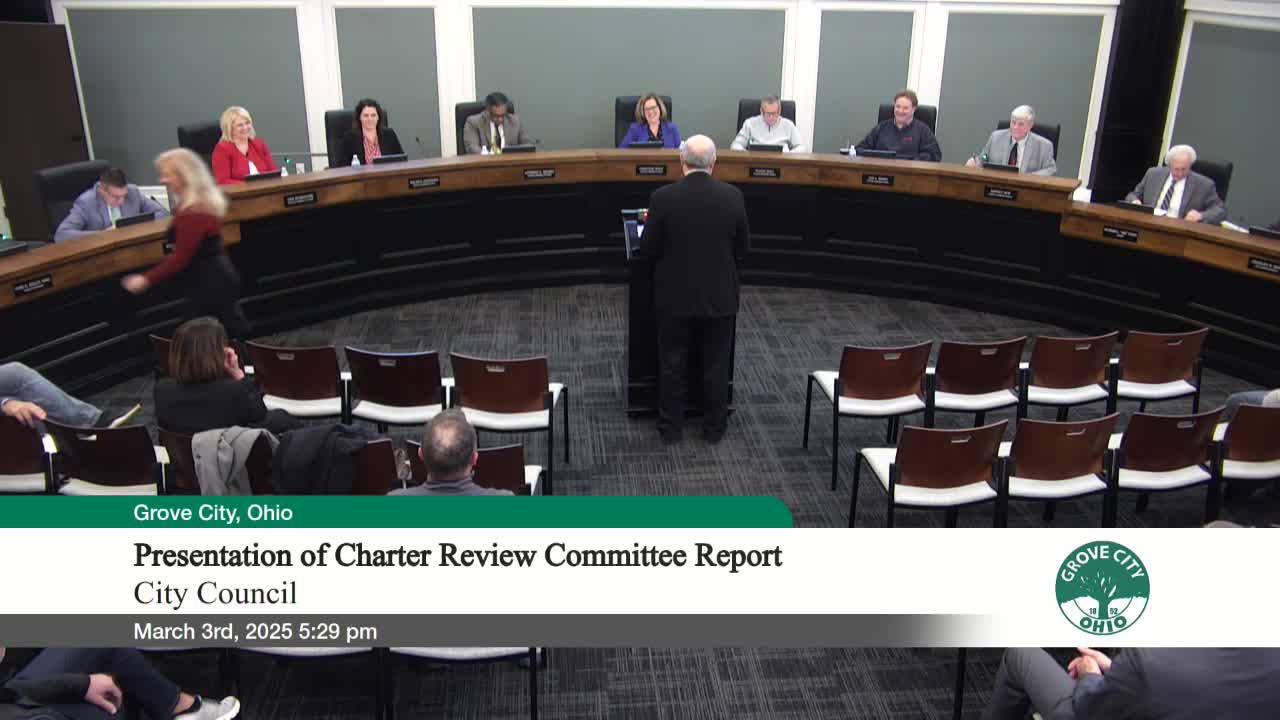
The Grove City Charter Review Committee recommended that Grove City Council pursue amendments to the city charter to change the city’s form of government, committee chair David Free told the council at a special meeting called to review the panel’s report.
"It is the recommendation of the 2024 Charter Review Committee that the Grove City Council pursue charter amendments to effectuate change with respect to Grove City's current form of government," Free said.
The recommendation concludes a months-long review by the nine-member panel, which met beginning Sept. 11 and completed its work Jan. 25, the committee reported. Committee members studied published materials, heard a presentation from officials in Hilliard and reviewed examples of local practice before producing a written report that lays out three primary options: retain the current strong-mayor/city-administrator model; move to a council–city manager form in which the council hires a professional manager; or adopt a hybrid maintaining an elected mayor while giving the council confirmation authority for appointments.
Why it matters: The choice affects who makes executive appointments, how hiring and accountability work, and which checks and balances apply. Committee members and councilors discussed the mechanics — including appointment authority, the mayoral veto, and the council’s role over the budget — as central considerations.
The committee’s report summarized individual preferences. It identified five members who listed a council–city manager model as their first choice, three who preferred to keep the current strong-mayor model, and one who favored a hybrid. The report also notes that several members said they would accept a hybrid if their first-choice option proved impractical. Free told council that a majority of committee members supported pursuing change of some kind.
Committee co-chair Judy Zamamra, who also described her experience in both mayor–chief-of-staff and city manager systems, said the panel sought to be evenhanded. "This is a discussion of what direction do we go forward," Zamamra said, adding that the review was not a critique of individuals currently serving in city offices: "I didn't hear anyone not speak to that with the thought of this is not a debate on the quality of these two excellent public administrators," she said.
Council members and committee members raised specific concerns and tradeoffs: several speakers stressed the need to preserve institutional knowledge and to avoid rushing changes without public education. Councilmember Mike Linder, a committee member, said many residents did not understand the differences between government forms and urged careful voter outreach if changes advance. Another committee member, Wayne Kintz, said professional management in neighboring communities appeared to correlate with economic development outcomes and influenced his preference.
Mayor Stage and City Administrator Chuck Bozzo pressed for inclusion of the mayor’s and administrator’s perspectives in the record; the mayor said he believed he and the administrator had not been given the same structured opportunity to respond to the committee’s external presentation. Jeff Buskirk, a resident who spoke during the meeting, asked the committee to be able to explain to voters what specifically would be fixed by any change: "If you want to change something, you gotta figure out what's broke," he said.
The report also recommended technical edits to the charter if amendments move forward, including correcting typographical errors, replacing gendered pronouns, and changing references to board and commission term lengths from six years to four years where indicated in the report.
No formal council vote was taken at the meeting. Council members agreed to discuss next steps at an upcoming council retreat and to develop a strategy for public engagement and any ordinance or ballot language that would be required if council decides to advance charter amendments to voters.
The committee’s written report and meeting minutes were entered into the record and will accompany council deliberations as members weigh whether to place a charter change before the electorate.