Get Full Government Meeting Transcripts, Videos, & Alerts Forever!
Get email alerts on the Childcare And Out Of School Time topic
No spam. Unsubscribe anytime.
Travis County details rollout plan for voter‑approved childcare and out‑of‑school fund
Summary
Travis County staff briefed the joint subcommittee on March 3 on implementation of a voter‑approved 2.5¢ tax to fund childcare and out‑of‑school time services — roughly $75 million annually — including hiring, community engagement, short‑term contracts and a phased procurement timeline
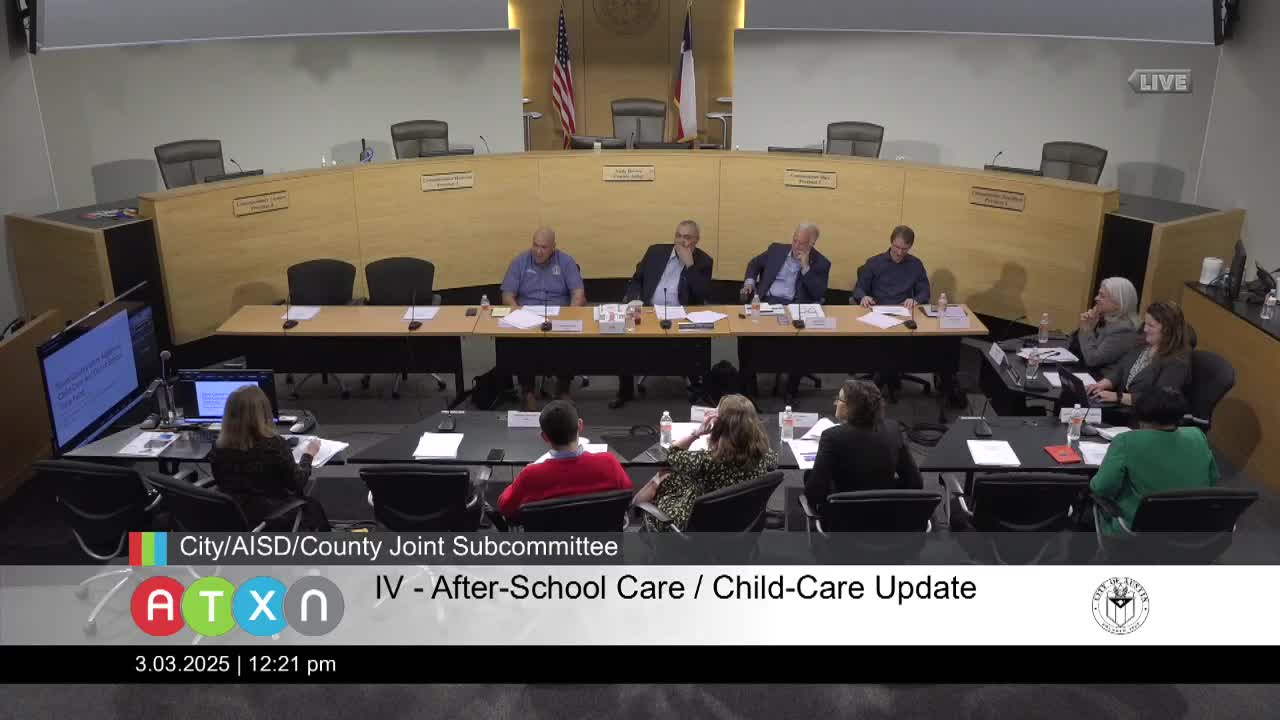
Corey Darling, research and planning division director at Travis County Health and Human Services, updated the joint subcommittee on March 3 about the county’s transition plan to implement the voter‑approved child‑care and out‑of‑school time fund.
Voters in November 2024 approved a 2.5¢ tax‑rate increase estimated to generate about $75 million annually for childcare and out‑of‑school services; the ballot language directs the county to expand child‑care slots, increase access to nontraditional hours, strengthen provider capacity through training and business supports, and build business–government partnerships to match public funds.
Darling said the county is pursuing four concurrent lines of work in the transition plan: hiring implementation staff, conducting broad community engagement, planning short‑term investments to use existing county contracts, and designing phased procurements for longer‑term services.
On hiring, the county is recruiting a strategic advisor for childcare and out‑of‑school time to lead implementation; the application period closed on the presentation day and staff expected to interview in March with an April start target. County departments — including health and human services, finance, purchasing, the auditor’s office and the county attorney — are also adding roles to support contracting and oversight.
For near‑term service delivery, Darling said staff are exploring expanding existing contracts (for example, with Workforce Solutions and current youth‑service providers) to serve more families while full competitive solicitations are planned. He said interlocal agreements with other government entities are being explored as a transitional tool to accelerate capacity.
On community engagement, the county plans a bilingual survey (English and Spanish), ongoing meetings with child‑care and out‑of‑school providers, three public listening sessions and an online Zoom forum. The engagement is intended to inform eligibility, performance measures, procurement specifications and the composition of a future community advisory council; the county expects to recruit advisory‑council members in late spring or early summer.
Darling described the procurement timeline as phased: staff plan to analyze community input in spring, return to commissioners court in summer 2025 with policy recommendations, release initial solicitations in fall 2025, and phase in contracts with the goal of having all services contracted by the end of 2026. He said some short‑term contracts could be in place by summer 2025 to align with the school year.
Darling emphasized that the full procurement cycle can take more than a year and that the county is using short‑term investments and possible interlocal agreements to address immediate need while following procurement rules.
County staff said they would continue outreach and would provide materials and a digital copy of the briefing on request.