Get Full Government Meeting Transcripts, Videos, & Alerts Forever!
Get email alerts on the K 12 Education topic
No spam. Unsubscribe anytime.
AISD outlines how competing House and Senate K‑12 bills would affect district funding, vouchers and program priorities
Summary
Austin ISD’s legislative liaison summarized House and Senate K‑12 proposals, including competing plans for distributing roughly $4.85 billion in new money, teacher pay proposals, universal education savings accounts (vouchers), and bills affecting DEI and school library review
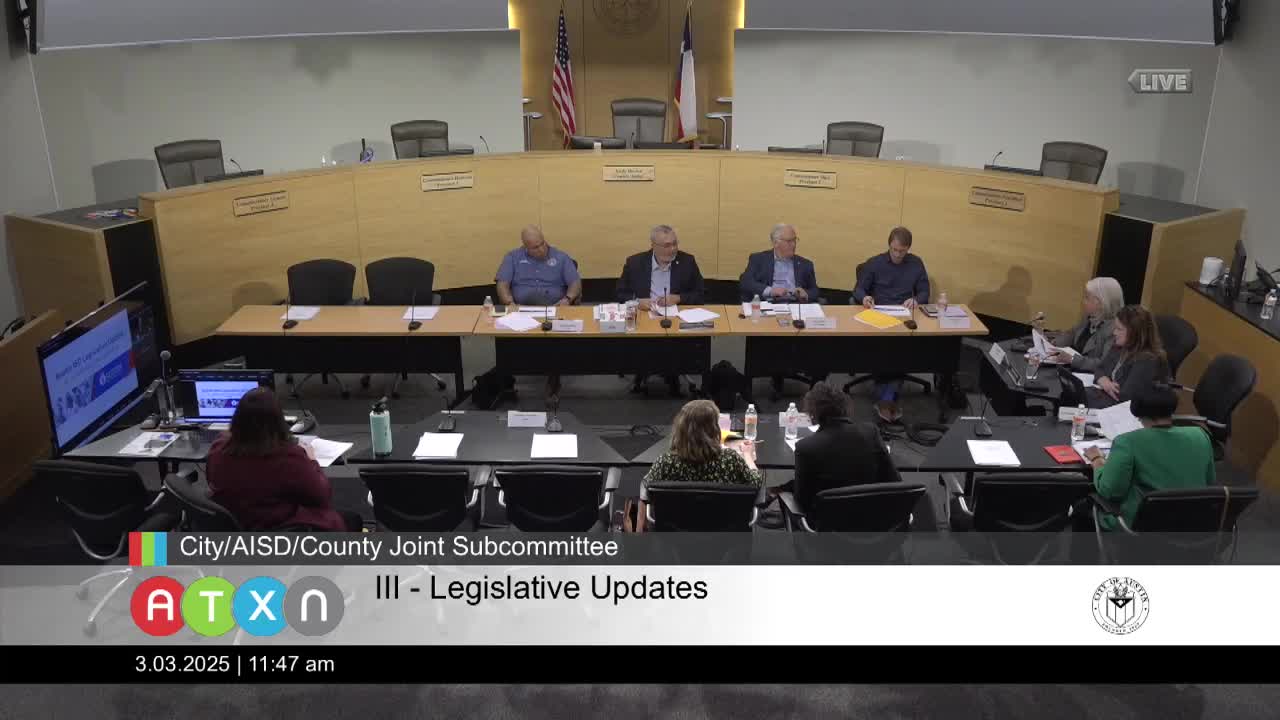
Edna Butts, Austin Independent School District’s legislative liaison, briefed the joint subcommittee on March 3 about competing House and Senate proposals for K‑12 funding and a suite of education bills under active consideration at the Capitol.
Butts said both HB1 and SB1 include new statewide education funding—each version identifies roughly $5.25 billion in new money and sets aside $1 billion for education savings accounts (universal vouchers). But the House and Senate differ on how to allocate other funds that would be distributed from a roughly $4.85 billion pool.
Butts outlined the key differences she highlighted: Senate proposals discussed by staff (including a referenced Senate bill 26) would hold school districts harmless for property tax cuts and focus some increases on teacher pay with district‑size tiers for raises. The House approach (presented as House Bill 2) would raise the basic allotment by $220 per student, increase special‑education funding changes (from site‑based funding to funding based on intensity of services), boost small/mid‑size district weights, add a $51 per‑student arts allotment, and increase the compensatory allotment for low‑income students.
On vouchers, Butts said the Senate’s education savings account proposal is universal for children eligible to attend public school; if applications exceed available slots the program would use a lottery with prioritization for low‑income households and students with disabilities. The Senate figures in Butts’s presentation allocated $10,000 per general voucher, $11,500 for students with disabilities and smaller amounts for homeschoolers. The House voucher proposal would set award amounts at 85% of estimated average state and local funding per student; Butts cautioned that there are differing interpretations of what the base per‑student amount will include (for example, whether state pension contributions are counted).
Butts also summarized other bills the district is tracking: a proposed expansion of the school‑safety allotment; bills that would limit or ban use of diversity, equity and inclusion (DEI) considerations in hiring, policy and training (cited as SB12 by Sen. Creighton and related measures); bills to change discipline and alternative‑placement rules for offenses such as e‑cigarette and marijuana possession; and proposals to require display of religious text or a period of prayer in classrooms (two bills set for hearing). Butts flagged bills affecting library‑material review and a package of bills that would restrict lobbying and membership dues to associations that hire lobbyists, noting concern about how those measures could limit districts’ and cities’ ability to track legislation and advocate.
During the discussion, trustees and elected officials pressed Butts for district‑specific estimates. Butts said district “runs” estimating AISD’s net under specific committee versions had not yet been released and that committee substitutes were likely; she said she would follow up with district estimates when available. She also provided her contact information (edna.butts@austinisd.org) for follow‑up questions.
Butts’s presentation covered program shortfalls the district has absorbed: she said the basic allotment of $6,160 has not been raised since 2019 and that inflation has eroded buying power. Butts noted special‑education shortfalls (an underfunding figure cited in the presentation: $73,200,000 for special education statewide) and that transportation funding is underfunded by amounts reflected in district materials.
Butts closed by noting committee hearing schedules for key measures and invited questions from joint subcommittee members.