Get Full Government Meeting Transcripts, Videos, & Alerts Forever!
Get email alerts on the Police Oversight topic
No spam. Unsubscribe anytime.
Office of Police Oversight outlines staffing, CPRC onboarding and backlog in publishing complaints
Summary
The Office of Police Oversight (OPO) updated the commission on four current vacancies, steps to reestablish the Community Police Review Commission (CPRC), and a backlog in posting complaint documents dating back to 2022.
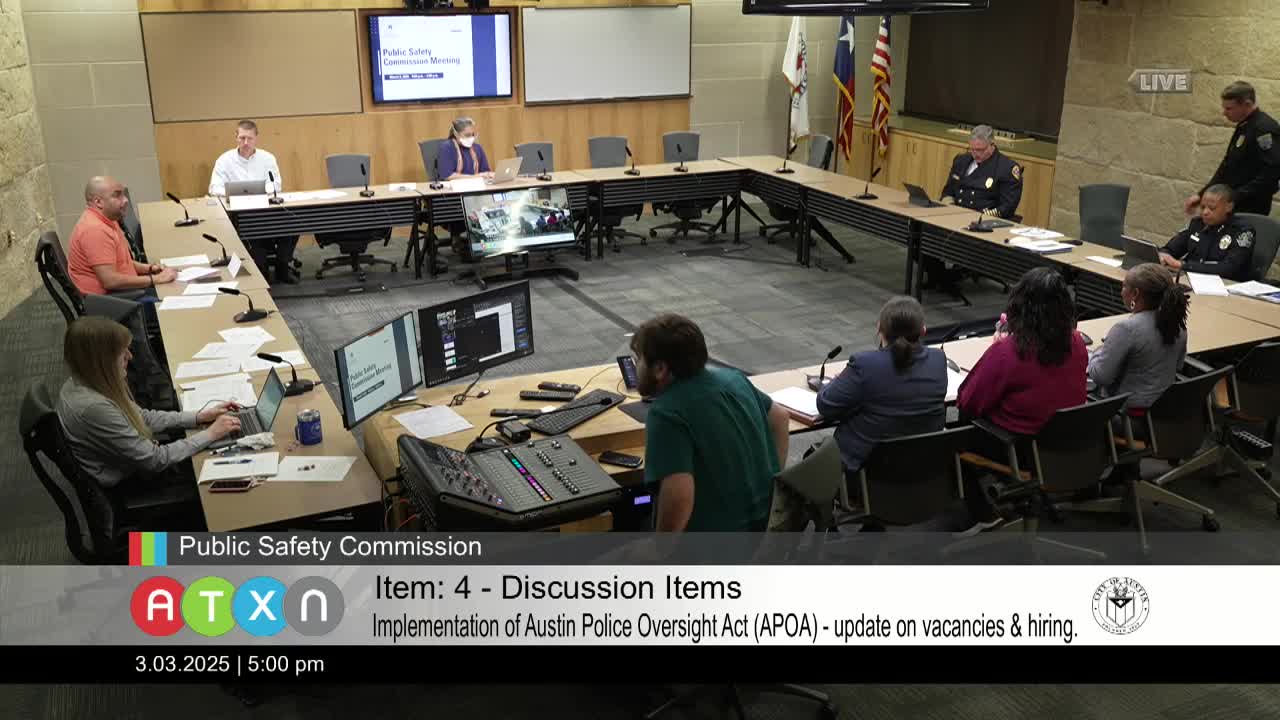
The Office of Police Oversight told the Public Safety Commission on March 10 that it has four current staff vacancies and is actively recruiting while reestablishing the Community Police Review Commission (CPRC) required under the Austin Police Oversight Act (City Code 2-15).
Gail McCant, director of the Office of Police Oversight, said the office currently has vacancies for a complaint supervisor, a business intelligence consultant, a community engagement specialist and a policy analyst. McCant outlined the responsibilities for each role and said interviews were complete for some positions with offers expected within weeks. “A top candidate has been identified and we will be extending an offer of employment in the next week or so,” she said about the complaint supervisor hire.
The office reported it completed the CPRC commissioner selection in November, onboarded 11 commissioners plus alternates, and began the statutorily required training in late January. Sarah Peralta, public information and marketing manager, said commissioners must complete 20 hours of training, with materials provided by OPO, the city clerk, city law and the National Association for Civilian Oversight of Law Enforcement. Mia DeMars, who coordinates CPRC onboarding, said the commission is still establishing bylaws and processes and that meetings will include public sessions before executive sessions.
Backlog and publishing of complaints: Commissioners pressed OPO on publicly posting complaint documents and data. McCant said the office has been reviewing and redacting older complaint files for publication and that a temporary employee hired to perform this work has been processing documents since September. “We are working on the 2022 documents,” she said, and estimated the work could be completed within three to six months, but added that staff do not want to publish documents containing personally identifying information and are moving carefully.
Why it matters: The APOA requires ongoing transparency, timely reporting and a functioning civilian review commission; commissioners raised concerns the city remains out of compliance until the required annual report is published and older complaints are posted online.
Commissioners repeatedly urged faster timelines. One commissioner noted the APOA’s reporting requirement and said the delay meant OPO was out of compliance. McCant said the citywide decision was to combine the 2023 and 2024 reports for a single spring release and cited coordination with the city manager’s year-end reporting process.
Ending: Commissioners requested the office return with the combined annual report when available and suggested prioritizing posting forward-facing complaints while processing the backlog.