Get AI Briefings, Transcripts & Alerts on Local & National Government Meetings — Forever.
Travis County outlines local bill package, including Austin State Hospital lease for jail-diversion work
Loading...
Summary
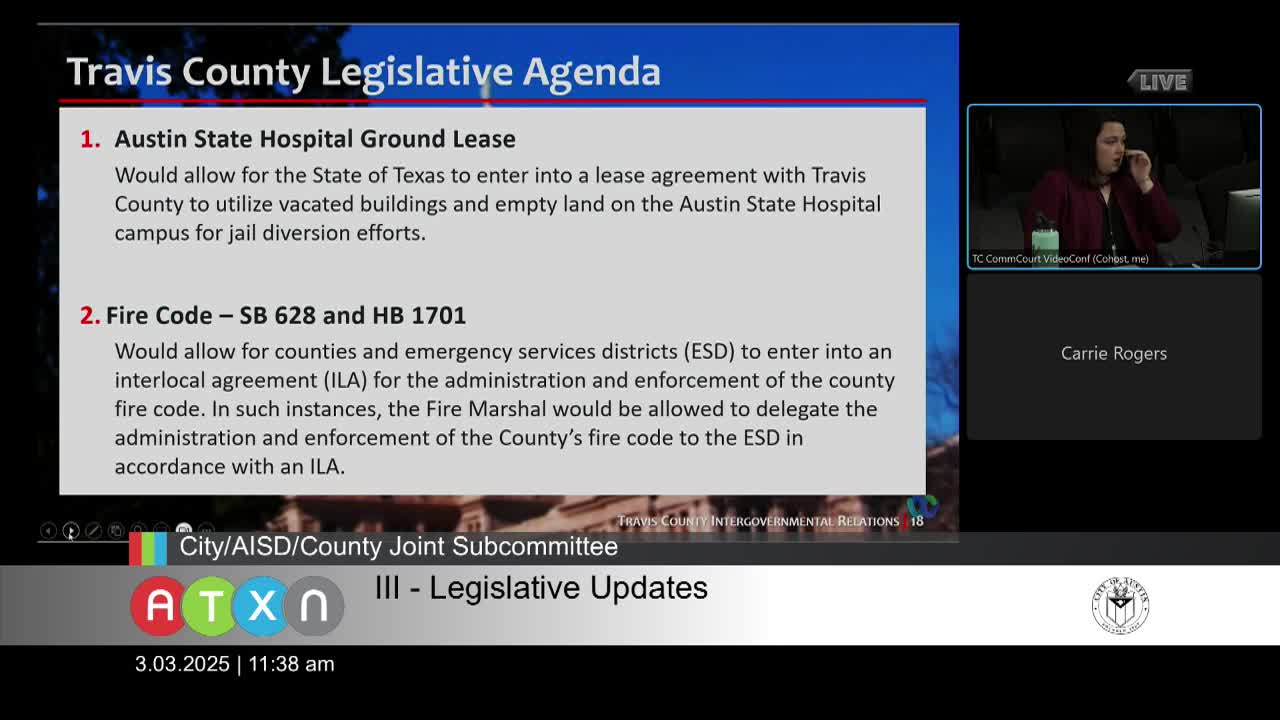
Travis County deputy intergovernmental relations officer Cecily Kaye told a joint subcommittee of county, city and school officials on March 3 that the county is pursuing six local bills this legislative session, including a proposal to allow state‑owned Austin State Hospital property to be leased to the county for mental‑health and jail‑diversion services.
Travis County deputy intergovernmental relations officer Cecily Kaye told a joint subcommittee of county, city and school officials on March 3 that the county is pursuing six local bills this legislative session, including a proposal to allow state-owned Austin State Hospital property to be leased to the county for mental‑health and jail‑diversion services.
The county’s proposal would authorize the Health and Human Services Commission (HHSC) to lease decommissioned buildings and vacant land on the Austin State Hospital campus to Travis County so the county can develop a mental‑health jail diversion center, Kaye said. County staff have secured sponsors in both the state House and Senate but had not filed the bill as of the presentation; Kaye said the county expected to file before the March 14 bill‑filing deadline.
Kaye said the county has been working for more than two years on alternatives for people in the county jail who need care for behavioral health or substance use disorders and that the county lacks crisis‑care beds and a single “no‑wrong‑door” drop‑off point for first responders. The proposed lease authority is intended to help address those gaps in the continuum of care.
Beyond the Austin State Hospital bill, Kaye described five other priorities in the county legislative package: - Fire‑code enforcement: A bill, filed by Sen. Judith Zaffirini and Rep. Lulu Flores, would allow counties and emergency service districts to enter interlocal agreements for enforcement and administration of county fire codes. - Surplus property donation: A bill (noted in county materials as also filed in the Senate as SB1713) would modify a three‑part statutory test that currently prevents counties from donating surplus computers if a small residual dollar amount remains, enabling donations to local programs such as the City of Austin’s Community PC program. - County bail bond board meetings: HB3566 (as presented) would let the Travis County bail bond board meet fewer than monthly—requiring at least six meetings a year—because the board often lacks business or quorum for monthly meetings; the proposal is bracketed to apply only to Travis County. - Deer management at Balcones Canyon Preserve: A bill (filed by Rep. Weiner) would allow the county to hire professional agents to conduct precise deer management on the Balcones Canyon Preserve, which is home to federally protected species and borders roughly 19,000 residential properties. - Waste management in extraterritorial jurisdiction (ETJ): A bill (noted in county slides and also filed in the Senate as SB1714) would allow counties, if commissioners court chooses, to provide waste‑management services in a city’s ETJ where a city does not provide those services; Kaye said the county spends at least $1 million annually on cleanup of illegal dumping.
Kaye also flagged a set of bills that would change how local governments issue certificates of obligation (COs) and how bond and tax elections are approved. Proposals tracked by the county would restrict CO issuance to legally required purposes (for example, to comply with state or federal law, court orders, public‑health emergencies or natural disasters), prohibit CO issuance if a similar bond failed within five years, and raise vote thresholds for bond or tax increases—some proposals would require two‑thirds or 60% approval. Kaye said the county was monitoring those measures because they would affect local capital finance options.
Kaye opened the presentation by summarizing session timing: the 2025 regular session runs through June 2 and the last day to file bills is March 14, with limited exceptions. She also noted that the pre‑filing period has been unusually active; as of her briefing the Legislature had filed roughly 5,443 bills.
Kaye concluded by inviting questions and saying county staff were tracking a broad set of bills that affect county operations and intergovernmental partners.
The county presentation included the statutory and procedural points the staff relied on; Kaye attributed legal authority and bill numbers as described above.