Get Full Government Meeting Transcripts, Videos, & Alerts Forever!
Get email alerts on the Public Comment Quality Of Life topic
No spam. Unsubscribe anytime.
Residents at Public Safety Commission cite 311 gaps, library bans and alleged police harassment
Summary
Multiple public commentators told the Public Safety Commission about frustrations with 311 reporting for quality-of-life issues, Austin Public Library conduct and alleged police harassment.
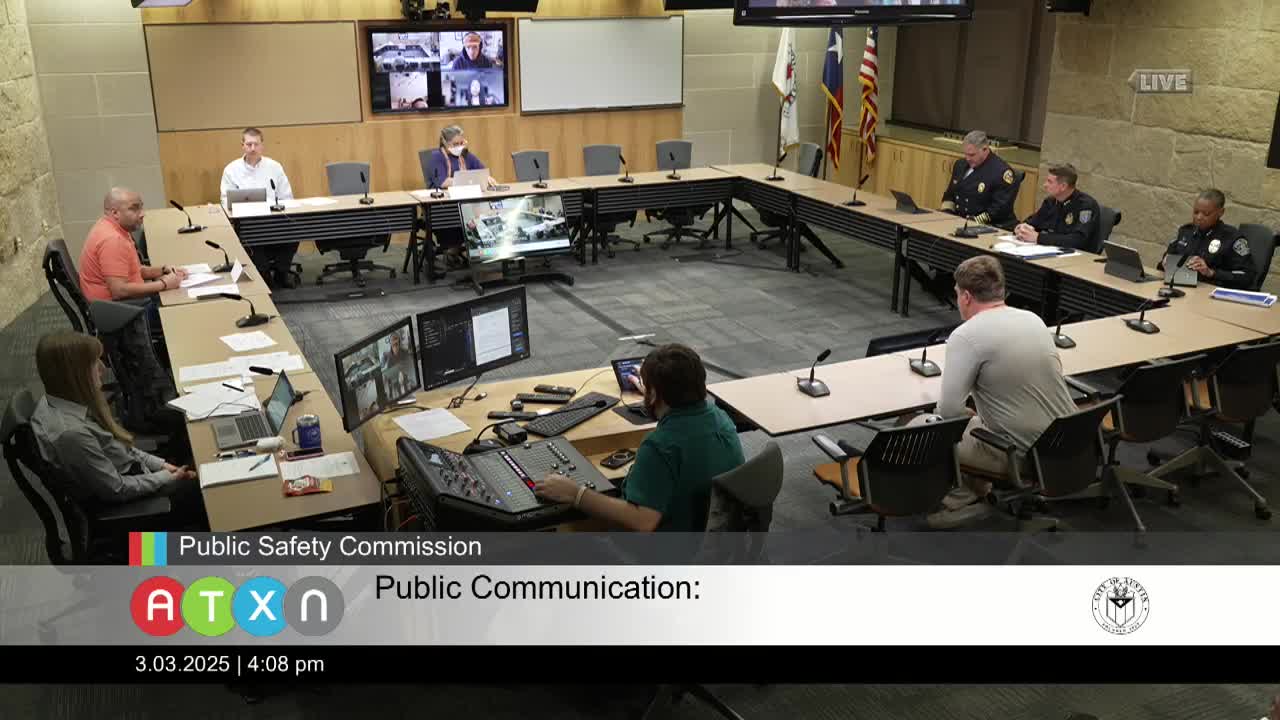
At the Public Safety Commission’s March 10 meeting several residents used the public-comment period to describe persistent quality-of-life problems, a library trespass order policy and alleged police harassment.
Ryan Saunders, who identified himself as a resident of East Austin’s Heather Chavez Street neighborhood, said 311 no longer accepts animal-noise reports and that response to blocked driveways can take hours. “You either’re blocked in or blocked access from your house. You have to wait 2, 3 hours for police to respond,” Saunders said, adding that delayed responses increase frustration between residents and businesses.
Saunders said he and neighbors live amid commercial activity and experience repeated barking-dog complaints, driveway blockages and noise. He said he has filed citizen affidavits at municipal court and asked the commission to consider a quality-of-life advisory board or other mechanism to help residents navigate which city office handles which problems.
Another speaker, who identified himself as Carlos Leon, criticized Austin Public Library (APL) enforcement practices and a citywide “CTN” ban he said the library applied across multiple branches. He said the library’s practice conflicted with city rules that limit denial of access to the property where a violation occurred and asked police and oversight bodies to follow the city’s current controlling rules when called to library incidents.
Ruben Rivera-Clementez, who identified himself as a resident, described years of alleged harassment by a university police organized unit and said multiple officers were focusing on him. He said he had repeatedly filed complaints to city officials and asked for help addressing recurring conduct he characterized as retaliatory.
Why it matters: Public-comment testimony identifies constituent concerns about public-safety responses, city enforcement of library bans and long-standing complaints involving law enforcement interactions. Commission members acknowledged the comments and moved into the scheduled agenda items.
Ending: The chair thanked public commentators and transitioned to the EMS quarterly report.