Get Full Government Meeting Transcripts, Videos, & Alerts Forever!
Get email alerts on the Opioid Response topic
No spam. Unsubscribe anytime.
Austin EMS reports decline in opioid overdoses, expands naloxone and buprenorphine outreach
Summary
Austin-Travis County EMS told commissioners it has seen a leveling and decline in opioid overdoses and is scaling naloxone distribution, buprenorphine bridge doses and a zero-barrier MAT clinic in partnership with Central Health.
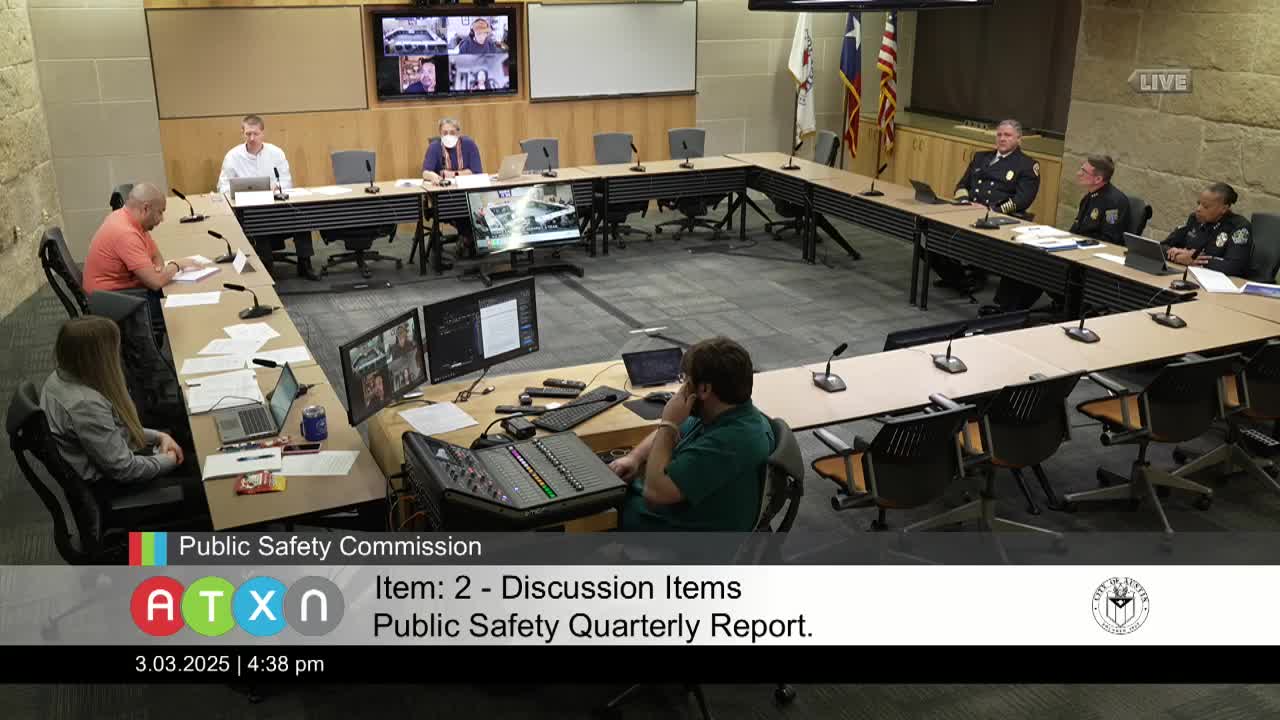
Austin-Travis County EMS told the Public Safety Commission that local opioid overdoses and deaths have shown signs of decline and that the department has expanded field and community-based responses.
Assistant Chief Steven White and Division Chief Angela Carr presented data showing a downward trend in opioid-specific overdoses from 2024 into early 2025. “We are seeing a decline,” White said, noting the change compared with earlier years when Travis County had among the highest per-capita opioid death rates in Texas.
The department described several active programs: daily overdose follow-ups by community health paramedics, a buprenorphine “bridge” program that provides short-term medication to patients after an overdose while they await enrollment in long-term medication-assisted treatment (MAT), and large-scale naloxone (Narcan) distribution. Carr said 239 clients enrolled in the buprenorphine bridge program in 2024 and that EMS provided 783 doses of buprenorphine. The department reported distribution of roughly 3,505 naloxone kits and—counting other interventions—more than 5,000 opioid use disorder interventions handled by specialized community health paramedics.
The presentation highlighted partnerships and new care pathways. EMS said it is working with Austin Public Health and a SAMHSA-funded Breathe Now training program to place naloxone in city agencies and that a new Central Health “zero-barrier” clinic at Capitol Plaza will offer MAT and other services without requiring ID, insurance or prior registration. “It is the very first zero-barrier clinic that we’ve ever participated in,” White said, adding that the clinic allows EMS to transport patients directly from a 911 scene and bypass hospitals when clinically appropriate.
Why it matters: Expanded prehospital treatment, naloxone access and low-barrier pathways to MAT can reduce overdose deaths and lower hospital transports when medically safe.
Commissioners asked about mapping of overdose hot spots and targeted outreach. Presenters said the EMS/APH dashboard shows ZIP-code-level overdose activity and that surge responses and targeted kit distribution rely on both EMS alerts and community partners.
Ending: Staff asked to provide dashboard links to commissioners and to return with updated metrics. Commissioners praised the expanded C4 and outreach programs and requested continued reporting as enrollment and outcomes are tracked.