Get Full Government Meeting Transcripts, Videos, & Alerts Forever!
Get email alerts on the Housing Development topic
No spam. Unsubscribe anytime.
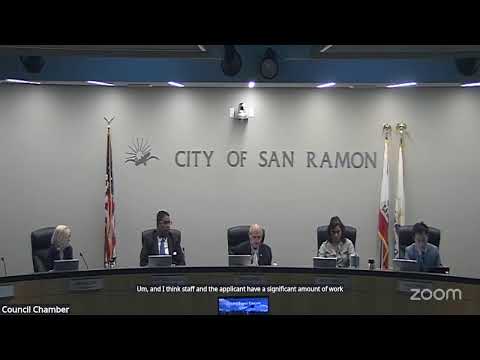
Planning commission hears early proposal for 82-unit Toll Brothers townhome project at 500 Bollinger Canyon Lane
Summary
The San Ramon Planning Commission received a study-session presentation Tuesday on Toll Brothers’ proposal to build 82 for-sale townhome condominium units and seven accessory dwelling units on roughly 9.4 acres at 500 Bollinger Canyon Lane, a site that now contains ClubSport’s tennis courts.
The San Ramon Planning Commission received a study-session presentation Tuesday on Toll Brothers’ proposal to build 82 for-sale townhome condominium units and seven accessory dwelling units on roughly 9.4 acres at 500 Bollinger Canyon Lane, a site that now contains ClubSport’s tennis courts.
City planner Ryan Driscoll, who introduced the item as a study session, told commissioners the city received the development applications on Sept. 2 and that staff is conducting the 30-day application completeness review required by state law. “The project would demolish the existing tennis court facility and associated landscape at the ClubSport facility,” Driscoll said, describing the proposal and the review process.
Rob Connolly, representing Toll Brothers, presented the applicant’s concept and design direction, saying the project would include 207 on-site parking spaces (164 garage spaces and 43 surface spaces), a 15 percent below-market-rate component equal to 12 affordable units (five very-low, one low, six moderate), and four three-story plan types sized roughly 1,880 to 2,200 square feet. “Toll Brothers is an award winning Fortune 500 company and the nation’s leading builder, of luxury homes,” Connolly said during the presentation.
The meeting functioned as an early study session, and Driscoll emphasized that no formal action would be taken because the application has not been deemed complete. He said the city has circulated materials to internal departments and outside agencies — including East Bay MUD, Contra Costa Sanitary District, San Ramon Valley Fire Protection District and the local school district — and will forward agency comments to the applicant as they are received.
Dozens of residents attended and dozens submitted written comments. Neighbors raised a range of concerns during public comment and in follow-up questions from commissioners: the loss of public recreational courts at ClubSport (including pickleball capacity), traffic congestion on Bollinger Canyon Road and at nearby intersections, wildfire risk on the adjacent open hillsides, potential geotechnical issues and drainage (residents pointed to prior local flooding and apparent land movement), the height and visibility of proposed buildings, retaining walls described in the application (one shown in package text as up to about 20 feet), parking spillover into the existing neighborhood, and uncertainties about access and title for the private lanes and parcels that would be used for project entry.
Ariel Strauss, attorney for the Sienna Hills homeowners association, told the commission the application does not resolve a number of title and approval issues and lacks several required technical submittals. “Parcel L is owned by Sienna HOA, and the plan papers over this problem by simply saying to be quit claimed,” Strauss said; she also flagged missing geotechnical, drainage/stormwater and title reports and urged the city to use the 30-day completeness list to require those items. Strauss referred the commission to state permit-streamlining law, noting, “The 30 day deadline is September 2,” and urging staff to document all outstanding items in the city’s completeness notice so the city may enforce objective standards in later review.
Speakers from the neighborhood described wildlife habitat on the hills behind the site (residents reported coyotes, owls, bobcats and a mountain lion), visual and privacy impacts, and public-safety worries. “We want safety for all people here,” Charles Shannon, former HOA board president, said during public comment. Noah Hausman, a longtime resident, said he opposed the project and urged the commission to halt it: “Please. I’m begging you. Please.”
Commissioners used the study session to identify issues they want staff and the applicant to address before the project returns for formal review. Commissioners repeatedly asked the applicant and staff to provide: an overlay that compares the existing tennis-court footprint and grading to the proposed building footprint; clear evidence of access and title or easement rights for proposed entryways across private parcels; a traffic study and level-of-service analysis for affected intersections; geotechnical and hydrology reports showing how retaining walls and cut-and-fill would be designed and how drainage/flooding risk would be managed; clear fire-access plans and fire-department truck-turn diagrams; visual simulations showing how the project would appear from adjacent neighborhoods and Bollinger Canyon Lane; and further explanation or enhancement of community amenities beyond the single overlook depicted in the application.
Staff and the commission reminded the public that the study session is intended to solicit early feedback; Driscoll and chair Alpert said that once an application is deemed complete the city will move into formal public review, including Architecture Review Board review and later public hearings with the commission. Driscoll confirmed CEQA review would occur after the completeness determination.
The presentation and public comment highlighted several unresolved civil and title matters that residents asked Toll Brothers and the Sienna Hills HOA to resolve between themselves. Staff said the city’s completeness determination will list any missing documents; Strauss warned that items not listed in the city’s 30-day completeness notice may be difficult for staff to require later. The applicant said it had previously reached out to the HOA, had received at least one attorney letter, and would continue to meet with neighborhood representatives and revise plans.
No formal land-use approvals or votes were taken on the project at the study session. The only formal action recorded in the minutes earlier on the agenda involved acceptance of the Commission’s Aug. 19 meeting minutes (a motion to accept was made and seconded and commissioners voted; the record shows the motion was moved and seconded and the chair thanked commissioners for voting on the motion). The project will return for formal processing only after the city deems the application complete and the applicant addresses outstanding submittal items and agency comments.