Get Full Government Meeting Transcripts, Videos, & Alerts Forever!
Get email alerts on the Council Compensation topic
No spam. Unsubscribe anytime.
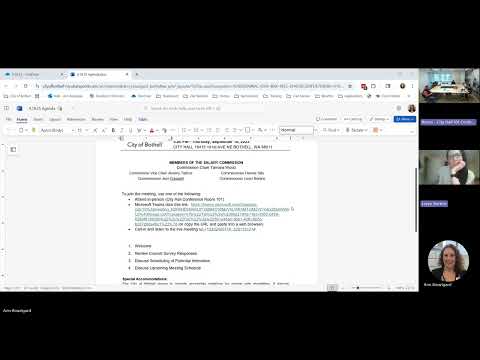
Bothell salary commission reviews council survey, plans candidate interviews and questions on stipend, equity and retirement
Summary
The Bothell Salary Commission reviewed responses from five of seven council members, agreed to schedule interviews and discussed options including a bundled stipend with opt-out, childcare support, deferred-comp options and equity-focused questions.
Members of the Bothell Salary Commission spent a study-session meeting reviewing open-ended survey responses from council members and agreed on next steps to conduct follow-up interviews and refine questions. Commissioners were told five of seven council members had responded to the survey and that the most common items named were increased salary (three of five respondents), a low-income stipend (two) and childcare assistance (two).
The commission decided to hold a preparatory discussion before interviewing the council members and to invite the two respondents who are available next week to a joint interview. Commissioners discussed beginning the study-session an hour earlier to finalize interview questions, then starting the interviews at 6 p.m.; suggested interview lengths ranged from 20 to 45 minutes with a plan to allot about 45 minutes if both interviewees attend together. Staff said they would notify the interviewees whether the meeting will be held in person or remotely.
Commissioners emphasized protecting confidentiality around the written survey responses while noting that any written responses are public records and could be disclosed if requested. City staff also summarized a procedural point raised by the city attorney: if the council needs to extend a statutory 90-day deadline, that extension must be placed as a resolution on a council consent agenda and would require internal lead time to draft and route paperwork (staff said, for example, that to place a resolution on an Oct. 20 council agenda they would need notice by about Oct. 9 to meet packet deadlines).
On compensation design, the commission discussed several recurring options from the survey: raising base salary; providing a low-income or targeted stipend; offering childcare assistance; and bundling benefits (health, retirement contribution or other supports) into a single stipend or into salary. Several commissioners described a model that would bundle smaller supports into a single payment and allow individual council members to opt out and return the money to the city if they do not need it. Commissioners said a bundled stipend with an opt-out would let those who view the role primarily as public service decline payment while providing support for those who need it to serve.
The meeting also included a discussion of retirement and deferred-compensation options. Staff clarified that a state retirement contribution (the PERS-related percentage discussed by members in the session) is set by law and not subject to local redesign, and that separate deferred-comp (457) matching or flat-dollar contributions could be designed but would carry costs the commission must model. Commissioners asked staff to prepare cost models showing the budget impact of different salary and deferred-comp options under varying assumptions about tenure.
Commissioners reviewed survey items about time commitment and workload: earlier work by the commission produced an estimate in the neighborhood of 19–20 weekly hours; several survey respondents noted midday and daytime meeting obligations that create opportunity costs for employed council members. Commissioners discussed asking interviewees to describe how they personally calculate the opportunity cost of service (for example, lost pay, use of paid time off, child-care expenses or other impacts) rather than requiring a precise dollar figure.
Survey responses also described non-financial impacts such as stress, safety concerns and reputational effects. Commissioners agreed those issues are significant for council members’ experience but largely outside the salary commission’s direct authority; they said those impacts should be acknowledged in interviews as part of understanding total costs to incumbents and prospective candidates.
Next steps: commissioners asked staff to circulate the proposed interview questions as soon as possible, to confirm whether the scheduled interviews will be in person or remote, and to produce cost-models that show the fiscal impact of different compensation and deferred-comp approaches. Staff provided an email contact for members of the public experiencing technical problems with the virtual meeting recording to submit written feedback.
Ending: The commission closed the session with agreement to finalize a short interview guide tonight, hold a half-hour to 45-minute joint interview for the two available respondents next week, and to request staff cost modeling and additional clarification on retirement and deferred-compensation mechanics for the next meeting.