Get Full Government Meeting Transcripts, Videos, & Alerts Forever!
Get email alerts on the Mortgage Finance topic
No spam. Unsubscribe anytime.
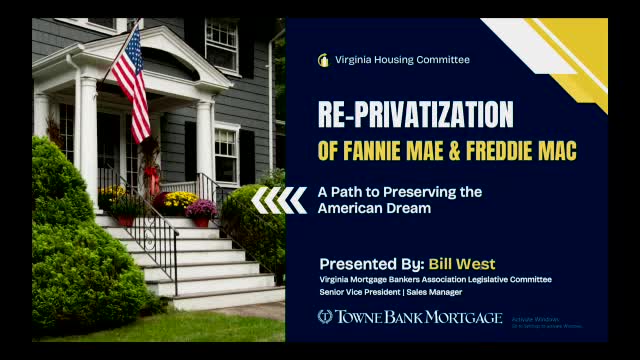
Industry presenter: reprivatization of Fannie, Freddie is complex; reforms could lower borrowing costs if guarantee structure is fixed
Summary
Bill West told the Virginia Housing Commission that decisions about returning Fannie Mae and Freddie Mac to private capital markets are complex and that reforms to the guarantee structure could lower mortgage borrowing costs if they preserve a liquid, well‑insured mortgage‑backed security.
Bill West addressed the commission on policy choices for Fannie Mae and Freddie Mac and their potential effect on mortgage borrowing costs.
West described Fannie and Freddie as government‑sponsored entities that "bundle and securitized mortgages" to provide liquidity to the mortgage market. He told commissioners that the entities' conservatorship after 2008 led to higher guarantee fees and loan‑level price adjustments that have increased consumer borrowing costs. He said Treasury's capital intervention and subsequent dividend receipts have left complex capital and policy questions to resolve before a return to private capital markets.
West explained several technical concepts for commissioners, including guarantee fees (G‑fees), loan‑level price adjustments (LLPAs), the role of the Federal Housing Finance Agency (FHFA) and the Treasury's preferred stock purchase agreements (PSPAs). He said G‑fees rose materially after conservatorship as policy and revenue needs accumulated and that those higher fees contribute directly to higher mortgage rates. He proposed that one path to lower borrowing costs would be to reduce excessive G‑fees while preserving a bulletproof mortgage‑backed security (MBS), for instance by pairing a reduced government guarantee with additional pool insurance or a Ginnie Mae‑style backstop so taxpayers are only on the final line of defense.
West outlined a plausible timeline: if Fannie and Freddie recapitalize organically, he said it could take several years (on the order of seven or more) to restore private capital levels; policymakers might instead pursue a multi‑year ramp that balances Treasury repayment, investor protections and an explicit guarantee for the MBS market. He warned that an abrupt removal of any effective guarantee would risk higher interest rates and reduced investor demand for MBS.
West urged regulators and Congress to pursue a framework that protects taxpayers while restoring liquidity and affordability. He said a successful reform would replace the current PSPA structure, convert conservatorship to a regulatory regime, and create transparent, equitable access to the secondary market.
Commissioners asked few questions during his presentation; West said mortgage markets and the timing of potential reform will be decided chiefly at the federal level.