Get Full Government Meeting Transcripts, Videos, & Alerts Forever!
Get email alerts on the Community Visioning topic
No spam. Unsubscribe anytime.
Livingston council hosts community visioning workshop; residents prioritize safety, recreation and local health services
Summary
At a Sept. 23 special meeting, facilitator Paul Pierce led a citywide visioning workshop where residents and officials outlined shared values and proposed projects including safer public spaces, expanded recreation, and health-care access.
A community visioning workshop convened by the Livingston City Council on Sept. 23 brought residents, commissioners and staff together to surface priorities for the city’s next 3–10 years, with repeated emphasis on public safety, recreation and health services.
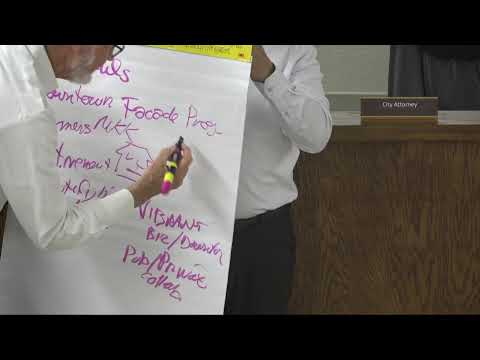
The session, led by facilitator Paul Pierce, used an “appreciative inquiry” format in which participants paired at tables to identify what makes Livingston strong and to draft headlines imagining the city’s future. Participants produced recurring themes — “safety,” “community,” “green space,” and “economic opportunity” — and suggested concrete projects such as a RecPlex (indoor recreation and senior center), trails and a push to expand local health-care services.
Why it matters: The workshop is intended to feed the council’s planning and long-range work. Council members and staff said they will compile the worksheets and table reports into a draft vision for future public engagement and potential policy and capital planning.
Residents and officials repeatedly framed the conversation around safety as a foundation for other priorities. Table reports and an extended discussion cited fully staffed emergency services, traffic calming and well‑used public spaces as ingredients for a city where families and businesses want to locate. Participants also proposed cultural and economic events — for example, a larger “Livingston Unity Fest” — to leverage the city’s agricultural base for tourism and jobs.
Facilitator Paul Pierce described the exercise as a way to build a common “vision” rather than a set of immediate policy directives. “Projects work a whole lot better when we have an idea of who’s in the room,” Pierce said during the meeting. City Manager Jose Ramirez told attendees he was “inspired, energized and enthusiastic” about using the results for planning.
The workshop included table-level proposals that varied in scale. Some participants envisioned a “RecPlex” combining indoor sports, senior programming and community meeting space; others recommended pursuing expanded primary-care services or a large distribution center to attract employers because of Livingston’s central location. Several tables suggested downtown façade improvements, a “third-space” strategy (free public gathering places) and improved walking and bike connections.
Participants acknowledged constraints. At least one table noted water and tax‑sharing issues that would affect expansion; planners on hand signaled those topics would require formal follow‑up. The city manager and planning staff committed to collecting written worksheets to inform subsequent analysis and public outreach.
The meeting was a workshop and produced no formal motions or votes. City officials said the next step is to compile the input and return a summary to the council and the community for further direction and prioritization.
Members of the public, planning commissioners and city staff who spoke or were identified during the meeting included Paul Pierce (facilitator), Jose Ramirez (city manager), Mayor Jose Moran, Councilmember Jagjit Singh Gopal, Vice Chair Renee Mendonca (Planning Commission), Jackie Benoit (Recreation Superintendent), and planning staff such as Miguel Calvez. Many table reports were offered by residents and commissioners whose remarks were presented as table findings rather than policy proposals.