Get Full Government Meeting Transcripts, Videos, & Alerts Forever!
Get email alerts on the Right To Repair topic
No spam. Unsubscribe anytime.
Duluth council hears hours of testimony on tenant ‘right to repair’; ballot petition fails, alternate landlord-focused ordinance passes
Summary
After hours of public comment and council debate, a citizen-led petition for a tenant "right to repair" ordinance failed on a council vote 2–6; the council then adopted an alternate ordinance tightening landlord notification, training and timelines, 6–2.
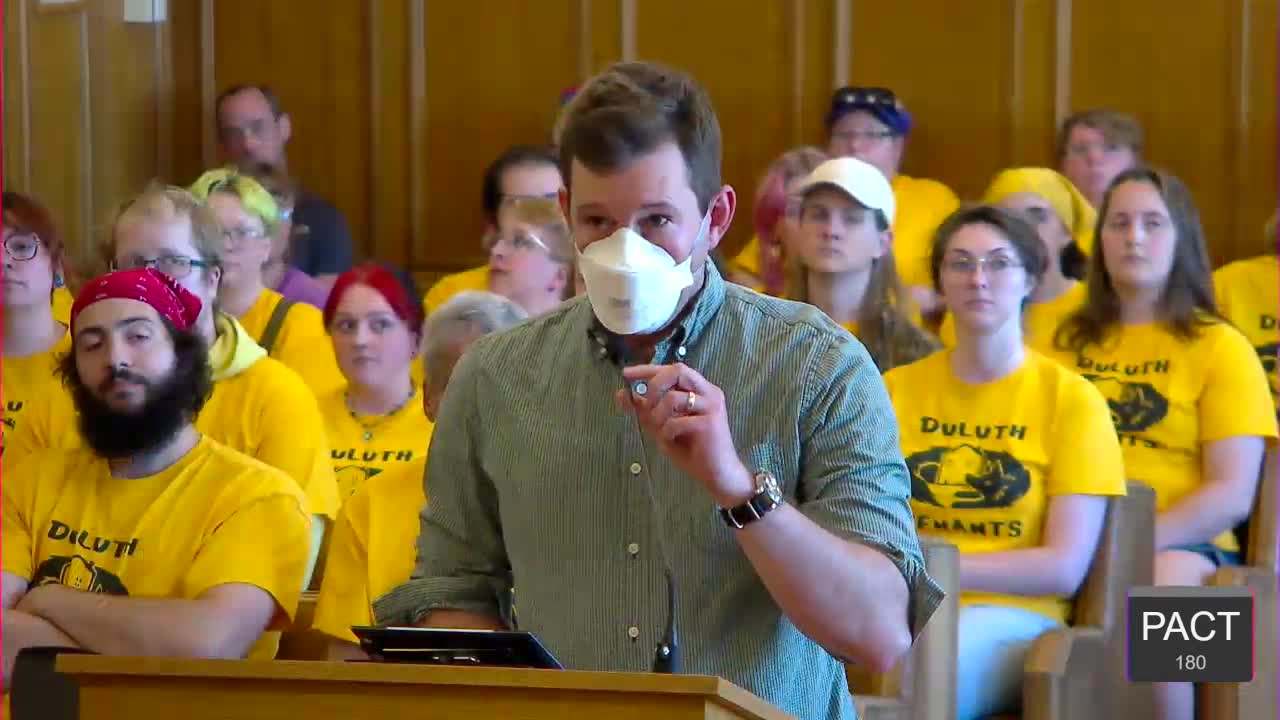
The Duluth City Council on Tuesday heard more than an hour of public testimony and extended debate over competing approaches to a tenant “right to repair” before voting down a citizen petition ordinance and approving a council-drafted alternative.
The petition ordinance, titled “Tenant right to repair in residential rental property,” was a citizen-led measure submitted by Duluth Tenants Union and Housing Justice Center and backed by roughly 6,000 petition signatures. The council voted 2–6 against placing that petition ordinance in effect. The council then adopted an alternate ordinance amending Chapter 29A of the Duluth City Code to add landlord training requirements, increased tenant notification and shortened repair timelines; that measure passed 6–2.
Why it matters: The competing measures address the same problem—renters and tenant advocates told the council they routinely face months-long waits for relatively small repairs—but they take different approaches to who performs and pays for repairs and how disputes are resolved. The citizen petition would have allowed tenants to hire contractors and deduct the cost from rent under certain conditions; the council’s alternative centers on enforcement through the city’s life‑safety/code process, shorter response windows for landlords and mandatory training for property owners.
Public testimony emphasized tenant experiences and the petition’s broad community support. Grant Studer, a renter and member of the Hillside neighborhood, told the council, “I appreciate the ordinance to require landlords to inform tenants about their rights. I think it is a great step in the right direction.” Aaron Rose, a disabled veteran and District 2 resident, summarized why he supported the citizen petition: “The system isn't working... The Duluth right to repair gives us a tool, not to punish landlords, but to protect ourselves.” Several other tenants gave specific accounts of delayed repairs, mold, nonlocking doors and months of repeated requests without timely fixes.
Landlord and business groups urged caution. Gloria Allen, chair of the Lake Superior Area Realtors’ government affairs committee, told the council that the proposal could have “unintended consequences that ultimately make it more difficult for housing providers to continue serving our community” and urged rejection. Matt Baumgartner of the Duluth Area Chamber of Commerce raised concerns about precedent and regional lessons, citing a 2021 rent-control initiative in St. Paul and warning of reduced new construction and falling property values in that example.
Council debate centered on process, legal risk and outcomes. Several council members said they support stronger tenant protections generally but differed on the patchwork approach of a ballot measure versus deliberative council-crafted law. Councilor Forsman described the tradeoffs of ballot initiatives and the loss of iterative stakeholder review that typically accompanies council legislation; “A ballot initiative by design circumvents all of those steps,” she said, adding concerns that an initiative adopted by voters is difficult for the council to amend later under the city charter.
Councilor Randolph, a co‑author of the council ordinance, argued the alternate ordinance balances tenant safety with enforceability and avoids exposing tenants to legal or financial risk if an in‑home repair goes wrong. “The alternate ordinance…provides the real enforceable protections that keep tenants safe without putting them at legal or financial risk,” she said, describing a process in which tenants report issues to the city’s life‑safety inspectors, landlords have 14 days to respond and the city issues penalties under existing code for failures to act.
Councilor Dirwachter said she opposed the council’s alternative because in her view it was being used as a direct countermeasure to the citizen petition and because she believed the alternative did not guarantee the same immediate remedies tenants wanted; she announced she would vote no on the council ordinance.
Council staff and life‑safety officials described operational constraints and enforcement capacity. Deputy Chief John Otis and life‑safety manager Greg Smith were repeatedly thanked by councilors for the division’s work; staff noted the division operates with five housing inspectors, one unhoused‑response coordinator and two support staff, and that the department’s capacity to take on an expanded enforcement workload is tied to budget decisions.
Votes at a glance: - Petition ordinance (Ordinance 15, petition from Duluth Tenants Union): motion to enact petition ordinance—moved and seconded on the floor; roll-call vote resulted in 2 yes, 6 no; outcome: failed. Recorded yes votes included Councilor Howell and Councilor Derwachter; other names on the roll call were read and recorded as no. The ordinance would have placed the citizen-drafted right‑to‑repair text onto the City’s code via the initiative process if earlier steps had been satisfied.
- Council alternative (Ordinance 16, amendment to Chapter 29A): motion to adopt an ordinance requiring landlord training, additional tenant notifications and shortened repair timelines—moved and seconded; roll‑call returned enough recorded yes votes for passage with a final tally of 6 yes, 2 no; outcome: passed. Named yes votes recorded during the roll call include Councilors Randolph, Derwachter, Kennedy, Swenson, Vice President Nephew and President Tomanek; final tally reported 6–2.
What the measures change (key distinctions): The citizen petition would have allowed tenants, after following notice and delay requirements, to hire licensed contractors in some circumstances and deduct verified repair costs from rent; it sets a 14‑day initial response clock that starts when a tenant notifies the landlord. The council’s alternative shortens timelines for landlord response, requires landlord training and heightened notification and relies on city enforcement (life‑safety/code) as the primary remedy rather than empowering tenants to contract and deduct. Both proposals reference existing state legal frameworks and city code; the council emphasized enforceability through existing code violations and penalties.
What’s next: Because the council rejected the petition ordinance tonight, that measure will not be enacted by council action. The citizen petition remains a ballot item unless petition signers withdraw signatures according to the clerk’s process; the clerk’s office indicated it will provide a form and public information for any petition signers who want to withdraw their names. The council’s adopted ordinance takes immediate effect under the city’s code process and will be implemented by city staff; councilors and staff said they will monitor implementation and—if necessary—consider further changes in future sessions.
Reporting note: Quotes and attributions are drawn from the meeting record and public testimony. The article distinguishes between public comment, staff input, council debate and formal council action.
Ending: The council’s two votes reflected a broader civic debate in Duluth over the best path to deliver timely, safe repairs to renters—whether by a voter-enacted, tenant-empowering policy or by a council-enacted, enforcement-centered approach—and the choices will shape how tenant repair claims are handled locally going forward.