Get Full Government Meeting Transcripts, Videos, & Alerts Forever!
Get email alerts on the Children And Families topic
No spam. Unsubscribe anytime.
St. Paul Children’s Collaborative presents youth outcome data, opens $2 million RFP for community grants
Summary
Leaders of the St. Paul Children’s Collaborative briefed the City Council Policy Committee on the Collaborative’s youth outcome indicators, racial and socioeconomic disparities in school readiness and achievement, and an open $2 million grant opportunity for community organizations.
The St. Paul Children’s Collaborative updated the City Council Policy Committee on June 1 on its youth outcome plan and announced a $2,000,000 request for proposals to fund community programs that support young people in Saint Paul.
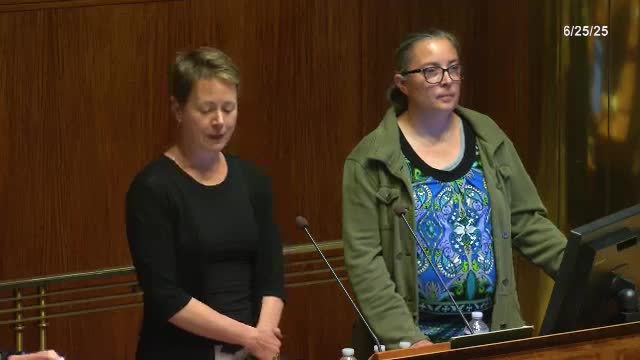
The update covered indicators the Collaborative’s board has identified as priority measures, including kindergarten readiness, third-grade reading proficiency, health insurance coverage, youth connections to caring adults, child maltreatment, and on-time high school graduation. “Our mission at the St. Paul Children’s Collaborative is to mobilize the influence and resources of the city, county, school district and community to improve outcomes for young people in the city,” said Laurie Davis, co-director of the Collaborative.
Why this matters: The Collaborative ties its grantmaking and advocacy to these indicators and explicitly uses the data to shape funding priorities. The board’s recent additions to the plan — social competence and positive identity — reflect a growing emphasis on social-emotional and identity-related measures in response to community concerns about youth mental health.
Key findings and data cited
- Kindergarten readiness: St. Paul Public Schools data show roughly half of entering kindergartners were classified as “low risk” (interpreted in the presentation as ready for kindergarten). The district’s FastBridge/FAST screening is administered in the fall, and presenters noted that further detail on children’s prior early-learning experiences was not available in the datasets shown.
- Third-grade reading: Minnesota Comprehensive Assessment (MCA) results reported that 27 percent of third graders in St. Paul schools met the reading proficiency benchmark in 2024, the lowest level in six years. Presenters noted substantial variation across charter schools and wide disparities by race and by indicators such as eligibility for free or reduced-price meals, English learner status, special education, and homelessness.
- Health coverage: The Collaborative reported an uninsured rate near 4 percent for children in Saint Paul, with modest variation by age and household income.
- Connections to caring adults: Using scales derived from the Minnesota Student Survey, staff said younger students report higher family/community support than older students and that Somali and white students report higher levels of adult connection than some other groups; foster youth, LGBTQ youth and students who report trauma register lower levels of perceived support.
- Child maltreatment: Ramsey County Child Protection data presented show neglect as the largest confirmed category. Confirmed maltreatment rates per 1,000 children were highest for American Indian children and for some children recorded as two-or-more races.
- High school graduation: Citywide four-year on-time graduation was reported at about 70 percent, the lowest in six years, with significant variation across charters (9 percent to 97 percent) and lower rates for some demographic subgroups, including students experiencing homelessness.
New indicators and next data updates
The board added two new indicators in January 2025 — positive identity and social competence — which are measured using Minnesota Student Survey scales; staff said data on those indicators will appear in the next reporting cycle.
Grants and RFP details
Davis and co-director Nicole Martin Rogers said the Collaborative uses revenue from the state’s local collaborative time study Medicaid waiver (distributed via Ramsey County) to fund community grantmaking. The Collaborative announced an open RFP for the 2026 grant period totaling $2,000,000. Interested applicants must notify the Collaborative by 5 p.m. this Friday; full proposals are due by 5 p.m. on July 11, 2025. Davis said the Collaborative intends to use 100 percent of funds it receives for community grants.
Board composition, partners and funding context
The Collaborative’s board includes four statutorily mandated partners: the City of Saint Paul, Ramsey County, the Community Action Partnership of Ramsey & Washington Counties (CAPRW, which includes Head Start) and Saint Paul Public Schools; the board also includes community members and youth representatives as voting members. Nicole Martin Rogers thanked Wilder Research and Minnesota Compass for compiling the data used in the presentation.
Council reaction and follow-up
Council members raised methodological and equity questions, including requests for disaggregated data (for example, within Asian and multiracial categories), how instruments are administered (for example, whether FAST is re-administered later in kindergarten), and whether additional cross-tabulations (for example, English learner status by race or family health insurance coverage) could be produced. “Focus on the youngest kids because the disparities start there, and they only get bigger,” Martin Rogers said when asked what local leaders should prioritize.
Budget note and next steps
Council President Baker said the city’s planned increase to the Collaborative’s contribution was line-item vetoed by the administration last year; staff confirmed the increase ($15,000) was vetoed and that the city’s historic base contribution dates to the joint powers agreement. Baker said she would work with the Collaborative’s directors to restore funding in the next budget cycle. The Collaborative’s current grantee list and data tables are posted at www.stpaulkids.org, staff said.
Ending
Davis and Martin Rogers encouraged interested organizations to apply to the RFP and noted that the Collaborative uses the indicators to guide both policy work and grantmaking. “We want you to address where the gaps are,” Martin Rogers said of potential applicants.