Lifetime Citizen Portal Access — AI Briefings, Alerts & Unlimited Follows
Vero Beach council advances land‑use rules and rezoning for 3 Corners waterfront redevelopment
Loading...
Summary
After extensive review and months of planning, the Vero Beach City Council agreed by consensus to advance a new set of land‑development regulations and a companion rezoning to implement the city's voter‑backed "3 Corners" master concept plan for the former power plant and sewer sites.
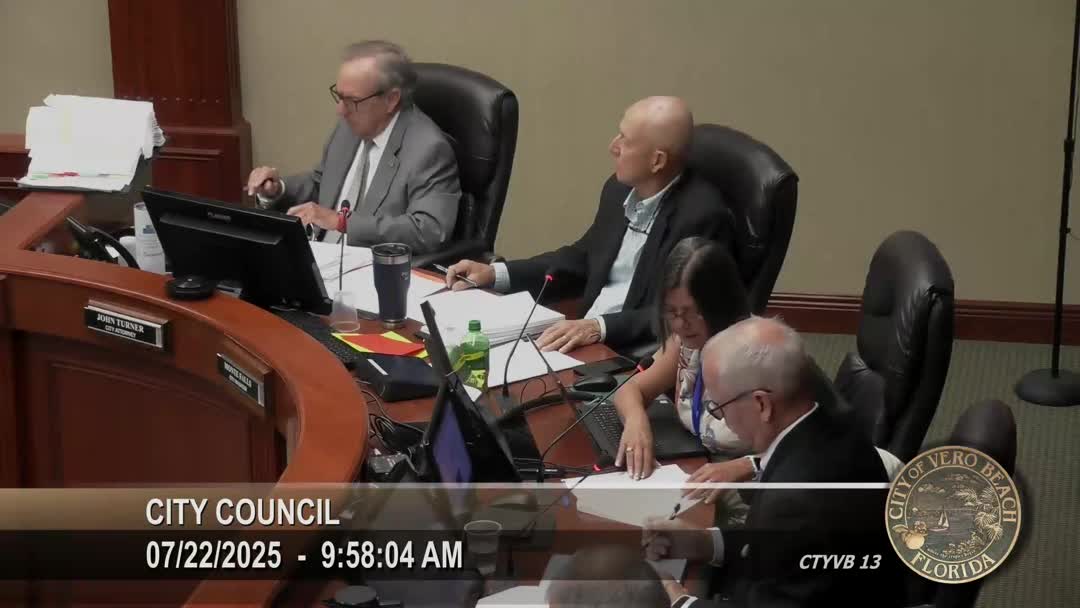
The Vero Beach City Council on Tuesday moved forward by consensus on an extensive set of land‑development code changes and a related rezoning meant to implement the 3 Corners Waterfront master concept plan for the former power plant and adjacent city property.
City planning staff described the ordinance changes as the final regulatory step to allow redevelopment of roughly 33.7 acres at the northeast and southeast quadrants of the Indian River Boulevard/Seventeenth Street intersection. The changes add a new "3 Corners Waterfront" zoning framework, amend multiple chapters of the land‑development code and create use‑specific standards intended to align zoning with the citizen‑approved 2022 master plan.
Planning staff told the council the package translates the community‑driven master plan into the city's land development regulations and follows the planning board's unanimous recommendation, with two specific revisions the board requested.
Jason, a city planning staff member who presented the measures, said the rules standardize definitions and measurement sections across chapters 60, 62 and 67 of the land‑development code and add a new Article 8 creating the waterfront district. He summarized the process as a multi‑year effort that began with community planning work in 2019, a referendum in November 2022 and subsequent comprehensive plan amendments.
Councilmember Carroll pressed staff on technical drafting points and policy details that he said warrant further attention as the city proceeds. Carroll asked that certain terms be clarified (for example changing a repeated phrase "area" to "lot size") and raised several substantive development questions including whether the city should exclude an agreed‑upon amount of garage or carport area from floor‑area‑ratio calculations, how to treat carports and open storage, and how building height is measured for multi‑family structures. Carroll asked that the council and planning staff treat those topics as part of an upcoming, broader revision of residential and multifamily standards.
Jason acknowledged the concerns and said some items will be refined before final adoption and that any substantive changes would require referral back to the planning and zoning board. He also noted that some design standards (for example building facades and rooftop deck rules) may be further updated as negotiations with the selected master developer proceed.
Staff noted two procedural constraints: state statute requires two public hearings for text amendments that affect 10 acres or more, and the planning board previously reviewed the text and recommended approval 5‑0 with two modifications related to size thresholds and live‑aboard watercraft definitions. The planning staff recommended approval of the text amendment and the map rezoning, subject to final ordinance drafting changes and corrections.
On procedural next steps the council signaled consensus to advance the ordinance language with staff adjustments and to continue the rezoning process. Councilmembers said they want staff to return with the corrected ordinance and any clarifying edits for the required second hearing and formal vote.
The council also discussed implementation details for the district's use matrix, signage, and architectural standards and flagged that the land development code has not been comprehensively updated since the late 1970s. Jason said the amendments are part of a multi‑phase code modernization effort and that additional residential and multifamily revisions will be brought forward separately.
The package before the council includes multiple cross‑references: changes to chapter 60 (definitions and measurement), deletion of the city's earlier hospital/institutional article 8 and creation of a new Article 8 for the 3 Corners Waterfront District, amendments to chapter 67's use‑specific standards, and a new table in chapter 38 for signage in the district.
Councilmembers thanked staff and the planning and zoning board for the extensive preparatory work. The council did not take a final adoption vote at Tuesday's meeting; instead members agreed to let staff make the identified corrections and return the ordinance for the statutorily required second hearing and a formal roll call vote.
If adopted, the amendments would rezone the 33.72‑acre site away from its current M‑Industrial designation and establish three new 3 Corners subdistricts described in staff materials, with the stated aim of enabling pedestrian‑oriented redevelopment consistent with the community's 2022 master concept plan.