Get Full Government Meeting Transcripts, Videos, & Alerts Forever!
Get email alerts on the Sewer And Infrastructure topic
No spam. Unsubscribe anytime.
Spring Hill leaders weigh alternative wastewater systems, fee offsets and capacity transfers as TDEC consent order nears
Summary
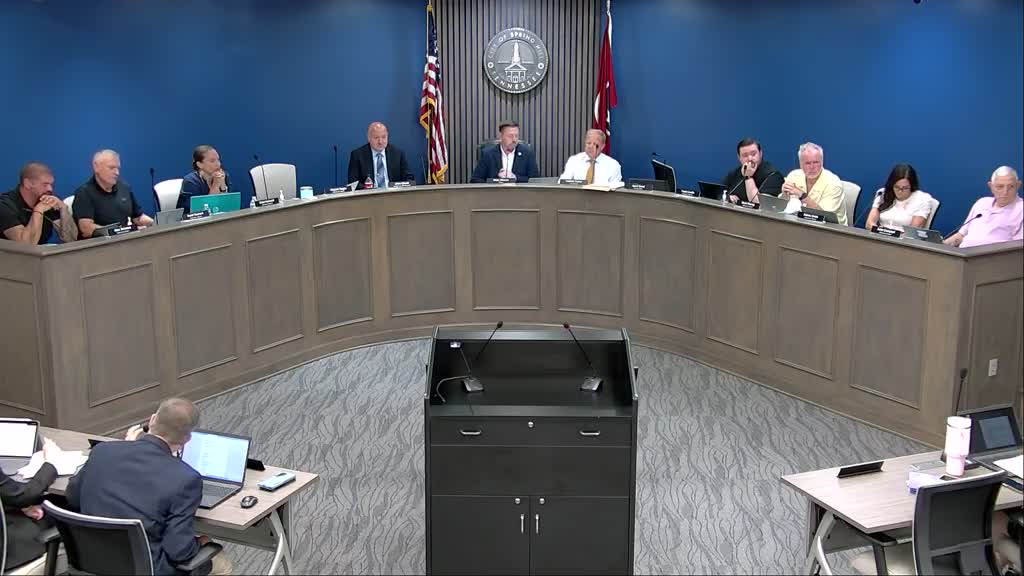
City of Spring Hill leaders spent the July 21 work session hashing out several parallel plans to limit sewer connections while keeping some vested residential projects moving, as an expected Tennessee Department of Environment and Conservation consent order approaches.
City of Spring Hill leaders spent the July 21 work session hashing out several parallel plans to limit sewer connections while keeping some vested residential projects moving, as an expected Tennessee Department of Environment and Conservation (TDEC) consent order approaches.
The proposals discussed ranged from case-by-case memoranda of understanding (MOUs) for on-site alternative wastewater treatment to a pooled system serving multiple vested developments and a program to offset sewer development fees against construction of alternative infrastructure.
Taken together the items are intended to give the city and the development community temporary tools to manage sewage flows without adding load to the existing wastewater treatment plant while long‑term projects — including an advanced purification pilot — proceed. City staff said the proposals are not automatic approvals of sewer capacity and would be structured to preserve the city’s oversight and, where appropriate, to have the infrastructure dedicated to the utility.
“Future connection will be made at developer’s expense,” staff legal counsel and municipal staff told the board while describing draft MOU language. Staff emphasized the MOUs would be preliminary, site‑specific agreements to decide whether further engineering work should proceed.
Why it matters: Spring Hill is preparing for enforcement action by TDEC that staff said will include fines, a connection moratorium and required remediation. Several large, already‑vested subdivisions are near or at entitlement; without options, developers have warned building schedules will be disrupted. The board and staff described the current effort as balancing legal compliance, public health and fairness to vested projects.
Key elements discussed
- Cameron Land LLC MOU: Staff highlighted preliminary soils testing done for a Cameron Land site south of Battle Creek schools and identified favorable soils zones. Staff described a path where a developer would submit conceptual plans first, the board would approve an MOU outlining terms, and only then would the developer invest in design and planning. City staff said the MOU would not guarantee sewer capacity or vesting; it would establish terms for how an on‑site alternative treatment system could be evaluated.
- Harvest Point / Arbor Valley / Barton Hills pooled system and fee offset: Developers for these adjacent communities identified large open spaces with suitable soils; staff said combined on‑site alternative treatment could potentially carry the combined loading of roughly 964 future homes that represent the vested entitlement across the three projects. In return, the city proposed an offset arrangement in which sewer impact fees otherwise paid by those units would be banked as credits against the developer’s cost of designing and building the alternative system. Staff estimated the group’s total fee credit would be “a little over a million dollars,” but said construction costs would likely exceed that amount and any offset would be a partial contribution, not full reimbursement.
- Transfer of vested sewer capacity: The board discussed a narrowly targeted option allowing vested capacity to be moved between closely related ownership entities in limited circumstances. Staff framed the possibility as a strictly constrained tool to help financially stressed projects within common financial interests; they resisted any notion of an open market for capacity. Several aldermen said they would prefer an approach that preserves board discretion and includes clear limits (time, gallons, or number of taps) and that any transfers be brought to BOMA for approval rather than handled administratively without oversight.
- Brandon Woods / Wilkes Lane proposal: Staff described an actual example where a vested multi‑phase project (the sending site) could defer some remaining entitlement and that entitlement would be applied to a smaller project (the receiving site). Staff said any transfer would require a written MOU with precise holdbacks so the sending project cannot exceed the retained entitlement.
- Policy design and operations: Staff recommended that the city retain ownership and operational control of any alternative systems built under these arrangements (to avoid many separate operating permits) and to treat such facilities as utility assets for maintenance, replacement and depreciation purposes. That approach would also allow the utility to incorporate operation costs into rate and capital planning.
- Redeployment of consultants and financing work: The board heard that the city intends to reengage Rafleus (financial modelers) to help structure potential debt for a five‑year water and sewer capital program and to retain SCC Engineers to prepare technical specifications and operations support for on‑site/alternative systems. Staff said these are small, time‑sensitive engagements to be ready once any consent order timelines are set.
Board concerns and next steps
Board members repeatedly emphasized two constraints: (1) protecting the existing entitlement and vesting rights of projects already approved, and (2) not creating an open market or “commodities” trading for sewer capacity. Vice Mayor Linville urged strict limits and discretionary board review; others asked that any tool developed include a sunset or be tightly bounded by the moratorium’s terms.
City staff and the development representatives acknowledged many details are unresolved — how to measure transfers (gallons vs taps), bonding or financial guarantees, precise MOU terms, and operations responsibilities — and recommended case‑by‑case MOUs as a near‑term mechanism. Staff said they will return with draft MOU language and specific proposals for council action where appropriate.
Clarifying details
- Soil/feasibility: Cameron Land preliminary soils evaluation showed contiguous favorable soils areas; staff flagged that on‑site systems are highly site specific. - Vested entitlement: Staff and developers estimated roughly 964 combined units across Harvest Point, Arbor Valley and Barton Hills that could be served by a pooled on‑site system (figure used for preliminary feasibility and fee offset conversation). - Fee offset: Staff estimated the total sewer impact fee credit for the combined projects would be “a little over a million dollars” (exact amount to be determined during final accounting). - Developer workload: Development Services Director said engineering division (two engineers) reviewed 313 plan sets in the first half of 2025; most were turned around in 22 days or less, but some reviews stretched to 45–55 days when multiple incomplete submittals arrived concurrently.
What the discussions did not decide
No ordinance or final MOU was adopted. The board directed staff to draft detailed MOU templates and to return with recommended language, terms for fee offsets, and recommended guardrails for any transfers of vested capacity. Staff will also continue coordination with TDEC and the city’s environmental counsel as the consent order is finalized.
Ending
City staff said they are preparing for a likely TDEC consent order and will present more specific MOU drafts and fee‑offset language for board consideration in coming weeks. Board members requested strict limits and board review on any transactions that move vested sewer entitlement between projects.