Get Full Government Meeting Transcripts, Videos, & Alerts Forever!
Get email alerts on the Floodplain Management topic
No spam. Unsubscribe anytime.
State floodplain officials tell Baker County to tighten documentation, accept training as NFIP compliance risk grows
Summary
State and federal floodplain officials told Baker County commissioners at a July workshop that inconsistent documentation of storm work has reduced federal recovery payments and could threaten future eligibility for FEMA assistance and NFIP benefits.
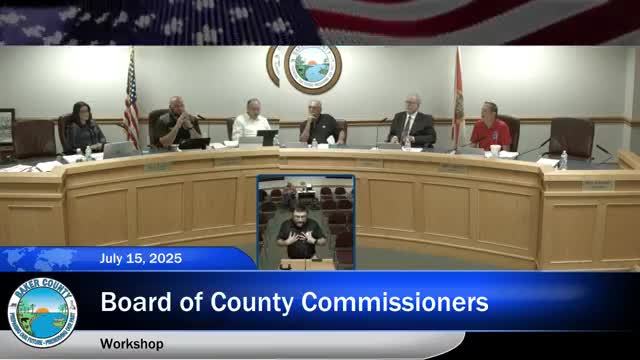
Baker County commissioners heard a detailed briefing on floodplain management, documentation problems after recent storms and federal expectations at a July 15 workshop.
Deputy state floodplain manager Michael Brichette and floodplain specialists told commissioners that weaknesses in recordkeeping following multiple storms have limited what the county could recover from state and federal programs, and that National Flood Insurance Program (NFIP) compliance affects eligibility for many FEMA public-assistance and mitigation grants. Brichette summarized the NFIP’s purpose as three tasks: “know the risk, ensure the risk, and manage the risk,” and urged county officials to adopt clearer processes for permit records, damage assessments and consistent enforcement of floodplain ordinances.
The presentation explained common single-site rules that affect property owners, including the NFIP “50% rule”: when repairs or improvements to a structure in a Special Flood Hazard Area reach roughly half of pre‑damage market value, the structure must be brought up to current codes. Brichette explained that the rule applies to damage of any origin to buildings located in mapped flood zones and said local floodplain administrators must be able to document substantial‑damage and substantial‑improvement determinations. He and staff also reviewed local options to reduce future losses, including adopting higher standards such as freeboard, no‑rise analyses and open‑space preservation.
County emergency management and community development staff described where documentation had been incomplete in prior storm recovery work — missing purchase orders, inconsistent coding and incomplete timesheets — and cited the effect on reimbursements. Staff said vendors and federal/state teams can help but county departments must provide complete, correctly coded records to be reimbursed. County staff also said they will host training on state FDEM/FEMA forms and processes; one training team is scheduled to be here in October and a state-led “post‑disaster toolkit” was offered to county staff.
Consultants and state officials urged the county to better track structures inside A/AE flood zones, to maintain permanent records of damage assessments and permits, and to plan pre‑positioned contractor agreements so staff augmentation can start immediately after a declaration. County staff said they will provide commissioners a two‑to‑three week priority plan (a proposed 30/60/90 list compiled with third‑party contractor Tetra Tech and state teams) and requested commissioner support to require departmental participation in trainings.
Commissioners pressed for timelines and clear next steps. County staff said they would return with a prioritized implementation plan and proposed funding options. Commissioners repeatedly emphasized they want a short timeline for action because noncompliance can limit future FEMA and mitigation funding and can affect federally backed mortgages or grant eligibility in flood‑affected areas.
State and federal presenters encouraged ongoing coordination: Brichette offered technical assistance and FEMA personnel described how communities are monitored for NFIP compliance and how suspension from NFIP can limit access to FEMA recovery and mitigation programs.
The workshop closed with county staff saying they will bring a detailed action plan to the commission in coming weeks and seek approvals (and, where appropriate, budget authority) to hire or pre‑position contractors and to fund the work needed to meet NFIP standards.