Get Full Government Meeting Transcripts, Videos, & Alerts Forever!
Get email alerts on the Emergency Management topic
No spam. Unsubscribe anytime.
Palm Bay fire rescue briefs council on 2025 hurricane readiness, emphasizes EOC, sandbags and volunteer training
Summary
Fire rescue emergency management staff told council the 2025 Atlantic season is expected to be slightly above normal and outlined plans for sandbag operations, pre-solicited contracts, debris removal and volunteer (CERT) development to improve cost recovery and response capacity.
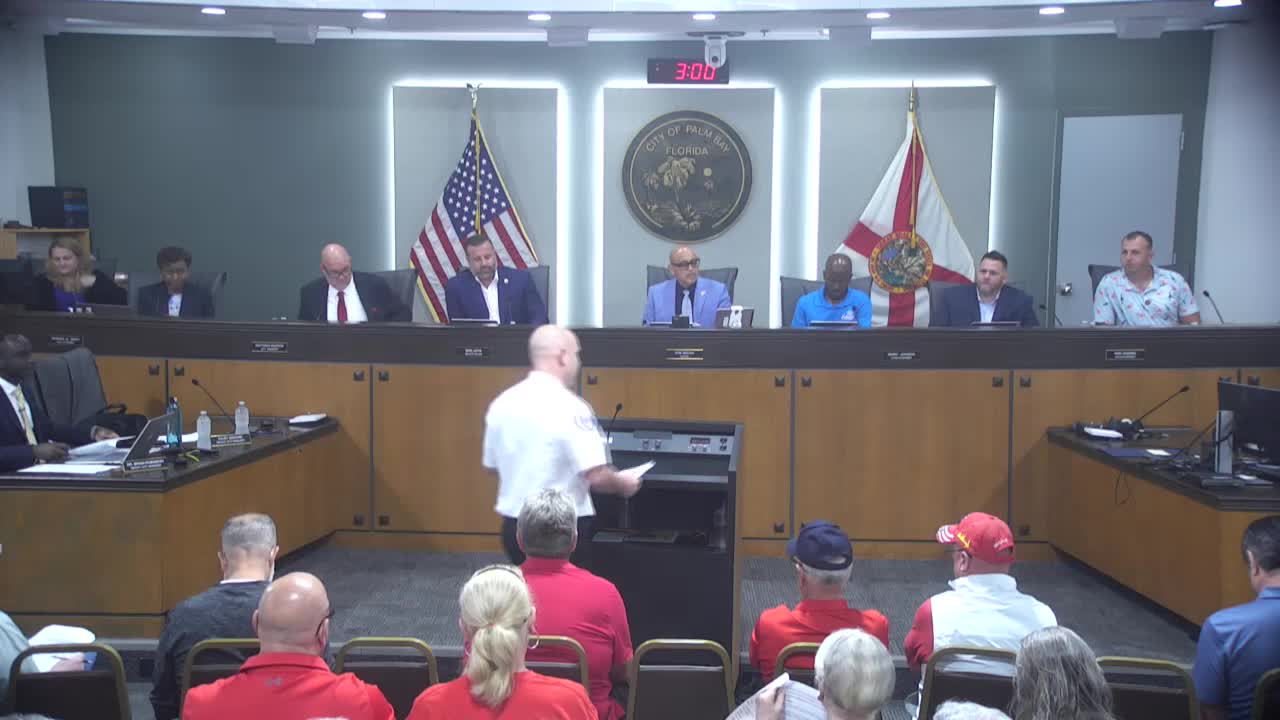
Brandon McKee, representing Palm Bay Fire Rescue's emergency management division, briefed City Council on June 16 about preparations for the 2025 hurricane season and lessons learned from last year's Hurricane Milton.
McKee said forecast models (Colorado State University and the National Hurricane Center) point to a slightly more active season than normal, though less intense than 2024. He emphasized that "our job is to prepare the city for the worst," and laid out operational priorities: rapid intensification monitoring, pre-positioning equipment, pre-solicited standby contracts, documented pre-disaster condition records for FEMA reimbursement, debris-removal plans and expanded incident command training.
Key items presented: - Rapid intensification: McKee noted storms can strengthen very quickly and that some effects are difficult to predict. - Simulations and surge planning: staff use the National Hurricane Center's tools (HurvA C and surge mapping) to predict impacts at Turkey Creek and other low-lying areas. - Sandbags: Public Works has purchased a mechanized sandbagging funnel capable of filling roughly 30 sandbags per minute; staff are finalizing staging locations and traffic patterns to avoid blocking critical evacuation routes. - Cost recovery: McKee said the city targets a high FEMA cost recovery rate (goal cited as 90%+). He gave a ballpark figure for a full Emergency Operations Center activation of about $6,000 per 24-hour period and said the total recoverable response and recovery for Hurricane Milton was roughly $44 million, with anticipated recoveries for specific incidents (Norwood) being pursued. - Debris removal and private-property debris removal (PPDR): staff said pre-solicited contracts and documentation are critical for rapid removal and reimbursement. - Volunteers and CERT: McKee described recruiting and training volunteers, noting the state valuation used for volunteer-hours (example $33 per hour) and an example calculation (a 50-person CERT team averaging 30 hours per person could represent roughly $50,000 of recoverable force-account labor if documented).
Coordination with county and state: McKee and council discussed how the city's emergency management coordinator works with Brevard County EOC, the state and FEMA and the role of the Florida Resiliency (FROC) disaster readiness assessment. McKee said the city has a FROC score in the mid-50s and that better documentation and readiness help accelerate state fronting of disaster projects when large projects are declared.
Council questions focused on how the city coordinates with the county EOC, sandbag logistics and reducing traffic congestion during sandbag operations. McKee said the city has a traffic plan for sandbag staging and that staff will run more public information and consider separate lanes for residents with disabilities or mobility challenges.
No formal action was required at the meeting; staff asked the council to support ongoing preparedness work and volunteer recruitment.