Get Full Government Meeting Transcripts, Videos, & Alerts Forever!
Get email alerts on the Solid Waste Ila topic
No spam. Unsubscribe anytime.
Council approves interlocal solid waste agreement; members press county on revenue sharing and contamination rules
Summary
After negotiation, Port St. Lucie City Council approved a redlined interlocal agreement with St. Lucie County to govern solid waste disposal from Oct. 1, 2025, through Sept. 30, 2030, with a five‑year renewal option, while directing the City Manager to continue negotiating revenue‑sharing terms and clarifying recycling contamination procedures.
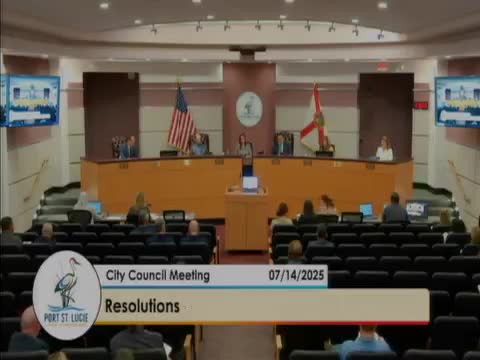
Port St. Lucie City Council on July 14 voted to approve a redlined interlocal agreement (ILA) with St. Lucie County for solid waste disposal, while asking staff to continue negotiations on parts of the agreement governing revenue distribution and recycling procedures.
City staff and county representatives told council the county undertook a recent landfill operations reassessment that required rate increases. St. Lucie County Director of Public Utilities and Solid Waste Rebecca Ventrella said a rate study showed decades‑long stagnant tipping fees and recent inflation in operating and maintenance costs that left the county with shortfalls.
“At the end of the day, over the past 30 years, our rates have been pretty stagnant,” Ventrella said; she added the county finished recent years “in the hole,” which prompted the rate study. Staff described specific increases presented to council: the yard‑waste rate was described in the meeting as moving from about $31.20 to about $59 (an increase staff characterized as roughly $27.80), recycling into an assessed tipping fee of $35 where previously there had been no fee, and class‑1 waste increases described in council comments during the presentation. City staff also said the ILA includes an allowance for diversion of up to 80% of the city’s yard waste.
Council questions and staff responses
Vice Mayor Caraballo and other councilmembers pressed county and city staff on three points: the agreement term, recycling contamination thresholds and the proposed revenue‑sharing method.
- Term: Council described a previously proposed 10‑year term as too long; the version presented at the meeting carried a five‑year initial term (Oct. 1, 2025 to Sept. 30, 2030) with a five‑year renewal option, which several councilmembers supported.
- Recycling contamination threshold: The draft includes a 25% contamination threshold that could require a truckload to be treated as garbage if confirmed by inspection. Rebecca Ventrella said the county’s contamination rate historically has been low (initially about 12%) and is currently about 18–20%. She said the county intends to inspect suspected loads and that the protocol would involve discussion with city staff before reclassifying a load as garbage.
- Revenue sharing and Exhibit D: Vice Mayor Caraballo and other members criticized the example revenue distribution in Exhibit D as structured in a way that they said could appear to allocate revenue multiple times to county costs and tip fees. Councilmembers asked that the redline remove scale‑tip fees from the illustrative distribution and asked staff to continue negotiating the revenue‑sharing language; county staff acknowledged an amendment should remove scale tip fees from the distribution example.
Approval with conditions
Council approved Resolution 25‑R‑39 adopting the redlined ILA and instructed the City Manager to continue negotiations with the county administrator specifically on Exhibit D (revenue distribution) and to report back; legal staff agreed that if final changes are not “significant substantive changes,” the City Manager could accept a more favorable result without returning the agreement to council.
What council said about rate pressures and alternatives
Several councilmembers said they preferred shorter contract windows so the city could reassess options if landfill or processing economics changed. Councilman Pickett suggested aligning the county ILA timeline with other service contracts to retain negotiation flexibility. The city noted it has a separate contract to divert yard waste to an alternate processor as a cost‑saving measure for residents and that diverting yard waste reduces disposal costs in the new ILA.
Ending
The ILA approval moves the draft toward final county consideration (county staff indicated an intent to place the item on the county agenda for July 22). Council approval was unanimous at this meeting, but several members asked staff to continue negotiations and to provide final language on Exhibit D and contamination protocols before the county’s final action.