Get Full Government Meeting Transcripts, Videos, & Alerts Forever!
Get email alerts on the Utilities Undergrounding topic
No spam. Unsubscribe anytime.
FPL outlines multiyear program to bury neighborhood power lines to reduce outages
Summary
Florida Power & Light updated the Sarasota City Commission on its Storm Secure Underground Program (SSUP), describing data-driven area selection, outreach and construction sequencing, and local projects planned this year while answering commissioners' questions about timing, costs and customer protections.
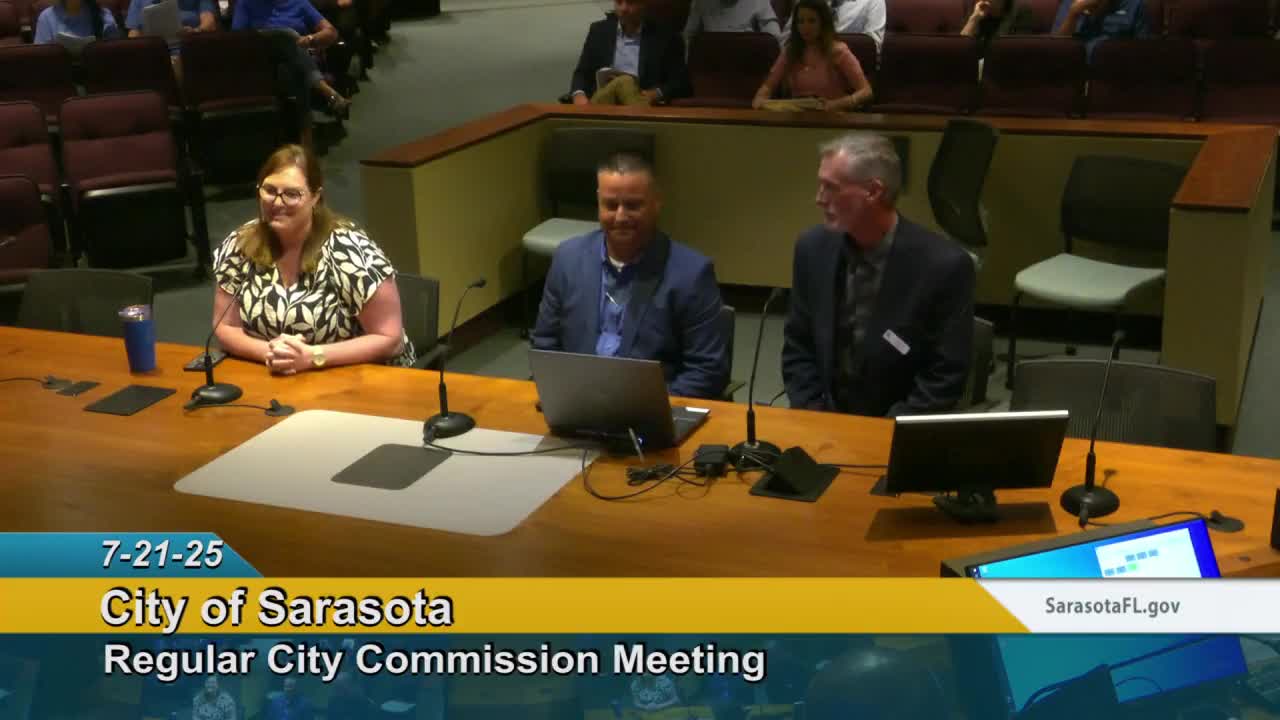
Florida Power & Light Company officials told the Sarasota City Commission on July 21 that the utility’s Storm Secure Underground Program, known as SSUP, aims to improve reliability by converting selected overhead neighborhood distribution lines to underground service.
FPL area manager Devonie (Devonie) Iglesias and project staff said SSUP focuses on lines that show the worst historical performance in outages or vegetation-caused interruptions and uses a multi-year planning, outreach and construction cycle. SSUP staff said the company does not assess upfront costs to individual customers for projects that are undertaken through SSUP; customers within project boundaries are not charged an up-front fee for undergrounding carried out under the program.
SSUP staff laid out the program process and recent local activity. Troy Todd, lead project manager for the West Region, said the three-stage project timeline begins with conceptual design and a year of outreach, then proceeds to final design, permitting and construction — typically a multi-year sequence. Michael Flowers, SSUP outreach lead, said the firm Pike (and contractor IRBI) serve as construction vendors and that FPL badges and identifies outreach representatives to reduce the risk of scams. Team members said directional boring minimizes surface disruption and that pad-mounted transformers, meter adapters and flush-mounted junction boxes ("hand holes") are commonly installed.
FPL officials provided specific figures for work in the Sarasota area: since 2019 SSUP has converted about 1,697 households and roughly 10.12 miles of overhead line to underground. For the current outreach they said they are reaching roughly 929 homes for 10.36 miles of overhead removal, including a Ringling Substation area with about 472 customers (about 5.87 miles) and a Hyde Park Substation area with about 457 customers (about 4.49 miles).
Commissioners pressed for detail on how SSUP selects areas. Todd said the selection is “data-driven,” relying on historical outage performance (including hurricane-era outages and recurring afternoon thunderstorm outages), vegetation problems and equipment history; SSUP prioritizes areas that generate the most recurring operating and maintenance costs. Commissioners asked about levers for communities to accelerate projects; staff described a separate “special projects” program that residents or HOAs can request and partially fund when they want a faster timeline. Commissioners also asked about interim safety measures for leaning or damaged poles; FPL said customers may report poles through the company website and that crews respond to urgent public-safety concerns.
On technical reliability, FPL staff described automated lateral and feeder switches and distribution-transformer monitoring equipment, noting that fault-isolation and automated switching together help limit the size and duration of outages. Staff also said undergrounded laterals generally speed restoration and reduce vegetation-caused outages. Commissioners requested clearer notification when crews address reported poles and urged the utility to continue close communications with neighborhoods through the outreach period.
FPL staff said SSUP was approved by the Florida Public Service Commission and that the program is intended to be a multi-decade effort; FPL noted the company’s broader grid investments including meter deployments, hardened transmission, and vegetation management.
Staff contacts and next steps: FPL said outreach specialists will contact affected customers in the project boundaries and that final design, permitting and construction follow outreach and easement acquisition.
Ending: Commissioners thanked the FPL team for the briefing; no formal action was required of the commission.