Get Full Government Meeting Transcripts, Videos, & Alerts Forever!
Get email alerts on the Environment Water Quality topic
No spam. Unsubscribe anytime.
Pensacola Bay Estuary Program seeks continued Milton support; highlights oyster restoration, monitoring and grants
Summary
Estuary Program presenters updated the council on a federal designation, a $10 million oyster-restoration grant and local programs including living shorelines, shell recycling, monitoring and a requested $15,000 local contribution.
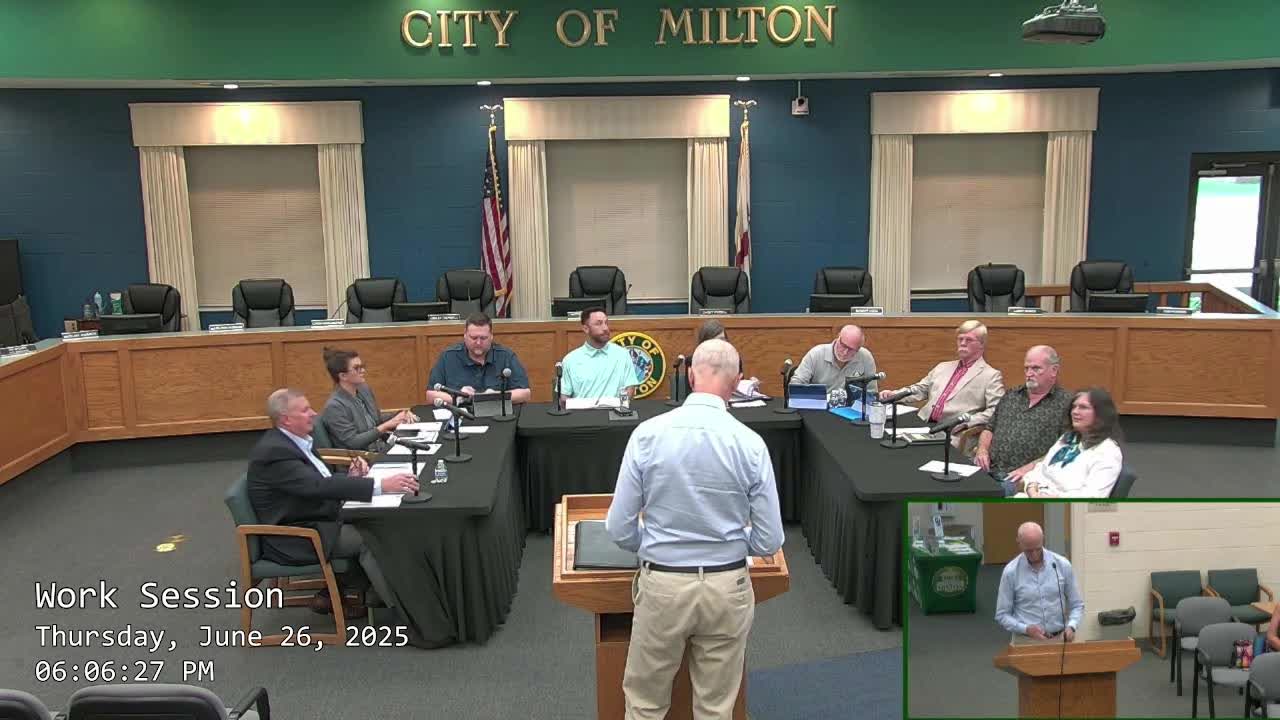
Representatives of the Pensacola Bay Estuary Program briefed the Milton City Council on recent program milestones, grant funding and opportunities for local participation and asked the city to continue its annual contribution at the previously approved level of $15,000.
The update emphasized a recent federal designation being pursued with the U.S. Environmental Protection Agency and large grant awards that program leaders say will fund habitat restoration, monitoring and community grants. Vernon (the program presenter) described outreach and on-the-ground work, and Matt Pazner, identified in the meeting as the program’s executive director, thanked Milton for long-standing support.
Why it matters: The estuary program says its work brings federal and state dollars and on-the-ground projects aimed at improving water quality, restoring oyster habitat and supporting shoreline resilience — initiatives local officials and residents have cited when discussing the health of the Blackwater River and surrounding waters.
Key items described at the meeting included: a $10 million grant from the National Fish and Wildlife Foundation to restore oyster habitat on 250 acres as an initial phase; plans to expand an oyster-shell-recycling partnership with local restaurants; a Living Shorelines Assistance Program that will be available in the Milton area in August; a community grant program awarding $10,000–$75,000 per grant if the state grant is approved; and a microbial source-tracking initiative and monthly water-quality monitoring to identify and address sources of nutrient and bacterial impairments in local watersheds (Blackwater River, Blackwater Bay and Pond Creek were listed as focus areas).
Program leaders noted the estuary program’s reported reach: thousands engaged through events, a large digital reach and $84 million in partner funding brought into the region (figures provided by the presenters). The presenters explained that local government contributions are population-based; Milton’s request this year was stated as $15,000, with the program noting total local-government requests of about $307,350 across partner jurisdictions.
Council members asked about the city’s contribution relative to grant leverage; the presenter said the national estuary designation could bring an EPA allocation (cited by the presenter as approximately $850,000 annually) and additional state funding. City staff later confirmed the city’s budget recommendation includes $15,000 this year.
The council did not take formal action at the session; presenters encouraged the city and property owners to apply for grants and to participate in living-shoreline and shell-recycling efforts.
Additional context: The presenters framed the program as nonregulatory and community-driven, and asked Milton to consider outreach to waterfront property owners about cost-share opportunities and to apply for community grants if appropriate.