Get Full Government Meeting Transcripts, Videos, & Alerts Forever!
Get email alerts on the Youth Civic Engagement topic
No spam. Unsubscribe anytime.
Sacramento students present local solutions on food access, safety, mental health and the environment at City Hall
Summary
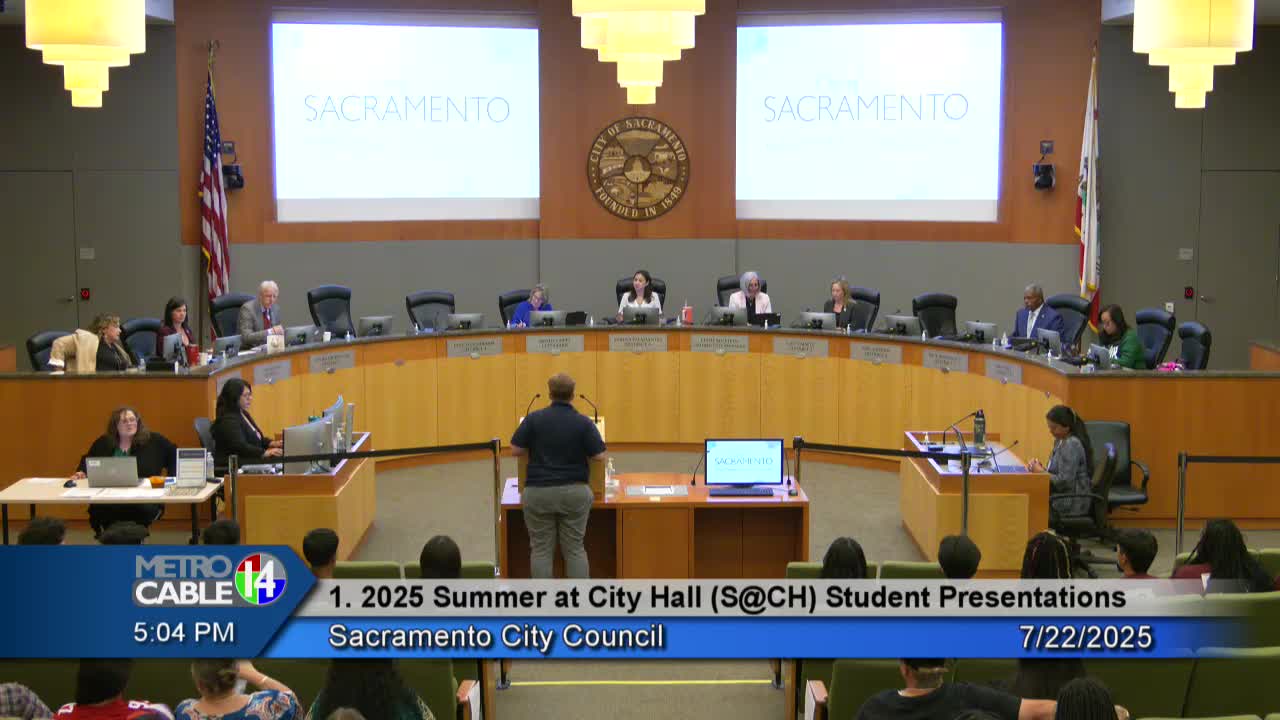
Eighty-two students and 28 mentors from Sacramento-area districts presented projects to the City Council highlighting local proposals on food deserts, sexual assault awareness, youth mental health, street violence, water pollution, drunk driving, youth independence, climate education and parental substance abuse.
Eighty-two students from Sacramento City Unified, Natomas Unified and Twin Rivers Unified school districts presented research and proposals to the Sacramento City Council during the annual Summer at City Hall program, urging the council to promote youth-led action on food access, safety, mental health and environmental issues.
The presentations, organized by Sarah Musser, recreation general supervisor with the city’s Youth Parks and Civic Engagement (YPSI) program, showcased nine student groups that surveyed peers, produced public-service videos and pitched concrete local interventions — from community gardens and supermarket advocacy to youth peer-support groups and river cleanups.
The program matters because it channels classroom work into civic engagement and gives council members direct feedback from residents under 24 about problems that affect neighborhoods across the city. Students and council members repeatedly discussed ways the city could amplify existing programs and direct funding toward local, youth-driven efforts.
Students presented survey data and proposals across multiple topics. The “Down Without Borders” team said it surveyed 102 peers about food access and proposed encouraging supermarkets to locate in underserved neighborhoods, expanding “Lunch at the Library” beyond summer, and creating community gardens tied to farmers markets; presenters reported that 60% of respondents occasionally buy junk food over produce and 92% would buy more produce if variety improved. Sarah Musser told the council the Summer at City Hall program hosted 82 students and 28 mentors this year.
Other student groups asked the city to help distribute informational materials and connect them with local nonprofits. A team addressing sexual-assault awareness (Project Phoenix) surveyed 155 youth and proposed an awareness campaign with flyers and Instagram resources directing victims to organizations such as Weave and My Sister’s House. The Pink Starfish group proposed Project CARE, a youth-led peer-support model and asked council members to consider Measure L and Measure U as possible funding sources for space and programming.
Voices Against Violence called for a local version of a group violence reduction strategy (GVRS), modeled on programs in Baltimore, emphasizing life coaching, job training, mentoring and “violence interrupters.” Roar and Restore urged more frequent river and creek cleanups and cited Central Valley Water Board monitoring that found multiple Lower American River stations exceeding E. coli limits. The Golden Grizzlies proposed early environmental education and youth-facing materials and the Black Bears urged action on parental substance abuse, including a non-emergency hotline and school presentations; the Black Bears’ survey drew 156 responses.
Council members repeatedly praised the students’ work and offered connections. Council member Kaplan, identifying herself as a domestic-violence survivor, praised teams working on sexual violence and offered to connect students to providers and local programs. Council member Maple encouraged students to table at the Meadowview Farmers Market and called out local partners. Council member Kaplan and others also flagged the River City Waterway Alliance and the Sacramento Stormwater Quality Partnership as existing groups that could partner on cleanups and outreach. Several council members urged students to pursue Measure L and Measure U funding opportunities where appropriate.
Students asked that the city elevate awareness of existing services — for example, how to report abuse, how to access free student RT passes, and where to find counseling or clean-up groups — and sought help distributing their materials at markets and community events. City staff and council members repeatedly offered to connect teams to community partners and volunteer opportunities.
The presentations concluded with staff and teachers recognized for organizing the program; interim city staff described the students’ progress over the summer and encouraged continued engagement.
The council did not take any formal vote or adopt new policies at the meeting; the session served as a forum for youth proposals and for city officials to offer follow-up support or referrals.