Get Full Government Meeting Transcripts, Videos, & Alerts Forever!
Get email alerts on the City Budget topic
No spam. Unsubscribe anytime.
League City reviews FY2026 proposed budget, flags tax-roll losses from apartment conversions
Summary
At a July 22 budget workshop, League City staff presented the FY2026 proposed budget and 2026–2030 CIP; council members raised concerns about compressed workshop timing, rising debt service, and loss of taxable value after several apartment complexes converted to tax-exempt status.
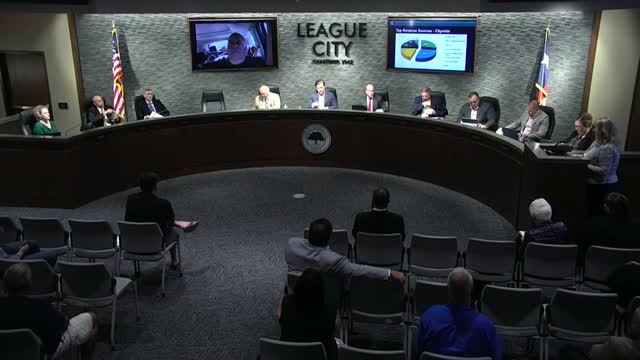
League City staff presented the proposed FY2026 budget and the FY2026–2030 capital improvement program at a July 22 council budget workshop, saying water and wastewater sales are projected to be the largest citywide revenue source for FY2026.
Angie, a city finance staff member who led the presentation, told the council the FY2026 proposal is based on preliminary 2025 taxable values of $13,590,000,000 — about a 1.4% increase over the prior year — and that the budget assumes property tax revenue of $50,040,000. She said new property added to the roll is estimated at $295,000,000, producing an estimated revenue “just over $1,000,000,” and noted anticipated increases to senior and disabled exemptions that will lower the taxable total.
The workshop highlighted several funding and staffing proposals in the FY2026 draft, including continued reinvestment projects on both the tax-supported and utility sides, a $3,000,000 plan to purchase existing streetlights from Texas New Mexico Power (split $1,500,000 from the general fund and $1,500,000 from Hurricane Harvey fund balance), and personnel changes across departments. The draft funds multiple compensation adjustments: a 3.5% cost-of-living adjustment for civil-service employees (police), a 2% January 2026 across-the-board increase for civilian staff, merit pools (2.5% for salaries under $76,500 and 1.5% for higher salaries), and higher holiday premium pay (from $5 to $8 per hour). The budget also continues funding for three positions previously approved in FY2025 but not filled due to an expected grant that was not awarded.
Staff identified 10.5 net new FTEs in the proposed budget, mostly in the general fund, plus one in the utility fund and one in the 4B special revenue fund. New positions listed included an IT cybersecurity/network engineer, split funding for a manager of community engagement and special projects, additional police officers and a four-person special investigative unit, a deputy fire marshal, EMS staffing adjustments (net +1.5 FTE), a part-time-to-full-time communications staff writer (0.5 FTE), an HR employee lead coordinator, a planning assistant administrator, and a parks part-time recreation specialist. The budget also lists 12 vehicle purchases tied to positions and operations, and a proposed addition of an ambulance for peak operations in FY2027 planning.
On capital and other line items, staff highlighted $8,000,000 in cash funding to the utilities reinvestment program, a $900,000 allowance for a police multi-use training facility, roughly $300,000 added to a capital replacement fund for future fire apparatus, nearly $400,000 of additional solid-waste expense offset by revenue, and several ballpark-related items (entrance door replacement, camera and badge-reader updates, legal-fee contingencies, a third-party operations audit, additional shade structures, and playground/outfield repairs).
Council members pressed for additional analysis and more meeting time. Councilmember Tommy Cones said he was “surprised” by the short workshop schedule and added, “I just don't think there's enough time to go over all of this information,” urging longer hearings and more opportunities to review the large binder of backup materials. Multiple councilmembers asked staff to provide a debt-service history and clearer analysis of how planned projects and use of sales tax dedicated to the CIP affect long-term debt.
Members also raised the loss of taxable value after several apartment complexes were purchased by housing finance entities and converted to tax-exempt status. One councilmember said four or five apartment complexes (together representing more than 1,000 units) moved off the tax rolls, “wiping that growth” for the city; staff said that while recent state law changes should prevent future conversions, there is no mechanism to reverse those already completed. Councilmembers requested a follow-up with the precise dollar amounts removed from the tax roll (staff agreed to circulate those figures by email).
For next steps, staff said the Galveston County certified roll should be available around July 25 and the official no-new-revenue (NNR) tax-rate calculation will follow; staff expected to provide the certified numbers and an agenda item in early August to support council decisions on a proposed tax rate. A council member asked staff to bring back information on grant and program options referenced as 287(g) and Operation Lone Star for an upcoming July 12 workshop, noting potential grant revenue and associated costs.
No formal votes were taken during the workshop. Staff and council agreed to consider adjusting the timing of the next workshop (a request was made to start the July 12 session at 5:00 p.m. to allow more discussion) and to supply requested backup (dollar impact of apartment conversions, a debt-service trend graph, sales-tax dedication to CIP, and details on staffing-vs-outsourcing options such as the HR leave coordinator).
The meeting adjourned after roughly 34 minutes.