Get Full Government Meeting Transcripts, Videos, & Alerts Forever!
Get email alerts on the Commission Procedures topic
No spam. Unsubscribe anytime.
DeSoto planning commission holds training on duties, public hearings and decorum
Summary
Attorney Caleb Smith led a work-session refresher for the DeSoto Planning & Zoning Commission covering the body’s advisory role, quorum and voting rules, public-hearing procedures and limits on deliberation and public comments.
Attorney Caleb Smith opened a training work session of the DeSoto Planning and Zoning Commission on procedural rules, saying the board is an advisory body that makes recommendations to city council and must follow open-meeting and notice requirements.
Smith told commissioners that the planning and zoning panel’s responsibilities include processing rezoning requests, specific-use permits, site plans, variances and plats. “You’re an advisory board to the city council,” he said, noting the commission’s role in presenting public hearings and recommending actions to council.
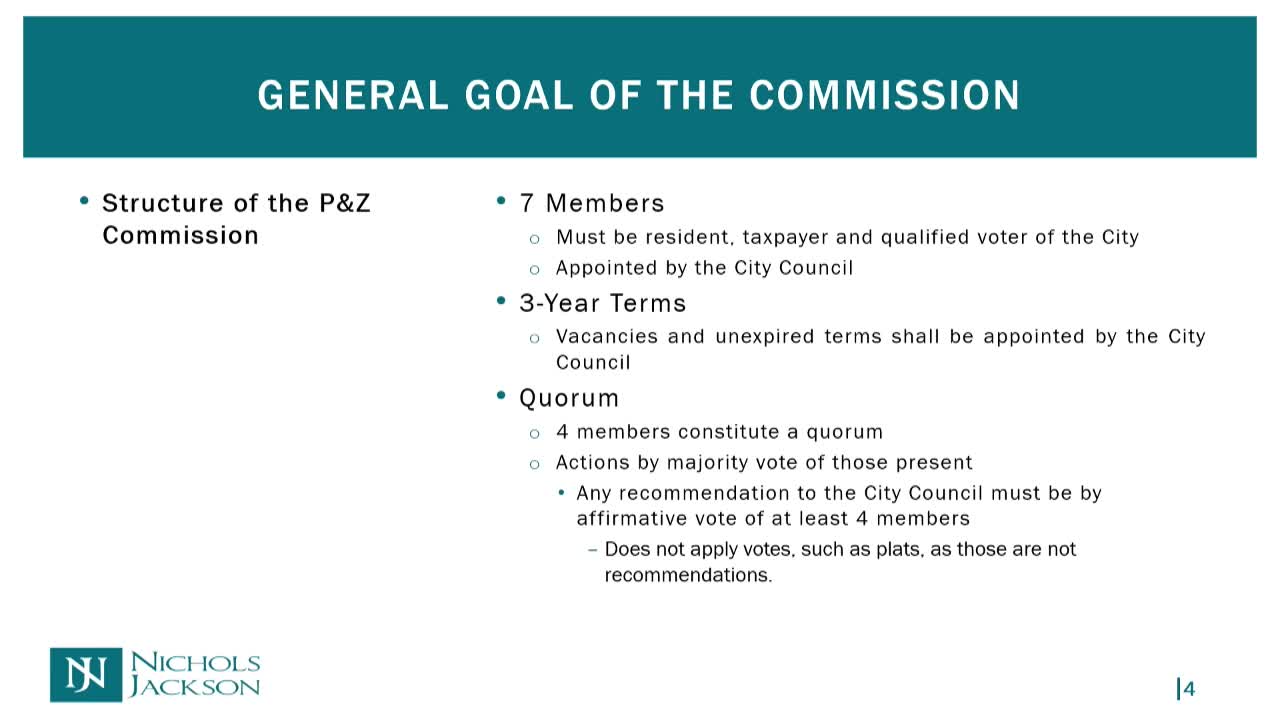
The training reiterated key operational rules: a quorum is a majority of appointed members (four of seven in DeSoto when six were present), any recommendation to council requires the affirmative votes of at least four commissioners, and commissioners must avoid deliberating outside noticed meetings. Smith warned against “walking quorums” and said commissioners may not decide official business by telephone, text or email.
Smith emphasized that staff recommendations are advisory, not binding on the commission: “Staff is staff and you are the commission,” he said. He also reviewed decorum rules, the commission chair’s authority to recognize speakers, and limits on commissioners’ public comments, advising against stating reasons for a vote that could expose the commission to legal challenges.
The presentation covered the structure of agendas (consent items, regular discussion and public hearings) and public-comment procedures, including the commission’s ability to impose reasonable time limits such as a three-minute speaker rule if applied uniformly. Smith said executive sessions at planning-and-zoning meetings are rare but may be appropriate for privileged legal advice, for example if the commission faces complex plat denial ramifications.
The session concluded with reminders that plats are typically ministerial approvals (handled on consent when staff finds legal requirements met), that planned developments and deviations should be used sparingly at the hearing stage, and that the commission should base rezoning recommendations on the city’s comprehensive plan and other adopted plans.