Get Full Government Meeting Transcripts, Videos, & Alerts Forever!
Get email alerts on the Land Use Development topic
No spam. Unsubscribe anytime.
Brady Sullivan outlines phased plan to convert Cigna building, ties project to Heads Pond sewer work
Summary
Developer Brady Sullivan described a two‑phase concept for the College Park Drive/ Cigna site in Hooksett, asking the planning board for guidance on a phased conversion of the vacant Cigna building while the larger Heads Pond subdivision advances — with many board members pressing for a binding development agreement and design changes.
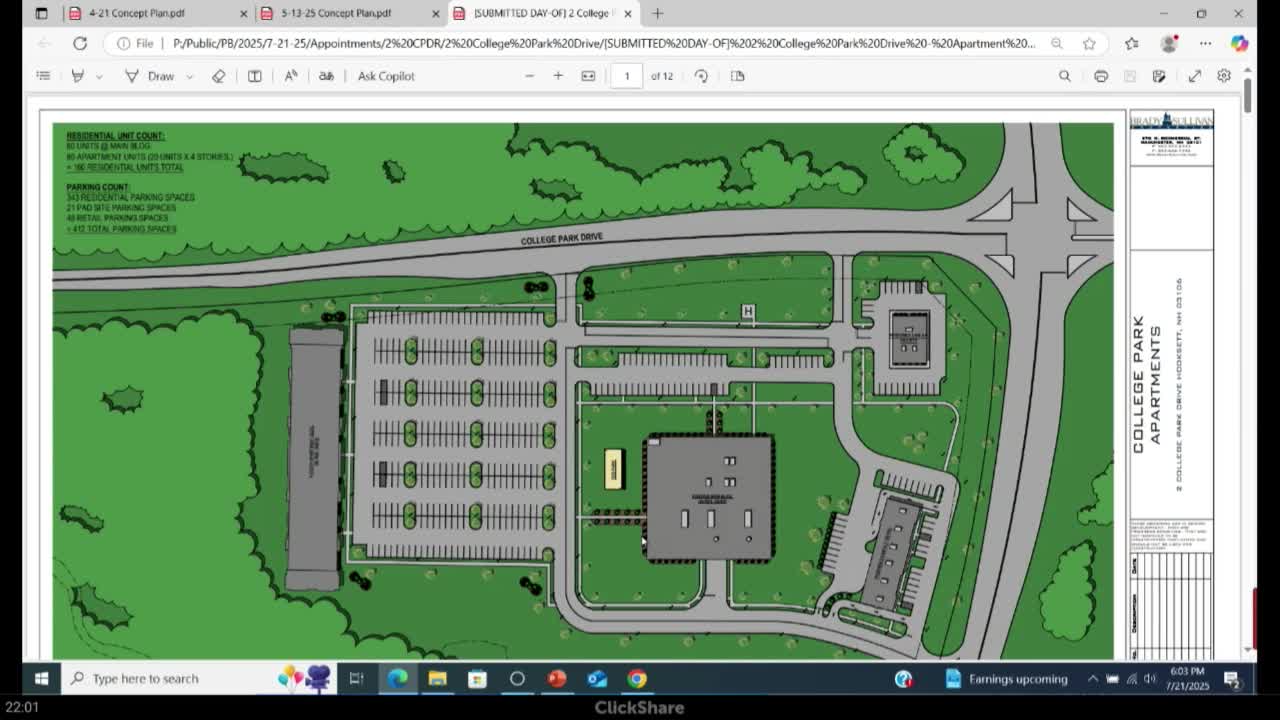
John Cronin, attorney for the applicant, told the Hooksett Planning Board on July 21 that Brady Sullivan is proposing a staged development for the College Park Drive parcel anchored by the long‑vacant Cigna building and linked to the larger Heads Pond subdivision to the north.
Cronin said Brady Sullivan plans two phases: an initial phase to convert the existing Cigna building so it is put back into productive use, and a later phase to complete new buildings on the site after sewer capacity and other infrastructure are addressed. "We'd like to come in with a plan that's in 2 phases," Cronin said, adding the developer would use a development agreement or other security "to give the town comfort" and tie timelines to sewer completion.
The applicant's team described ongoing coordination with the sewer department and an engineer, Tom Aspell, to design a cross‑country sewer alignment that would avoid tearing up Route 3. Cronin said the plan would use capacity transferred from vested units at Heads Pond and upgrade undersized segments of the line — in some cases converting a 7‑inch line out the back to a 15‑inch line and bringing new lateral service from a manhole just south of Greens Marine.
Grant, the town planner, briefed the board on Heads Pond's long permitting history and vesting status. He said the Heads Pond subdivision received master‑plan and subdivision approvals in the 2000s and that much of the work required for vesting — including wetlands work, conservation easements and road improvements — has been completed. He told the board the Heads Pond plan includes multiple phases: a first phase of single‑family homes and later multifamily phases that will require site‑plan review. "Phase 1 is 34 single family homes," Grant said; he said a later multifamily phase would require a separate site‑plan submission.
Board members focused much of their discussion on two issues: ensuring that the Cigna conversion and the remainder of the project do not repeat past unfinished phases elsewhere in town, and the architectural fit of the new buildings with the surrounding neighborhood.
"That is not tying the building into the surrounding area at all," said Sheena Gilbert, a planning board member, referring to the four‑story concept elevations presented for the new building. She urged the applicant to "tone it down" and asked whether the developer would accept a binding commitment to complete the commercial pads in a timely way rather than leave them unbuilt.
Several members recommended a development agreement or financial securitization to protect the town's interests and prevent the kind of partial build‑outs they said have occurred elsewhere. Cronin said Brady Sullivan is open to such an agreement and to working with the town attorney and planner on terms the board would find acceptable. He also argued the developer has a strong financial incentive to complete the overall work because of the scale of their investment in Heads Pond and the sewer improvements: "They're gonna have so much invested between this project, Heads Pond, and the sewer line that they will be motivated to get this developed as quickly and as efficiently as they can," Cronin said.
Planning board members also asked for clearer sequencing and conditions: which elements could begin if the purchase closed tomorrow, what would require additional approvals, and when the town could expect the sewer work to be bid and built. Cronin and Grant agreed that some single‑family lots at Heads Pond appear ready to proceed with sewer permits, while larger multifamily components will need site‑plan review and, in some cases, additional state permits.
The conversation also covered technical routing options for the sewer alignment, whether parts of the system would need pumping, and how new mains would be sized long term. Cronin said the cross‑country approach would lower construction costs and reduce the need for police details and traffic control along Route 3.
Board members asked the applicant to soften the commercial and residential elevations to better match the nearby older houses and historic buildings. Several members suggested pitched roofs, reduced modern color palettes, or masonry elements to relate the new construction to Mount Saint Mary's and nearby village architecture. Cronin said he would pass design feedback to the development team and that Brady Sullivan would bring a full site‑plan application back to the board for formal review.
What the board directed and what remains: the discussion was conceptual; no approvals or variances were granted at the July 21 meeting. The applicant was asked to return with a full application, more precise engineering for sewer connections, and draft development‑agreement language that would secure the phasing commitments the board seeks. Grant also recommended the applicant prepare the community‑impact information required by the mixed‑use zoning that governs Heads Pond, including updated traffic, school‑impact and fiscal studies as needed.
The project touches multiple regulatory tracks and approvals — site plan review, sewer department design and state permits — and the board flagged timing and implementation risk accordingly. Board members said they were broadly supportive of reusing the Cigna building and of the larger sewer fix, provided the town can secure enforceable commitments about phasing, design, and completion.
The applicant team left the meeting with an expectation of further coordination with Grant and with the town attorney before returning with formal submissions. "We'll file the application. I'll work with Grant, to give you the commitments that you want," Cronin said.
Ending: The board did not take a vote on any element of the concept plan. Members asked the applicant to bring the requested documentation and to return for a formal site‑plan review once the engineering and procurement details are finalized.