Get Full Government Meeting Transcripts, Videos, & Alerts Forever!
Get email alerts on the Emergency Preparedness topic
No spam. Unsubscribe anytime.
Richmond emergency-management officials outline hurricane readiness, Hagerty follow‑up after January water crisis
Summary
City emergency-management leaders told the Public Safety Standing Committee they are implementing consultant Hagerty’s recommendations, updating continuity and emergency operations plans, expanding alerting via Richmond Ready and auditing logistics after the January water incident.
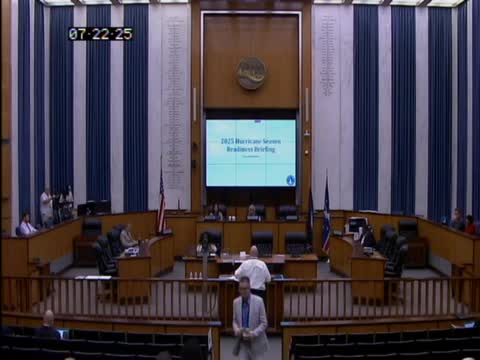
City emergency-management officials briefed the Richmond Public Safety Standing Committee on local preparations for the 2025 hurricane season and on steps to implement recommendations from an outside incident response assessment conducted after the January water crisis.
Stephen Willoughby, director of emergency communications, preparedness and response for the city of Richmond, said the city will update multiple plans, strengthen operational coordination and improve public information and logistics, and pledged periodic public updates on progress. "Find it, fix it," Willoughby said, summarizing the mayor's direction after Hagerty's assessment.
Hagerty's incident response assessment identified gaps in planning, operational coordination, logistics and public information during the January event. Willoughby told the committee the city will begin work on an integrated preparedness plan within 30 to 45 days and expects a comprehensive update of the Emergency Operations Plan (EOP) to take up to about 18 months, with higher‑priority amendments made sooner. He listed six specific follow‑on plans the administration intends to produce over the next two years, including a resource‑management plan, point‑of‑distribution plan, crisis communications plan, volunteer-and-donations plan and a citywide cost‑recovery plan.
The presentation summarized steps already taken: the city replaced its previous mass‑notification platform with Richmond Ready (built on the Everbridge product), is formalizing an emergency management liaison (EML) program through an administrative regulation the director said is cited as 1.9, and is revising continuity-of‑operations templates to align more closely with FEMA standards rather than the older VDEM template used previously. Willoughby said departments will be prioritized for updated continuity planning based on their risk to core city services.
Willoughby and Paul Hunley, an emergency planner in the Department of Social Services embedded with the Office of Emergency Management, outlined operational issues identified in January. Those included inconsistent use of WebEOC as the incident tracking system, ad hoc logistics handoffs that produced supply chain problems, and an Emergency Operations Center (EOC) setup that requires large amounts of equipment to be assembled because the city lacks a permanent EOC location. Willoughby said the library basement currently designated in the EOP is inadequate for a city of Richmond's size and recommended a permanent EOC where equipment and staff could immediately operate.
On public alerts, Taylor Fuqua, detailed from the Office of Strategic Communications to emergency management, described Richmond Ready and how it differs from Wireless Emergency Alerts (WEA). Richmond Ready requires subscription and allows targeted opt‑ins; WEA goes to all cell phones in a geofenced area but is limited by federal criteria for approval. Willoughby said Richmond Ready subscriptions have grown from about 7,500 to “closer to 8,000” after recent marketing pushes and that the city will accept paper signups for residents without the technical ability to register themselves. He said the administration has issued a directive that boil‑water advisories will be pushed via WEA going forward.
Council members pressed staff for more specificity and faster progress. Councilwoman Trammell Aberbacher said council and residents experienced poor communication during January's incident and asked Willoughby to return with a fuller update in September. At several points Trammell sharply criticized the city's early response and told staff, "you failed us," urging a 100 percent effort to reach vulnerable residents. Staff acknowledged the Office of Emergency Management had been small relative to comparable cities; Willoughby said the office previously had two employees and an operating budget of $114,000, and that the office now has five staff and has increased funding, requiring continued use of contractors to accomplish the full work program while the office grows.
Willoughby said the city plans to publish Hagerty's recommendations and post quarterly public progress reports. He also described efforts to improve situational awareness, establish a consistent "battle rhythm" for reporting within the EOC, expand EML training with baseline and enhanced curricula, and improve coordination with agencies such as Richmond Ambulance Authority, public works and utilities for sheltering, distribution and recovery operations.
Council members asked for metrics on community emergency response teams (CERT), district‑level breakdowns of volunteers, and clearer expectations for communications to council members during incidents. Willoughby said CERT training is being expanded and that he will provide numbers and district details to the committee.
The committee did not take formal votes on these items at the meeting. Willoughby said the administration will begin implementing several high‑priority changes immediately and provide regular briefings to the committee and council.
Looking ahead, Willoughby and staff signaled an administration focus on institutionalizing lessons from the January incident through plan rewrites, training, and improved use of WebEOC and Richmond Ready so the city can better coordinate logistics and communications in future storms and utility outages.