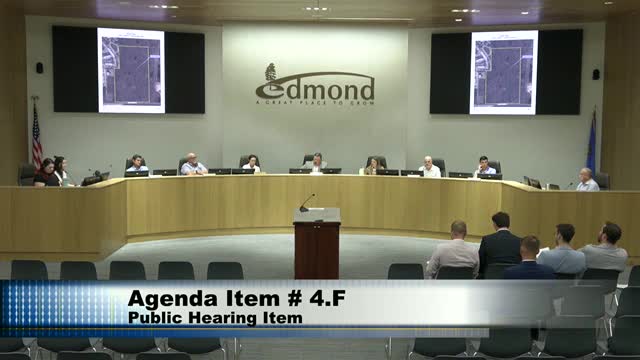
Planning commission approves Liberty Park preliminary plat but rejects Coffee Creek widening variance
Loading...
Summary
The commission approved the 86.3‑acre Liberty Park preliminary plat and most requested variances after extended discussion of street widths, easements and utilities; the commission declined one variance to avoid deferring Coffee Creek widening and approved the plat without it (motion passed 3–1, with one commissioner recusing).
The Edmond Planning Commission conditionally approved the preliminary plat for Liberty Park (PR24‑00027), an 86.3‑acre mixed‑use neighborhood proposal that would create 705 lots, private streets, and a central commercial village. The commission approved the plat with the variances requested by the applicant except for one variance (labeled “A” in staff materials), which would have allowed the developer to avoid required widening of Coffee Creek Road; commissioners voted to exclude that variance from approval.
Applicant representatives said the design is intended to create a walkable, mixed‑use village with narrower streets, alleys serving rear garages, and green spaces framed by housing faces rather than large setbacks. Jonathan Heisel, civil engineer for the developer (Park Hill), and David Box, attorney for the applicant, cited precedents such as the Wheeler District and other new‑urban examples and said current subdivision regulations are oriented to conventional suburban development and cannot produce the proposed walkable form without variances.
City engineering and planning staff raised several concerns: the required widening of Coffee Creek Road (variance A) should not be deferred because the road will carry more traffic as development occurs; several street sections and parallel parking widths are tighter than city standards and could result in temporary blockages during deliveries; alley widths and easement depths may be too narrow for long‑term utility access and repair; and staff requested more detailed drainage and utility plans before final approval. Staff said some variances might be supported later if engineering plans demonstrate that utilities and emergency access can be accommodated.
Public comment included a request from an adjacent homeowner, John Kane, who asked that the developer provide a buffer between his property and Lot 1 in Block 54 to avoid a house or building immediately adjacent to his lot line. Applicant representatives said they would continue discussions with neighbors on buffering and lot dimensions.
Commission debate focused on public access and safety (turning radii, emergency vehicle access), long‑term utility easement widths, and precedent for deferring public street widening. One commissioner said the applicant could withdraw the Coffee Creek variance (A) and proceed; the motion ultimately approved the preliminary plat while excluding variance A. A commissioner stated they would recuse themselves from the vote because of a personal connection to nearby Centennial Elementary School.
The motion to approve the preliminary plat excluding variance A passed on a 3–1 vote with one commissioner recused. Staff and the applicant will continue engineering work (drainage design, final utility plans and easement refinement) during the final‑plat process; staff noted that additional technical details will be required before the final plat is accepted and that some variance approvals could be revisited if final engineering supports them.
The applicant and staff said the development team will pursue detailed utility and drainage plans and coordinate tree‑preservation and buffer details with adjacent property owners as the application moves toward final plat review.