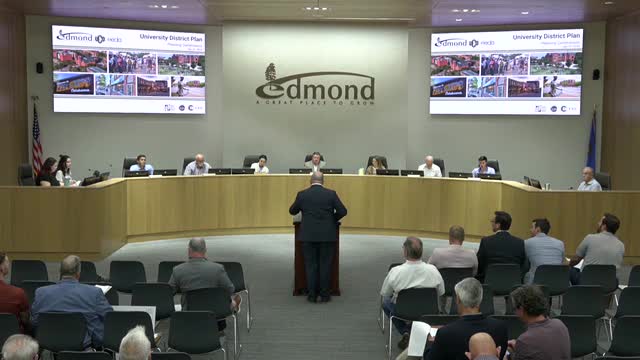
Planning commission recommends UCO-campus edge revitalization plan to city council
Loading...
Summary
The Edmond Planning Commission voted 5-0 to recommend a study and recommendations for the area between downtown Edmond and the University of Central Oklahoma to the city council, endorsing a strategy that emphasizes mixed-use development, parking strategy, and form-based zoning changes.
AJ Kirkpatrick, director of urban planning at ADG Blatt, presented a campus-edge revitalization study the firm prepared with city staff and University of Central Oklahoma (UCO) representatives. The planning commission voted to recommend the study and its recommendations to the Edmond City Council for further consideration.
The plan covers the district between downtown Edmond and the UCO campus and proposes a “campus corner” mixed-use commercial district, targeted housing types that avoid direct competition with university housing, stronger pedestrian connections along University Boulevard and Main, and a phased approach to new parking (including potential public parking garages). Kirkpatrick said the study included community engagement (a campus survey with 618 responses and a door-hanger neighborhood survey yielding 22 responses), market analysis, and two public “game board” workshops to test alternative scenarios.
Why it matters: the study aims to knit downtown and campus into a walkable, mixed‑use neighborhood, support private redevelopment already occurring on Campbell, and create a development framework (recommended rezoning using form‑based principles) to guide future projects and public investments. The plan also recommends a detailed parking analysis for the university, pursuing public‑private partnerships (an RFI) for UCO‑owned sites, including study items in capital improvement planning, and taking a measured approach to redevelopment near churches that currently own large surface parking areas.
Key points from the presentation included a land‑use/ownership review showing low rates of owner‑occupied parcels in the study area (Kirkpatrick said there were fewer than 20 homestead exemptions across roughly 170–180 parcels), a market consultant estimate that projected household and retail demand (the consultant’s estimate was presented in the study materials), and recommended near‑term testing of infill on Blocks 3 and 5 while reserving larger UCO holdings (Blocks 2 and 4) for possible future parking garages and larger infill projects.
Commission discussion touched on who the target residential market would be; Kirkpatrick said the intent was to avoid producing housing that primarily competes with student housing and instead to encourage niche options such as faculty/staff, married‑student, and retiree housing. A city official stated there is an existing Tax Increment Financing (TIF) district that could be used for gap financing of public infrastructure and that the plan’s recommended actions should be incorporated into capital improvement planning. A public commenter, Dan O'Neil, raised questions about UCO enrollment trends; a university representative said enrollment had declined over the last decade but had recently shown modest increases.
The commission voted 5–0 to recommend the plan to city council. The commission’s recommendation will be scheduled for a city council workshop and subsequent council consideration; staff said the item is tentatively planned for a workshop in September and council consideration in October.
The final plan text and the staff presentation include recommended implementation actions (form‑based rezoning, parking studies, a phased RFI for UCO parcels, continued dialogue with nearby churches, and inclusion of related capital costs in future CIP updates).