Get Full Government Meeting Transcripts, Videos, & Alerts Forever!
Get email alerts on the Environment topic
No spam. Unsubscribe anytime.
McClendon Chisholm officials describe cleanup after June sewer line break; county officials praised response
Summary
McClendon Chisholm Mayor Brian McNeil and the city's fire chief described cleanup steps after a June 17 sewer main failure that released wastewater into a creek and private property, saying crews pumped about 40,000 gallons, used biological treatment and worked with the Texas Commission on Environmental Quality.
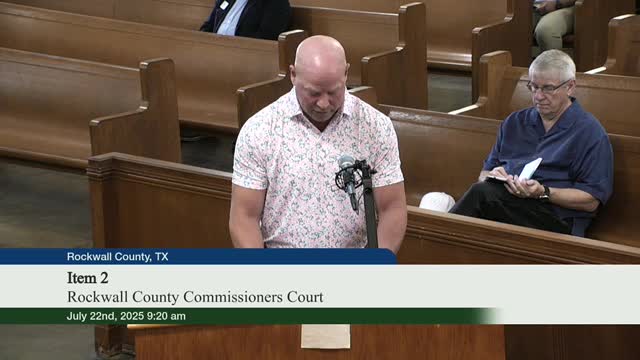
McClendon Chisholm Mayor Brian McNeil told the Rockwall County Commissioners Court on July 22 that city crews and contractors contained and began remediating a sewer main break that occurred on June 17, 2025, and released wastewater into a nearby creek and properties.
McClendon Chisholm Mayor Brian McNeil said the city mobilized partners within an hour and "we pumped approximately 40,000 gallons of sewage" as part of an initial response. He said the full spill volume was an estimated 60,000 gallons, with some absorbed into the ground, and that the city used a phased, targeted cleanup strategy rather than excavation.
The mayor said the city engaged contractor Inframark to halt the flow, EnviroServe as a cleanup partner, and a biological treatment firm (referred to in the presentation as MicroBac/BioRemedy) to treat contaminated soils and water. "By focusing on targeted treatments rather than excavation we not only manage cost effectively but also preserve the surrounding vegetation," McNeil said. He said MicroBac/BioRemedy "fight bacteria with bacteria" and that soil sampling began on day one and continued through the following weeks; he expected one more confirmatory sample.
Why it matters: Commissioners and the county judge praised the speed of response and interagency cooperation, and the city said it coordinated notifications to residents, the county's Nixle alerts and other public messaging to reassure the public that the water supply was not affected. County officials noted the importance of a documented response path and commended use of drones and sheriff's office assistance to assess impacted areas.
Details of the response and technical tradeoffs
McNeil said crews used a combination of mechanical pumping, temporary dams and spot treatments. In a second phase of the operation, the presentation said crews released approximately 8,000 gallons of a microbial product into a pooled area to "flush" the channel and then pumped and treated water downstream. McNeil said the excavation-and-replacement approach would have been far more expensive, estimating soil excavation costs in the $4 million to $6 million range, while the chosen biological treatment approach and spot remediation were in the roughly $1.4 million to $1.5 million range as presented to the court.
McClendon Chisholm Fire Chief Simmons, who spoke after McNeil, described the decision to use microbial remediation as an established option used in HAZMAT responses and said the city selected a vendor who could deploy quickly and treat absorbed contamination. The chief said the tactical decision balanced cost, homeowner impacts and environmental protection.
Regulatory oversight and follow-up
McNeil said the city engaged BioRemedy to conduct sampling to meet Texas Commission on Environmental Quality (TCEQ) requirements and that TCEQ had given "positive feedback" on the action plan. He said the city would likely collect at least one more soil sample to confirm cleanup goals had been met and that the remediation contractor would continue to adjust treatment zones based on lab results.
Public and county reaction
During the court discussion, a commissioner who visited the site praised McNeil and Chief Simmons for quick action, noting crews had already excavated and shut off flow before some elected officials arrived. McNeil thanked county responders and the sheriff's office for drone support and other on-scene assistance. The mayor also recognized that this approach preserved vegetation and limited disruption to private property.
What the city said it will do next
McNeil said the city will continue sampling and monitoring until contractors and TCEQ agree treatment goals are met. He also said the presentation aimed to show county officials an alternative, lower-cost remediation approach so other cities could adopt similar methods if they face a comparable incident.
Ending note
Officials urged residents with concerns about private property impacts to contact city staff; public-safety and environmental follow-up was ongoing at the time of the July 22 meeting.