Get Full Government Meeting Transcripts, Videos, & Alerts Forever!
Get email alerts on the Municipal Finance topic
No spam. Unsubscribe anytime.
Forney council workshop reviews 10-year facilities plan and financing options
Summary
City staff and consultants presented a long-range facilities strategy and debt scenarios, including bond and certificate of obligation (CO) options, and requested direction on priorities such as a public safety complex, library and parks improvements.
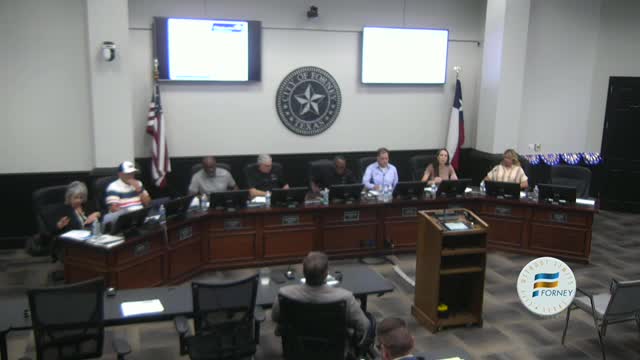
Forney City Council held a workshop May 20 focused on a long-term facilities plan and how to pay for it, hearing presentations from the city's municipal advisor and WRA Architects on debt capacity, legal constraints and possible project packages.
City staff and consultants said the city's debt profile declines sharply in coming years, creating capacity for new projects without substantially increasing the interest-and-sinking (I&S) portion of the tax rate. "The city's debt profile declines very rapidly," Nick Bulash, the city's municipal advisor from Hilltop Securities, told council members, adding that Forney currently carries AA/Aa2 ratings from Standard & Poor's and Moody's.
Bulash summarized legal and practical options for financing new buildings: general obligation (GO) bonds, certificates of obligation (COs) and tax notes. He noted key state constraints enacted in 2021 (House Bill 1869) that affect whether costs for certain projects can be placed in the I&S portion of the tax rate or must be counted on the maintenance-and-operations (M&O) side for rollback and truth-in-taxation purposes. "Renovating, improving, and equipping existing city facilities" is a category likely eligible for nonvoted debt under the law, he said, while new stand-alone facilities often require voter approval.
The consultants presented multiple issuance scenarios. Using conservative assumptions about growth and interest rates, Bulash showed that a single $60 million issuance would create an I&S peak roughly in line with the voter-information estimate the city provided in 2022; a $120 million single issuance would create a larger spike. "If you were to stagger issuance," he said, "it gives your tax base more time to grow," which reduces pressure on the tax rate.
WRA Architects framed a multi-decade facilities strategy and recommended a phased approach: begin with high-priority public safety work (design and construct a public safety/emergency response center), then pursue park improvements, a library and other municipal facilities in later phases. Brian Wyatt of WRA urged the council to identify the "large rocks" first and defer smaller, tactical items to later or separate meetings.
Councilmembers emphasized public safety and asked staff to return with more specific cost, site and timeline options for prioritized items. Several council members said they would prefer to fund core public safety projects via certificates of obligation if permitted, reserving voter-approved bonds for large community amenities. Staff agreed to produce more detailed exhibits showing square footage, estimated construction costs, and the debt-service impact (I&S tax-rate movement) for the prioritized projects.
The workshop did not include any formal votes or final decisions; staff and consultants were asked to return with refined financial models, site concepts and cost estimates at a subsequent meeting.
Bulash and WRA provided written attachments to the presentation including the 2022 bond-authorized project list ($52.7 million authorization) and a CO-eligibility "cheat sheet" used to determine what could be funded without an election.
Ending
Council directed staff to return with detailed, fiscally specific options for the projects that received the most support in the workshop'primarily a public safety complex and related renovations or reuses of vacated municipal buildings'and to include debt-service impacts presented to the penny so council can compare CO versus GO bond approaches.