Get Full Government Meeting Transcripts, Videos, & Alerts Forever!
Get email alerts on the Homelessness topic
No spam. Unsubscribe anytime.
Carbon County agencies report rising encampments and funding uncertainty for homelessness services
Summary
Service providers and county officials at a Carbon County meeting described growing trailhead encampments, strained shelter capacity and unclear federal funding after recent HUD NOFO changes, and discussed outreach, landlord incentives and a planned planning grant.
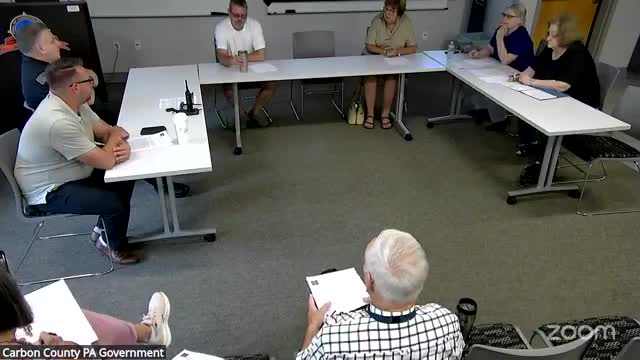
At a Friday meeting of Carbon County service providers and local officials, participants described persistent homeless encampments along rivers and trailheads, growing demand for shelter and case management, and uncertainty about federal funding that could affect local programs.
The discussion centered on safety and public-health concerns at local encampments, limits on outreach capacity, and near-term anxiety among nonprofit providers about whether state and federal funds will be available after recent changes to a U.S. Department of Housing and Urban Development (HUD) notice of funding opportunity (NOFO). Mary Penny, a staff member with the Eastern Pennsylvania Continuum of Care (COC), said HUD had “sent us a very cryptic announcement 2 weeks ago” withdrawing details of a previously expected two-year NOFO and that local providers are awaiting clarification about whether programs will be funded.
Chief Abelovsky, providing a policing perspective on encampments, said officers are responding to calls as they come and that staffing limits constrain sustained outreach. “We handle call volume as it comes in,” he said, adding that the county is coordinating with other agencies “to try to eliminate some of the structures and some of the things that are going on out there.” He and other speakers raised fire-safety and public-health concerns tied to makeshift structures along county land.
Shelter operators and case managers reported heavy demand. A Family Promise representative said the local shelter had six families and one single woman in residence and expects to be at full capacity by Monday, and that a waiting list exceeds 100 families. A separate intake report counted 134 calls for assistance since April 1, of which 22 callers were identified as street homeless; agencies enrolled 46 households since April 1 and currently provide case management to 48 households, the speaker said. The by-name list for street homelessness contains 23 people, and HMIS referrals from the 2-1-1 system accounted for 32 referrals during the same period.
Public- and nonprofit-sector speakers emphasized outreach and coordinated engagement. Jamie, a representative from drug-and-alcohol services, described weekly outreach efforts at a warming shelter and said the agency provides case management and help obtaining identification and basic needs for people willing to engage. Jamie and others noted a portion of the encampment population declines outreach offers and services.
Speakers repeatedly cited housing affordability and the limited supply of units as underlying drivers. Meeting participants cited national and state data discussed during the meeting: a cited fair market rent (FMR) for a two-bedroom apartment of $1,447 and an associated monthly income threshold of $4,824 (about $57,886 annually) to afford that rent while spending no more than 30 percent of income on housing; an hourly “housing wage” figure of $27.83 was also cited. A Harvard report was cited as reporting that a typical household now requires an annual income near $126,000 to afford a home in many areas. Local figures discussed included a reported local number of $71,507 for Carbon County (meeting speaker did not further specify the exact metric or whether that figure is an annual income requirement or another measure).
Participants discussed landlord engagement as a near-term strategy. Mary Penny said the Eastern PA COC is contracting with a consultant to develop landlord recruitment and marketing materials covering 33 counties; the materials will be shared with local groups and will build on a landlord-incentive program piloted in the Lehigh Valley and the Poconos. Penny described stackable incentives previously used in the Poconos RAB (regional advisory board) that can total up to $3,000 per unit across multiple incentives, but she noted the funds are restricted to people categorized as currently homeless and cannot be used for doubled-up households.
Multiple providers described budgetary uncertainty beginning July 1 and said that, while agencies continue to provide services, lack of confirmed funding is forcing difficult operational decisions. A service-provider representative said some programs have already exhausted available funds and that smaller nonprofits are especially at risk of not being able to pay staff if reimbursements or grants are delayed or reduced.
Participants agreed on several follow-up steps: leaving resource cards at the pavilion to increase awareness of services; coordinating outreach and a possible drop-in intake at the jury center; and pursuing a planning grant to align county partners, the housing authority and regional groups to identify affordable-housing needs. The group set its next meeting for Sept. 19 at 9:00 a.m. at the housing authority.
The meeting record shows active coordination among law enforcement, behavioral-health outreach, shelter operators and the Eastern PA COC, but speakers emphasized that persistent affordability problems, limited shelter capacity and unclear federal funding create significant near-term risks for both people experiencing homelessness and the nonprofits that serve them.