
Arlington County Board endorses refreshed transportation vision, adds ‘desirable choices’ language after public debate
Get AI-powered insights, summaries, and transcripts
Subscribe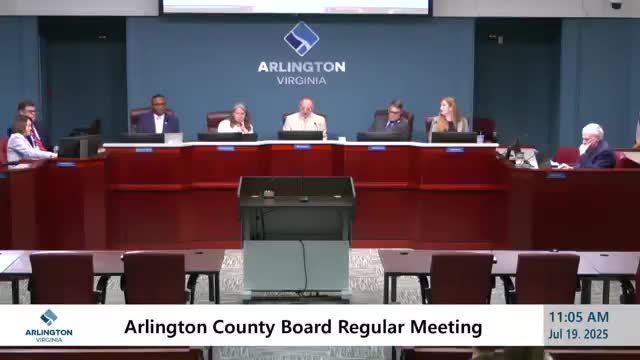
Summary
After months of public outreach, the County Board unanimously endorsed a refreshed transportation vision and goals aimed at making transit, walking and biking more viable — inserting the word “desirable” into the plan’s language after several speakers urged clearer commitment to reducing car dependence.
The Arlington County Board on July 19 unanimously endorsed a refreshed transportation vision and set of goals intended to guide the master transportation plan update, adopting a last-minute amendment to emphasize “desirable choices” beyond using a car.
Board members voted 5-0 to approve the resolution after staff presented a plan built from two phases of public engagement that included more than 12,000 direct contacts, about 2,500 online feedback forms and an interactive map with more than 2,700 submissions. The board added the word desirable to the phrase that now reads “with desirable choices beyond using a car.”
County transportation staff said the refresh replaces a decades-old modal structure with a holistic strategy, linking Vision Zero, transit strategic planning and mode networks so the county can prioritize where walking, biking, transit or cars should be emphasized. Kristen Calkins of the transportation team told the board the draft vision and goals were informed by thousands of comments and an advisory group made up of commissions and committees.
Supporters urged stronger language. Several speakers including transportation advocates and members of the advisory group said the plain phrase “without having to depend on a car” sent a clearer signal that the county intends to make driving optional for more trips. Advisory-group chair Mr. Slatt and others argued that keeping car dependence from being the default must be explicit to shape future projects and curb emissions and traffic. Board member Maureen Coffey proposed the amendment that inserted the word desirable into the vision, saying the change framed the plan as adding viable, attractive alternatives rather than merely removing driving as an option.
Opponents of more aggressive wording warned that the county must balance competing needs: some residents and workers rely on cars now and the county must maintain access for those users. Board members and staff stressed that the vision and goals are high-level guidance; detailed policies, curb management and modal networks will be developed in the fall 2025 phase of engagement with a draft plan expected in spring 2026 and a final plan returned to the board in late 2026.
The board’s action was procedural — endorsing the vision and goals rather than approving specific on-the-ground projects — but supporters said a clear aspirational statement is critical because it will steer design decisions and budget priorities for the next 15–20 years. The new goals include equity and inclusion, livability (where “access to nature” was added to the livable goal by motion), reliability, safety, sustainability and transparency.
Staff said the plan will not be a list of projects but will guide corridor studies, modal priorities and how curb space is allocated. The transportation team also committed to expanded outreach and to reflecting the board’s language while drafting the detailed policies this fall.
Board Chair Tax Carantonis and the county manager thanked staff and the many residents who testified and flagged issues such as sidewalk gaps, safety near Glebe Road, and the need for more reliable transit. The board’s vote to endorse the vision and goals was 5-0.
The endorsement sets the policy frame for subsequent plan phases and for staff review of site plans, corridor work and capital budgeting.