
Escondido utilities present 2024 drinking water public health goals report; system meets state and federal standards
Get AI-powered insights, summaries, and transcripts
Subscribe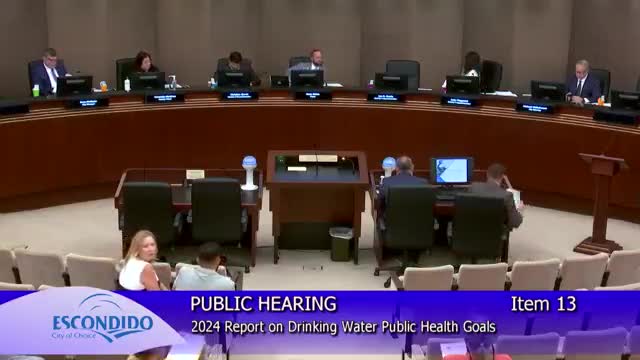
Summary
City staff told the council that Escondido's drinking water meets all enforceable state and federal standards though five substances measured above nonbinding public health goals; staff recommended no additional treatment due to cost and unclear health benefits.
Escondido Assistant Director of Utilities and Water Operations Reid Harlan told the City Council during a public hearing that the city's drinking water system meets all state and federal regulatory standards, though some substances were detected above nonbinding public health goals set by state or federal agencies.
Harlan said the utilities department analyzed water-quality data collected during 2022'2024 and monitors roughly 180 different substances and about 28,000 samples annually. "The city of Escondido's utilities department has met and continues to meet all state and federal regulations for drinking water quality," Harlan said.
City staff said five substances were detected at levels above public health goals or maximum contaminant level goals during the reporting period: total coliform (as an indicator), copper, chlorite (a disinfection byproduct), perchlorate, and gross alpha/beta particle activity. Council members were repeatedly told that public health goals (PHGs) are nonbinding benchmarks aimed at minimizing risk, and that the legally enforceable standards are the maximum contaminant levels (MCLs) set by the California Department of Public Health.
Harlan provided specific context for each measure: the maximum month of total coliform positives was 1.8 percent (September 2023), while average positives were far lower; 90 percent of household tap samples were under 0.55 milligrams per liter for copper (below the action level of 1.3 mg/L but above the PHG of 0.3 mg/L); chlorite ranged from 0.08 to 0.59 mg/L (the chlorite MCL is 1 mg/L); perchlorate readings ranged up to 1.1 micrograms per liter (the MCL is 6 µg/L); gross alpha ranged up to 4.8 picocuries per liter (standard 15 pCi/L) and gross beta ranged 7.1'22.1 pCi/L (standard 50 pCi/L).
On the practical effect of the findings, Harlan said costly additional treatment would be required to meaningfully lower some of the already-low values, the health benefits of such reductions are uncertain, and the city is therefore not proposing further treatment at this time. "The city of Escondido drinking water system meets all state and federal drinking water standards set to protect public health," he said.
Council members asked follow-up questions about sampling requirements and sources of supply. Harlan said the federal government sets minimum standards and the state may adopt stricter goals, that the city samples for all 180 substances reported, and that Escondido obtains water from a local source (Lake Henshaw, which can transfer to Lake Wolford for treatment) and from the County Water Authority aqueduct (a blend that can include State Water Project and Colorado River water).
Mayor Dane M. White and several council members thanked staff for the work and the city's outreach; no formal motion or vote on the report was recorded in the public hearing transcript.