Get Full Government Meeting Transcripts, Videos, & Alerts Forever!
Get email alerts on the Housing Development topic
No spam. Unsubscribe anytime.
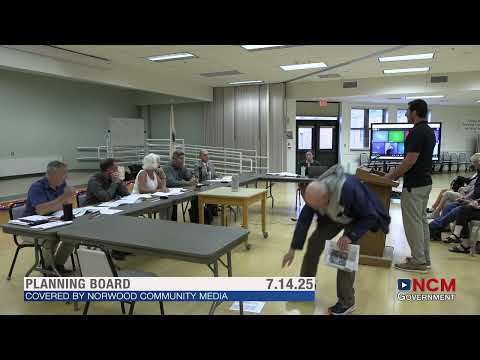
Norwood residents and Planning Board spar over parking waiver for proposed 55 Lennox apartments
Summary
Debbie Homewood, chair of the Norwood Planning Board, opened public comment during the board's continued hearing on a proposed 96-unit apartment building at 55 Lennox and acknowledged extensive public concern about parking, traffic and neighborhood impacts.
Debbie Homewood, chair of the Norwood Planning Board, opened public comment during the board's continued hearing on a proposed 96-unit apartment building at 55 Lennox and acknowledged extensive public concern about parking, traffic and neighborhood impacts.
The applicant, identified in the hearing as John (applicant/developer), told the board his revised plan will reserve parking for tenants and include some visitor parking. "The tenants now will have reserved parking," John said, adding that parking stickers and a towing policy would enforce assigned spots. He also told the board he could not commit to adding more deeply affordable units, saying, "the margin on these projects are razor thin" and that higher construction costs and interest rates limit flexibility.
Neighbors and board members repeatedly challenged the applicant on the size of the requested parking waiver and the likely real-world effects. Several residents and Planning Board members noted the applicant is asking to reduce parking from 96 required spaces to 67 — a waiver of 29 spaces — and asked how the developer will prevent spillover parking on nearby streets and municipal lots. "At 29, you're a third of the apartments," said one resident, later identified as Ernie (Planning Board member) during board discussion, expressing concern the units without parking could be hard to rent or would push cars into surrounding neighborhoods.
Board and public commenters referenced local examples to ask whether transit-oriented projects nearby are truly reducing car ownership. Planning Department staff cited a study that found typical multifamily developments in comparable suburban areas often have substantial unused parking: "the 70% utilization rate means ... at any given point, 30% of the parking lots were vacant," the staff member said. The staffer also noted Norwood-wide census data showing about 11% of renter-occupied households have no car.
Residents described everyday effects of limited visitor parking and deliveries near Lenox Street and the Mill Village area. Margaret Ray Steed, who lives at 1 Lennox Street, said her building of 51 units has only limited visitor parking and relies on neighbors sharing spaces: "We have a book, and we call our neighbors and say, can I use a space that you are not using?" she told the board. Another resident raised stormwater and soil-contamination concerns for the 55 Lennox site; the applicant said earlier tests had been done but did not produce evidence of contamination in the geotechnical work presented.
Board members and the public also explored operational questions: whether tenants could sublease, how delivery vehicles and trash pick-up would be handled, whether a building superintendent would be on-site, and how the developer would market units with and without parking. The applicant said parking would be advertised as an amenity for specific units; parking spots would likely carry a monthly charge and could be used to segment the market.
The Planning Board took no final vote on the project at this meeting. After extended public comment that included multiple residents and board questions, the board closed the public hearing and voted to continue the matter to a future meeting to allow time for additional information and to give the board more time to deliberate. The board set the continuation for July 28 at 7 p.m., to be held at the senior center and on Google Meet.
Why it matters: The application tests how Norwood implements MBTA-communities–style zoning changes in practice — balancing a town meeting–adopted parking standard and incentives for transit-oriented housing against neighborhood concerns about traffic, stormwater and neighborhood livability. The developer said the project as proposed meets the town's bylaw criteria for a transit-oriented waiver but acknowledged commercial realities limit additional affordability concessions.
The Planning Board asked for follow-up information and a fuller accounting of parking utilization at comparable nearby developments before its next session; board members said they want more data showing how many existing nearby apartments are rented to households without vehicles and to see any finalized soil and stormwater testing reports.
The hearing remains open to written comment submitted to the Planning Department until the board resumes the matter on July 28.