Get Full Government Meeting Transcripts, Videos, & Alerts Forever!
Get email alerts on the Small Business Support topic
No spam. Unsubscribe anytime.
Staff briefing recommends multilingual outreach, navigator program and industry guides to support immigrant entrepreneurs
Summary
City staff and volunteer commissioners recommended restoring a multilingual community navigator program, expanding data collection and developing sector-specific guides and one-stop supports to reduce barriers facing immigrant entrepreneurs with limited English proficiency.
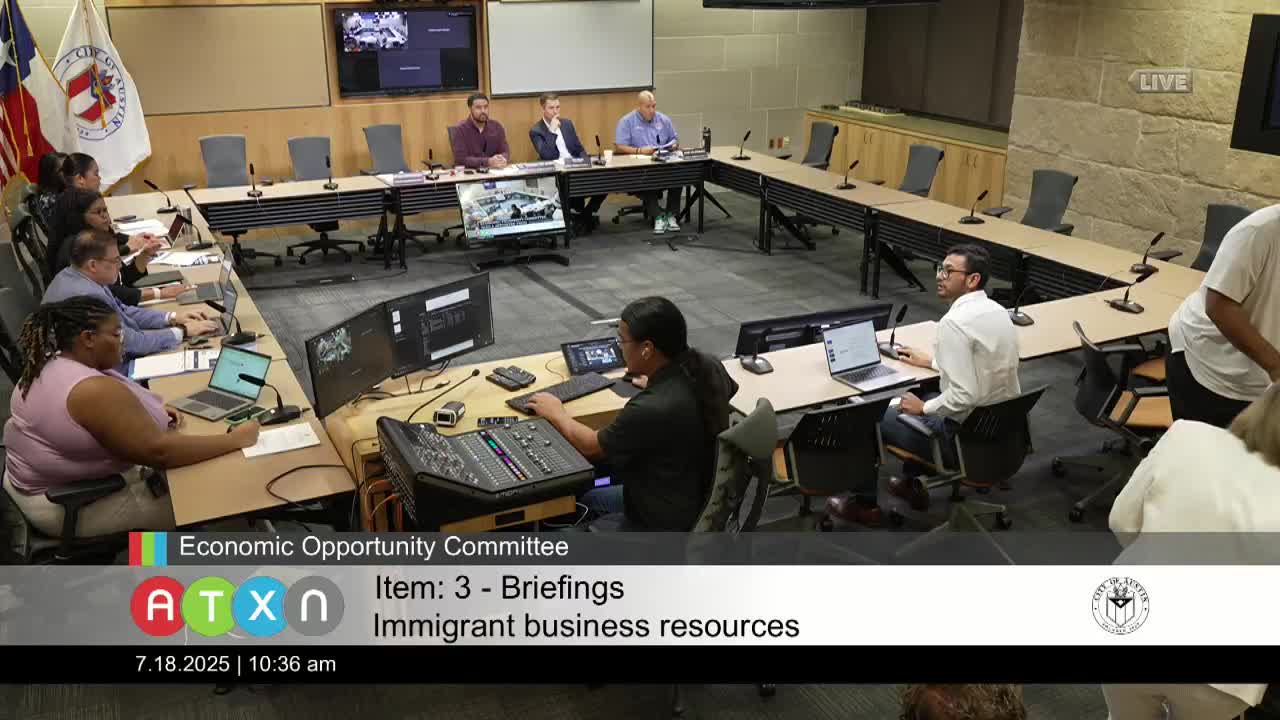
City staff and Economic Prosperity Commission volunteers briefed the Economic Opportunity Committee on July 18 about barriers facing immigrant entrepreneurs with limited English proficiency and offered recommendations that include restoring a community navigator program, expanding multilingual resources and improving data collection.
Aaron Gonzales, speaking on behalf of the Economic Prosperity Commission and identified as an appointee from District 9, presented data and peer-city practices. He said limited English proficiency (LEP) describes people who do not speak English as a primary language and who have difficulty reading, speaking, writing, or understanding English. Gonzales told the committee that "24% of all new businesses in Austin are founded by foreign-born entrepreneurs" and that immigrant entrepreneurs are more likely than native-born residents to start businesses.
The presentation compiled several numeric points: staff said foreign-born residents comprise "19% of Austin’s population," that about "15% of all business owners in Austin are not from the U.S.," and that there are "over 31,000 immigrant entrepreneurs in the metro area." The presentation also cited national and state research: for example, staff referenced a Stanford report that Latino immigrants make up "over 52% of all Latino-owned firms" nationally. The presenter acknowledged local data limits and said staff triangulated state and national sources to estimate local figures.
Staff described existing city work: the city manager directed development of universal translation and interpretation services in 2013, and the council adopted a language-access policy in 2022 that covers data collection, signage, translation, interpretation, training and contractors. Presenters said those policies are not specific to small-business needs and that programs aimed at immigrant business owners—such as a community navigator program and industry-specific guides—would address gaps in licensing, inspections, zoning and regulatory guidance.
Recommendations included: (1) restore a community navigator program to deliver multilingual assistance in partnership with trusted community organizations; (2) increase data collection and conduct an audit of city and partner resources to identify unmet translation/technical-assistance needs; (3) develop multilingual, industry-specific startup guides and one-stop neighborhood supports modeled on peer cities (Chicago, Philadelphia and others); and (4) partner with the Mayor’s Infrastructure Academy, local chambers and workforce partners to align technical assistance and sector training.
Committee members asked for more granular language-demand data and expressed interest in coordinating outreach through local chambers. Staff named local collaborators consulted for the briefing, including Monica Muñoz Andrée, CEO of the Greater Austin Hispanic Chamber, Dorian Mirantis (vice chair of the Immigrant Affairs Commission), and Catherine Sobel from the Economic Development Department’s Small Business Division.
Ending: No formal actions were taken; staff requested follow-up work to return with recommended program designs and data collection steps for committee review.