Get Full Government Meeting Transcripts, Videos, & Alerts Forever!
Get email alerts on the Homelessness Services topic
No spam. Unsubscribe anytime.
Carbon County agencies report strained homelessness services, HUD funding uncertainty
Summary
Local service providers and county officials reported rising calls, limited shelter capacity and uncertainty about federal funding at a multi-agency meeting. Agencies described landlord incentives planning and outreach efforts but warned budgets could shrink after HUD signaled changes to a two‑year NOFO.
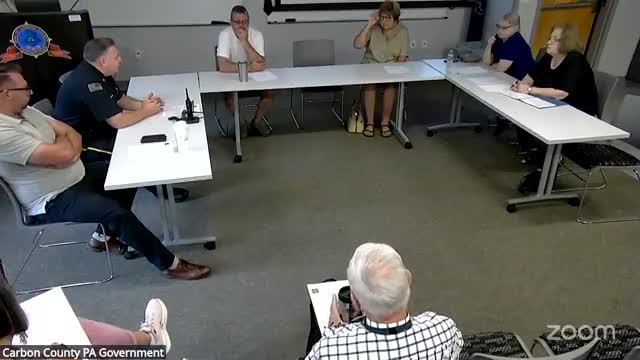
Carbon County housing and service providers and county officials described stretched resources, rising demand and federal funding uncertainty during a multi‑agency meeting on homelessness services.
County law enforcement and service providers said they continue to respond to encampments and calls as they come in, while shelters and outreach programs reported high call volumes and long wait lists. A regional Continuum of Care representative said the U.S. Department of Housing and Urban Development (HUD) has sent a “very cryptic” notice that could change a two‑year funding cycle promised to providers.
The discussion matters because local agencies said their ability to place people in housing, run warming shelters and provide case management could be reduced if federal or state funds are cut. Providers described ongoing outreach, planned landlord recruitment efforts and limited program capacity.
“We handle call volume as it comes in,” Chief Abelovsky said, describing patrol and outreach constraints and noting staffing limits. “We try to do the best we can with the manpower that we have at the times that things come in.”
Mary Penny, a representative of the Eastern Pennsylvania Continuum of Care (CoC), said HUD earlier signaled it would fund a two‑year Notice of Funding Opportunity (NOFO) but that the agency has since “pulled that back” and the CoC was waiting for a clearer NOFO. “They sent us a very cryptic announcement two weeks ago,” Penny said. “We're waiting to hear from HUD what the NOFO entails.”
Shelter and case‑management staff described demand and limited capacity. “Since April 1, we've had 134 people call in looking for different types of assistance,” said Shannon, a shelter staffer. Of those calls, Shannon said 22 were for people who were street homeless; the shelter and related programs have enrolled 46 households since April and currently provide case management to approximately 48 households. Agencies also reported receiving referrals through the 2‑1‑1 system and that gaps in data quality sometimes require follow‑up calls to understand client needs.
Panelists reviewed local cost and affordability data drawn from statewide and national reports. Penny cited statewide figures showing the fair‑market rent for a two‑bedroom apartment at $1,447 and said a household would need roughly $4,824 per month (about $57,886 per year) to avoid spending more than 30% of income on housing. A speaker also referenced Harvard University’s State of the Nation’s Housing report and the Economic Policy Institute’s family budget tools as context for outreach and public messaging.
Participants discussed a planned landlord engagement and incentive program to increase housing options for people experiencing homelessness. Penny said the CoC is contracting a consultant to develop materials and marketing to recruit landlords across the CoC’s 33 counties and pointed to a model from the Poconos that used stackable incentives. “In the Poconos RAB… they did a thousand dollars for each incentive so you can pay the landlord up to $3,000,” Penny said, adding a caveat: the incentives in that program require the tenant be categorized as currently homeless.
Behavioral‑health outreach staff said outreach and relationship building take time but can yield placements for people who show some willingness to accept services. “We spent a lot of time over the winter in trying to engage that population,” said Jamie from drug and alcohol services. Jamie described case management work—helping clients get IDs and other essentials—that does not always require clinical treatment but is time‑ and resource‑intensive.
Several providers warned of looming budget uncertainty. A nonprofit housing provider said many agencies “are out of money” or unsure whether programs will be funded beyond the next fiscal cycle, and that agencies are continuing services now while awaiting funding decisions from state and federal sources.
Speakers also flagged operational and safety concerns tied to encampments along rivers and trailheads, including health and fire risks from unauthorized structures and burning. Chief Abelovsky referenced previous large wildfires as a reason for urgency in addressing structures and debris on county land.
Participants suggested coordinated next steps: pursue landlord recruitment with shared materials from the CoC, expand outreach partnerships that link shelter staff, behavioral‑health outreach and county law enforcement, and refine data sharing from the CoC’s by‑name list and 2‑1‑1 to improve placement and prevention efforts. A participant said the group planned further planning work and noted a future meeting to continue coordination.
A motion to approve the meeting minutes from the prior session was made and adopted early in the session.
A participant said the group plans to meet again on July 31 at 3:00 p.m. at the housing authority to continue planning; organizers also discussed a September 19 meeting date for fall scheduling.
The meeting combined county law enforcement, CoC staff and multiple nonprofit providers to review outreach, shelter capacity, landlord engagement and the possible effects of federal funding changes on local emergency housing services.