Get Full Government Meeting Transcripts, Videos, & Alerts Forever!
Get email alerts on the School Budget topic
No spam. Unsubscribe anytime.
Lacey Township board adopts 2025–26 budget; public speakers warn near‑10% levy will hit seniors and staff
Summary
The Lacey Township Board of Education voted 5–2 to adopt an amended 2025–26 budget the administration said carries a roughly 9.58% tax‑levy implication, prompting public comment about cuts that include 17 teaching positions, two administrators and several support roles.
The Lacey Township Board of Education voted 5–2 on Tuesday to adopt an amended 2025–26 school budget the administration presented, which the superintendent said carries a roughly 9.58% tax‑levy implication.
Superintendent Kim Brzezinski presented the amended final budget and the slide packet the administration provided to the board and public. Brzezinski said the package reflects an increased tax‑levy implication compared with earlier proposals and described staffing and operational reductions that will follow if the budget is approved. "Seventeen teachers will still be eliminated. Two administrators will be eliminated," she said, and added the district has "not budgeted for any salary increases that aren't contractually obligated." She also told the board the district is pursuing a land sale estimated at about $400,000 for property it said it will not use.
Why it matters: The adopted budget raises the district's tax burden significantly compared with recent years, while cutting personnel and some services. Speakers at a lengthy public‑comment period said the combination of cuts and the tax increase will strain seniors, single parents and families with special‑needs students, and they urged the board and community to press state lawmakers for more aid.
Details of the adopted plan and impacts Brzezinski walked listeners through the major revenue and expense lines. She said the district previously presented a budget based on a 3.15% statutory levy that showed a $63,000,000 property tax levy, and that state aid in the administration's materials was listed at about $7,700,000 with $803,000 in extraordinary aid. In describing the current amended package, Brzezinski said the overall year‑to‑year total budget would be up about 3.35% and that the administration characterized the tax‑levy implication on the slides as 9.58%.
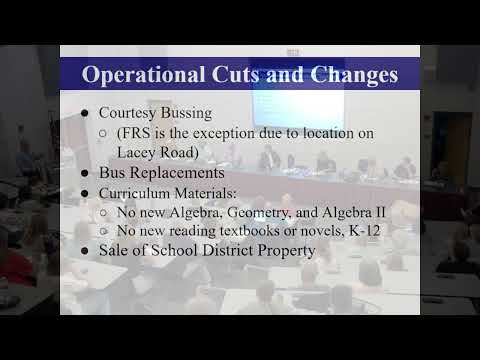
She and business administrator Sharon Ormsby outlined specific cuts the administration said were necessary to balance the budget: elimination of 17 certified staff positions; elimination of two administrators; reductions in support staff including two custodial positions, two full‑time paraprofessionals and four grounds workers; no bus replacements this year; no new curriculum materials; and no discretionary salary increases beyond contractual obligations. Brzezinski also noted the district is in a survey process for a parcel of land described as not needed for district use and said the administration had been allowed by county officials to proceed with that sale "to take our chances" on the revenue.
Public reaction and board discussion During public comment, dozens of residents, staff and elected officials spoke for and against the proposed levy. Denise (no last name given) said, "the seniors are gonna be hit very hard," and urged sensitivity to fixed‑income households. Kelly Brenner, who said she has children who will enroll in the district, argued the district should prioritize elementary supervision and safety, warning that shared elementary supervisors could impede standardized testing and bus arrival/dismissal supervision. Several parents and teachers described the roles of full‑time paraprofessionals and custodial staff as essential to special‑needs services and day‑to‑day operations.
Opponents of the tax increase criticized prior board decisions and the district's long‑term planning. Richard Bidnick of Lacey Citizens for Responsible Government called the increase "unconscionable," saying it would remove more than "$10,000,000 in extra tax money beyond the 2% cap" from township households (commenter’s figure). Multiple speakers urged residents to contact state lawmakers over the state funding formula and referenced S‑2 and the 2% tax‑levy cap as central to the district’s fiscal pressures.
Supporters of the budget urged the board to adopt the plan to provide stability for the coming school year. Superintendent Brzezinski and several board members said delaying approval would increase uncertainty for staffing, programming and preparation for the next school year; Brzezinski warned of possible deeper cuts or state intervention if a budget was not in place. Deputy Mayor Stephen Kennes clarified that losses tied to the power‑plant closure so far have been small and that reductions in assessed values have been limited to buildings removed from the tax rolls.
Board vote When the board voted on the adoption of the 2025–26 budget (agenda item 9), the roll call was recorded as: Mr. Armato — No; Mr. Peters — Yes; Mr. Bell — Yes; Mrs. Armato — No; Mrs. Walker — Yes; Mr. Conaty — Yes; Mrs. Claus (board president) — Yes. The motion carried 5–2. The administration had described the adopted plan as the amended final budget presented at the meeting and characterized its tax‑levy implication as approximately 9.58% (the number appears elsewhere in board materials as 9.9%).
What was not decided or clarified at the meeting Board members and speakers raised longer‑term concerns about the state funding formula (often referenced as S‑2) and whether the district has a multi‑year plan to avoid recurring large levy increases. Several speakers alleged previous boards had not used the 2% cap consistently over many years; others urged the district to pursue changes at the state level. The board did not, during the meeting, adopt additional mitigation steps beyond the cuts described by the administration nor did it provide a multi‑year funding plan for public review.
The board’s adoption means the district will move forward with staffing and operational plans in the adopted budget and proceed with preparations for the 2025–26 school year under the new levy. The board and administration also faced repeated public calls to prioritize meetings with state officials and to pursue additional state aid or structural changes to the funding formula.