Get Full Government Meeting Transcripts, Videos, & Alerts Forever!
Get email alerts on the City Budget topic
No spam. Unsubscribe anytime.
Cape Coral council sets maximum tentative millage, backs 11% fire assessment increase amid FY2026 funding gap
Summary
At a July 16 budget workshop the Cape Coral City Council gave direction to set a maximum tentative millage of 5.5188 mills, to advertise an increase in the fire service assessment to 81% cost recovery (an 11% boost), and to hold the public service tax at 7% while staff continues budget work and public outreach.
Cape Coral — At a July 16 budget workshop, the Cape Coral City Council directed staff to prepare the city’s tentative FY2026 tax and fee notices using a maximum millage rate of 5.5188 mills, to advertise a fire service assessment increase to 81% cost recovery (an 11% increase from 70%), and to leave the city’s public service tax at 7% for now. Councilmembers said the city manager’s proposal and outside modeling show the changes are needed to keep the fiscal 2026 budget balanced and to limit projected reserve draws in later years.
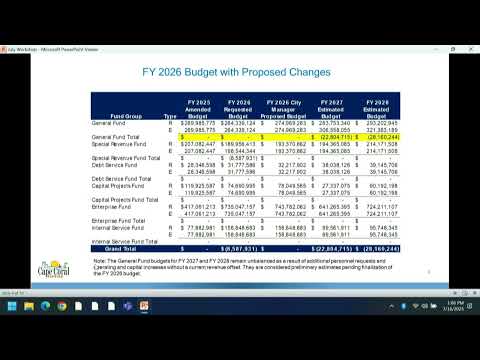
The instruction came after presentations from city finance staff and Stantec Consulting that updated council on July 1 property-value revisions, proposed program additions for FY2026 and multi‑year projections. “Based on these adjustments, we are pleased to report that in the fiscal year 2026 city manager's proposed budget, we are currently balanced,” Nicole Reitler, the city’s budget administrator, told the council. She and staff said updated July 1 taxable values produced an estimated $2.3 million in additional ad valorem revenue but program and personnel requests left the city with an $8.1 million funding gap for 2026 without revenue adjustments.
Why it matters: Council and consultants warned that although staff’s recommended combination of program reductions and revenue changes balances FY2026, the city’s five‑year forecast shows deficits returning in 2027–2029 under the current revenue structure. Peter Napoli of Stantec told the council the baseline forecast assumes revenues grow about 3.6% per year while operating expenses escalate about 6% per year, which would deplete reserves unless adjustments are made.
Key figures and proposed changes
- July 1 taxable values: staff reported a 7.4% overall increase from FY2024 values, producing roughly $2.3 million more ad valorem revenue than earlier estimates. - FY2026 proposed general fund revenues (after July 1 adjustments): approximately $266.6 million; proposed expenditures: approximately $274.4 million — a gap of roughly $8.1 million. - Program and personnel additions for FY2026 summarized by staff total about $10.4 million; included in that are new hires spread across departments and other recurring costs that produce the larger gap after offsetting the $2.3 million revenue gain. - Staffing highlights included adding 12 firefighters (to reduce overtime), roughly 9 sworn police officers plus civilian public service aides and other police support positions, 4 code compliance officers and a supervisor in development services, and several clerical/contract positions in other departments. The police presentation described public service aides as civilian positions tasked with handling non‑in‑progress incidents and minor reports.
Funding options discussed
Staff and the consultant modeled four broad options to close the FY2026 gap: a mix of changes across the city’s three revenue “legs” (property tax/millage, fire service assessment, public service tax); a larger increase in the fire assessment with no millage change; a millage‑focused option; and an option relying mostly on fire assessment. Sample impacts presented by Stantec included:
- Option 1 (mixed): 0.1‑mill increase, PST to 9%, FSA +2% (estimated ~$7.7M). Short of the $8.1M need. - Option 2 (PST + larger FSA): PST to 10%, FSA +5% (estimated ~$8.9M), leaving a modest surplus/available reallocation. - Option 3 (millage): 0.3‑mill increase (from 5.2188 to 5.5188) (estimated ~$9.2M), leaving roughly $1M available for reallocation. - Option 4 (FSA‑focused): FSA raised 11 percentage points (70% → 81%) (estimated ~$8.3M), leaving some reserves available.
Stantec’s household impact chart showed the distributional differences: property‑tax (millage) and FSA impacts scale with property value or structure value while PST (utility tax) is flatter because it is tied to utility bills. Stantec also emphasized that the long‑term outlook depends heavily on assumptions about taxable value growth (they used 3% new growth in out years in the baseline), payroll and benefit escalation, and capital spending.
Council debate and staff responses
Councilmembers pressed staff on details including the size and composition of the proposed new positions, whether overtime savings would materialize if new firefighters were added, why six development positions were moved from the building fund to the general fund, and whether parking enforcement should be outsourced or run by police. Police Chief Anthony Sizemore described public service aides as civilian employees who handle “non in progress, past occurred criminal matters,” and said some current PSAs were redirected to the Red Speed program.
Fire Chief Mike Russell told council the fire department supports the staffing additions and expects the new positions to raise service levels without reducing core emergency response capability. Stantec’s Napoli cautioned council that even with FY2026 balanced, the five‑year forecast shows reserves declining under current assumptions and emphasized the benefit of addressing structural gaps sooner rather than later.
Council direction and next steps
After extended discussion, a majority of councilmembers said they would set the tentative (maximum) FY2026 millage at 5.5188 mills, advertise a fire service assessment increase up to 81% cost recovery (an 11% increase from the current 70%), and keep the public service tax at 7% as the advertised maximum. City staff and the city attorney noted that the council is setting maximums for advertisement; the final adopted millage and assessment rates may be lower when council adopts a final budget following required public hearings.
Key dates staff announced: a tentative town hall was set for July 24 if needed; the first public hearing is scheduled for Sept. 11 and the final public hearing for Sept. 25. Staff said they will return with formal resolutions and notices required for the tentative millage and assessments and will continue to present modeling alternatives and the detailed budget document.
Ending
Council members who opposed larger immediate tax changes said they want more internal trimming and more time to analyze the five‑year outlook before final decisions. Supporters said modest advertised increases would stabilize the budget now and avoid larger, more disruptive changes later. City staff will prepare the written resolutions, the formal tentative‑rate notices and the detailed budget documents for upcoming hearings and public review.