Get Full Government Meeting Transcripts, Videos, & Alerts Forever!
Get email alerts on the Juvenile Justice topic
No spam. Unsubscribe anytime.
Albany County leaders outline youth programs and call for Raise-the-Age fixes after July 4 shootings
Summary
County officials, law enforcement and youth-service providers described expanded prevention and intervention programs but said legal and enforcement gaps in New York—s Raise-the-Age framework limit accountability for violent juvenile crimes tied to the July 4 incidents.
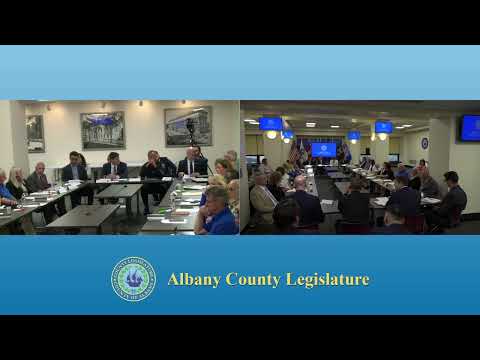
A joint meeting of the Albany County Legislature—s Law Committee and Public Safety Committee on July 8 brought county leaders, law enforcement and youth-service providers together to explain the county—s juvenile-justice programming after a series of violent incidents in Albany during the July 4 holiday and to press for targeted changes to state law.
Jeffrey (Chair, Law Committee, Albany County Legislature) opened the special session by describing the July 4 events and the county—s response: "Like many people in and out of government, I was saddened, angered, and frankly, embarrassed by what happened in our community on July." He said the meeting—s purpose was to "honestly identify the underlying problems," explain what government has done and is doing, and "use all the means at their disposal to formulate and implement solutions."
The Nut Graf: County officials said Albany County has added services and funding for youth prevention and intervention since New York—s Raise the Age law took effect, but prosecutors, sheriffs and some legislators said procedural aspects of the law and related criminal-justice reforms have reduced the ability to hold some juveniles criminally accountable. Officials emphasized outreach, evidence-based programs and proposed legislative tweaks to improve public safety.
County and program overview
Deputy County Executive Mike McLaughlin and Cameron Sagan, the county—s director of policy and intergovernmental affairs, described the county—s Raise the Age planning process, the state reimbursement model and a suite of prevention and intervention programs funded by a mix of state reimbursements, OCFS prevention funding, ARPA and county budget dollars. "Funding has not been cut," Sagan said, and the county—s Raise the Age plan has grown over time, he added; county officials said the current plan increased by about $5 million compared with a prior plan and that the next plan will grow by nearly $1 million.
The county and contractors operate numerous programs, officials said: diversion and intake services in probation, cognitive-behavioral group work, juvenile accountability boards, community-service placements, credible messenger programs (mentors with lived experience), a pre-permit driving class coordinated with the DMV, workforce-development and Project Growth (a work-stipend program for adjudicated youth). The county also said it awarded roughly $1.5 million in ARPA funding this year to local nonprofits for youth programming, workforce development and violence-prevention work.
Probation and child welfare
Bill Connors of the Probation Department described juvenile intake, diversion and supervision work. He outlined how probation assigns a risk score, diverts low-risk youth and supervises higher-risk cases remanded from family court. Connors said the department uses evidence-based programs including brief interactive therapy (BITS), Decision Points groups and a PATH program with credible messengers. He said the county—s PATH contract is increasing under the next Raise the Age plan and cited a current $400,000 Raise the Age contract that will rise to about $500,000.
Laura Manning of the Department for Children, Youth and Families (DCYF) described complementary prevention services funded through OCFS and other state programs, including functional family therapy, restorative case management, parent partner services and partnerships with SUNY Albany for program evaluation. DCYF staff said prevention funds and Raise the Age reimbursements are separate streams with some overlap and that the county plans to seek more community-based family resource centers.
Law enforcement and prosecutorial perspective
Albany County District Attorney Lee Kinlin said the district attorney—s office often has only a short window to act on adolescent-offender (AO) cases: "When an AO ... is charged initially, we only have a very, very short window to worry about the case ... typically within a week of charges being filed ... that AO passes out the criminal justice system and into the family court system." Kinlin said the transfer often removes criminal-court tools he needs for repeat offenders and victims.
Sheriff Craig Appel told legislators the sheriff—s Office is focused on "chasing young kids with deadly weapons around the streets of the county" and said the office needs more deputies on patrol and in courts. "I need more cops on the street," Appel said, and he questioned whether Raise the Age reimbursements can be used for sheriff staffing needs.
Kinlin identified several specific statutory and procedural issues he and other prosecutors want changed: ambiguous statutory language in Raise the Age that uses terms such as "significant physical injury" (he said that term is undefined and creates uncertainty), the requirement in some cases to prove a particular defendant caused that injury, and statutory distinctions that treat display of a gun differently than possession (Kinlin said a youth who possesses but does not display a weapon can be diverted to family court rather than remain in criminal court). He also said decisions that divert cases to family court are often unappealable, removing a remedy prosecutors would otherwise have.
Data cited at the meeting
County staff provided data dating from October 2018 through June 2024: 546 adolescent-offender (AO) cases in that period; of those, 269 were violent offenses and 142 involved a gun; 37 incidents involved a discharged firearm. For 2024 specifically, staff reported 64 AO arrests and 12 juvenile-offender (JO) arrests for a total of 76 arrests through midyear. County staff said the year-to-year trend is relatively flat, though officials and sheriffs said the level of violence has increased and that the incidents have had pronounced community impact.
Program gaps and implementation concerns
Panelists and legislators repeatedly said programs are necessary but not sufficient. Sheriff Appel and others argued that some youth and adults believe there are limited criminal consequences: "They are saying, you know, nothing's going to happen to me," Appel said of suspects. Multiple speakers said many of the youth involved in the July 4 incidents had no prior engagement with county programs.
Legislators and county staff discussed truancy as an upstream indicator and a prevention opportunity. DCYF and probation officials said the county is working with school districts on truancy prevention and early interventions, including family case management and a pre-diversion pilot. Officials said earlier intervention in elementary and middle school is critical because services are less effective once youth are chronically absent.
Next steps described
County leaders described practical next steps under local control and items that require state action. Locally, the county said it will continue to expand and reprocure programs (an evening reporting center RFP and a juvenile-justice services RFP were announced, with one RFP due Aug. 1), increase use of credible messengers, expand workforce and mentorship components in Project Growth and pursue targeted outreach like a gun buyback/tip line. The county also said it will coordinate more with municipalities, school districts and service providers to improve early intervention.
On state policy, District Attorney Kinlin and others urged legislative tweaks to Raise the Age, including clarifying injury thresholds, adjusting the possession/display gun distinction, allowing prosecutors a route to appeal diversion decisions, and enabling courts to consider rearrest histories when deciding appropriate forum and sanctions.
Ending: County officials said they would continue working with the state delegation, municipal partners and providers and promised ongoing engagement with the Legislature. "We're gonna want significant engagement," Deputy County Executive Mike McLaughlin said, describing follow-up with state and federal delegations. The committees said they would follow up with staff briefings and data requests to support legislative or budgetary action where appropriate.