Get Full Government Meeting Transcripts, Videos, & Alerts Forever!
Get email alerts on the Community Preservation Plan topic
No spam. Unsubscribe anytime.
Norwood CPC sets outreach schedule, assigns chapters for Community Preservation plan update
Summary
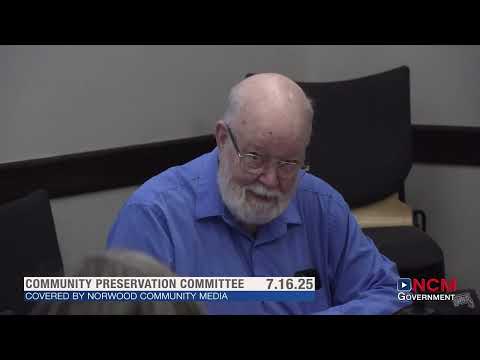
At its July 16 meeting, the Norwood Community Preservation Commission agreed on a public outreach plan, divided responsibility for drafting supporting chapters of the needs assessment, and set internal deadlines ahead of application season, while flagging concerns about language in the draft housing goals.
The Norwood Community Preservation Commission on July 16 agreed to a series of public outreach events and to divide work among commissioners to update its Community Preservation Act needs assessment and plan in advance of the fall application cycle.
The vote to adjourn followed a meeting in which commissioners set target dates for draft goals, scheduled four public meetings across town to solicit input (the Civic, the Library, the Senior Center and a television studio appearance), and assigned small teams to develop the chapters that will support each goals section: community housing, historic preservation, open space/passive recreation and active recreation.
Commission discussion focused on outreach logistics and the schedule for producing usable draft material before the fall application deadlines. Commissioners noted pre‑applications are due Oct. 16, with final applications due in mid‑November, and agreed to aim for substantially revised goals by September so staff can prepare a near‑final draft for wider review. Commission members also proposed continuing chapter work during and after the application season to avoid conflicting workloads.
“As we’re setting those agendas, we might want to target certain meetings to certain areas and potentially have representatives from those areas at those meetings,” Commission member Joe Grealy said, suggesting each public session emphasize one of the plan’s four categories and invite relevant town staff or civic leaders to attend.
Commission member Debbie described local outreach options she had secured, including a television studio slot: “The TV is free. We can do a whole hour,” she said, and noted free meeting space offers from the Civic and the Senior Center and an inexpensive paid insertion in the Marlborough Record that would reach roughly 5,500 households.
Several commissioners pressed for care in how the housing goals are worded. “When I look at community housing goals, I don’t see what I would expect to be the goals as defined by the housing authority or the planning department,” Commissioner Cheryl said, urging editors to avoid language that could be read as an advocacy position and to make the goals generic enough to avoid shutting down future policy options.
Commission members agreed on a mix of experts and community participants for the small working groups: John Anderson and Julie (last name not specified) on housing (with support requested from Sean Hartle or other housing representatives), Cheryl and Joe Sheehan for historic preservation, Joe Grealy for open space, and Amanda (last name not specified) and Debbie for recreation. The commission also discussed contacting Jim Kirker, the community member who previously completed an application, to learn from his experience and to better support non‑departmental applicants.
Members raised administrative capacity concerns: commissioners asked whether the commission’s administrative funds could be used to supplement staff time so Kristen (CPC staff) could coordinate outreach and chapter drafting during the busy application season. Commissioners agreed to consider reallocating some administrative funds to support coordination and project management but did not record a formal vote on the matter at the meeting.
Commissioners outlined outreach mechanics for the four public sessions: brief CPC/CPA introductions and slides, a short presentation from the relevant town representative (for example, Sam from the Recreation Department for the recreation meeting), a focused set of prompt questions to guide public input, and an opportunity for anonymous written suggestions. The group discussed scheduling events at different times (evenings, a Saturday morning or mixed times) to broaden participation.
The commission also committed to producing a concise “starter” packet summarizing the draft goals, example prompt questions and a list of prior projects to distribute in advance of the meetings. Commissioners agreed that the initial draft used as the basis for public conversation should be treated as a working document and circulated for comment rather than being held until a formal vote to release.
At the end of the meeting commissioners confirmed the next regular meeting date (Aug. 6) and closed the meeting by approving a motion to adjourn.
Clarifying details recorded during the meeting include: pre‑application deadline Oct. 16 and final application deadline mid‑November; a target to have goals substantially revised by September; four public outreach locations (Civic, Library, Senior Center, TV studio); and a proposal to use CPC administrative funds to supplement staff coordination time. No formal vote was taken on reallocating administrative funds during this session.