Get Full Government Meeting Transcripts, Videos, & Alerts Forever!
Get email alerts on the Zoning topic
No spam. Unsubscribe anytime.
Syracuse staff outline zoning ordinance revisions to tighten compliance, nonconformity rules
Summary
City planning staff presented proposed amendments to rename the code the Syracuse Zoning Ordinance, require legal compliance for development approvals, limit use of variances to cure nonconformities, and add enforcement procedures; formatting issues and a need for further edits were also flagged.
Syracuse City planning staff presented proposed amendments to the city's zoning code that would formalize the document's name as the "Syracuse Zoning Ordinance," require developers to comply with all applicable laws before seeking approvals, limit use of variances to address nonconforming situations, and add explicit enforcement procedures.
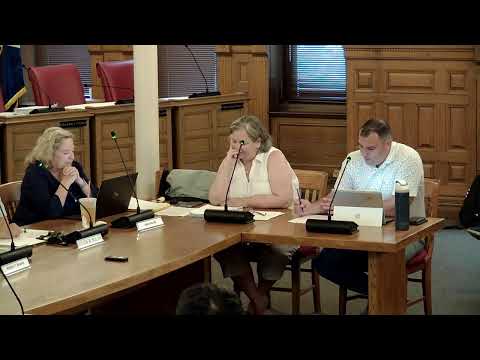
The proposals were discussed at a work session where staff summarized changes to Article 1 on general provisions and nonconformities and to Article 2 on zone districts and dimensional standards. "The code will be known as the Syracuse Zoning Ordinance," the staff presenter said, describing the change as a way to standardize legal language and notices.
The measure would bar applicants from seeking development approvals if they are not in compliance with relevant local, state or federal laws. Staff cited examples in discussion, saying applicants have sometimes sought special-use permits while lacking other required state or local approvals. The presenter said the change is intended to make clear that applicants must be lawfully authorized to operate before a zoning approval can be considered.
On nonconforming uses, staff proposed several clarifications: variances would not be permitted to cure or increase the level of an underlying nonconformity; the burden of proof for demonstrating nonconforming status would be clarified; and rules on when damaged or destroyed structures can be rebuilt as-is would be tightened. In an example discussed during the meeting, staff described a lot that is 38 feet wide where the current minimum is 40 feet; a prior owner had obtained a variance years ago to maintain a two-family use, but a new owner seeking to expand to eight units would not be allowed to use a variance to increase that nonconformity.
A participant identified as Nate summarized the legal rationale: "The case law holds that for the Board of Zoning Appeals to use their variance authority to change the limitations on a nonconforming use is tantamount to passing legislation, and they don't have authority to do that." Staff said the proposed language is intended to codify that interpretation and reduce requests that would effectively alter the code through variance rulings.
Staff also proposed a new enforcement section (Article 1.6) that would add procedures for issuing notices and processing violations specific to the zoning ordinance. The presenter said that many enforcement steps remain governed by state law and by the city's Property Maintenance Code, but that the revisions would make explicit the authority of the code enforcement director to issue zoning violation notices.
"Ryan Shield, the code enforcement director, has certain authorities to issue violation notices for violations of this code," the presenter said while noting much of the detailed procedure is set out elsewhere in state law and the Property Maintenance Code.
Discussion moved to Article 2, where staff described cleanup to how zone districts and dimensional exceptions are established. Staff warned that the document's numbering and formatting are currently inconsistent and noted a need to hire or assign someone to correct the formatting before adoption. One presenter said a consultant named Christian had reviewed the draft and found the automated numbering produced errors that must be fixed.
Staff said the group would continue discussion of specific edits during the session and in one-on-one follow-ups. The presenter clarified the planned voting approach: "No. We'll be voting on the entire document package. And all of it as it's contained. At the meeting. At the meeting." Several speakers asked questions and sought legal clarification on specific nonconformity examples and the limits of variance authority.
Next steps identified in the session included continued redlines based on the discussion, one-on-one follow-ups between staff and council or commission members, and correction of formatting errors before the ordinance is returned for formal adoption consideration.