Get Full Government Meeting Transcripts, Videos, & Alerts Forever!
Get email alerts on the Housing Policy topic
No spam. Unsubscribe anytime.
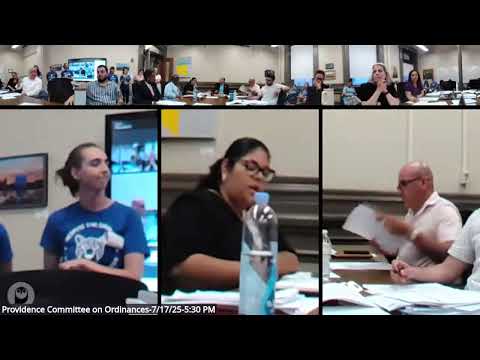
Councilors debate student-impact fee, licensing and nuisance-task-force changes; items continued for public hearings
Summary
Councilors discussed three related proposals: a $300 student-impact fee on properties exclusively rented to students, an annual $500 student-housing licensing fee, and codifying a monthly nuisance-task-force. Councilors asked for more analysis on enforcement, privacy and financial impacts; the items were continued for public hearings.
Providence City Councilors debated a package of proposals aimed at addressing the concentration of student housing, neighborhood nuisance issues, and municipal costs tied to high student residency in some neighborhoods.
Sponsor Councilor Peterson presented an ordinance that would charge a $300 annual student-impact fee on dwellings exclusively rented to students. The fee in the draft would be imposed on the property owner; landlords would be able to decide whether to pass the cost on to tenants. The proposal included a mechanism to adjust the fee for inflation and allowed for potential exemptions for students with demonstrated financial hardship. Councilors discussed payment timing (the sponsor described a $150 six‑month payment or roughly $25 a month as examples), enforcement and penalties for noncompliance (the draft included a $500 fine for violations), and whether the fee would be viable where management or ownership structures are opaque.
To support enforcement and program design, the ordinance requests anonymized, nonidentifying information from postsecondary institutions: total student enrollment, counts of students living on-campus and off-campus, and an anonymized breakdown of units occupied by students. Councilors raised concerns about federal privacy rules, including FERPA, and acknowledged universities have told the council they are limited in the identifying information they can provide. The sponsor said the request is nonidentifying and limited to aggregate counts.
Councilors also discussed a companion licensing proposal that would require properties exclusively serving students to register and pay a $500 annual licensing fee, and a separate measure to codify the city’s nuisance-task-force to meet monthly and act more promptly on repeated reports of problem properties.
Several council members supported the concept of requiring student housing to contribute to municipal services, citing pressure on police, fire, street maintenance, and other services. Others pressed for stronger enforcement language, questioned whether fees would be passed on to students, and asked for clarity about how quickly refunds or proration would be handled if tenants move during a billing period.
The council did not vote on these ordinances. Members moved to continue the items to allow further drafting, to add reporting requirements, and to hold public hearings so landlords, students, universities and neighbors can comment.