Get Full Government Meeting Transcripts, Videos, & Alerts Forever!
Get email alerts on the Housing Moderate Income topic
No spam. Unsubscribe anytime.
Planning staff outlines annual moderate‑income housing report, new state "super strategies" including deed‑restricted First Home tool
Summary
Planning staff reviewed the annual moderate‑income housing reporting requirement and recent state changes during the Orem City Planning Commission work session on July 16.
Planning staff reviewed the annual moderate‑income housing reporting requirement and recent state changes during the Orem City Planning Commission work session on July 16.
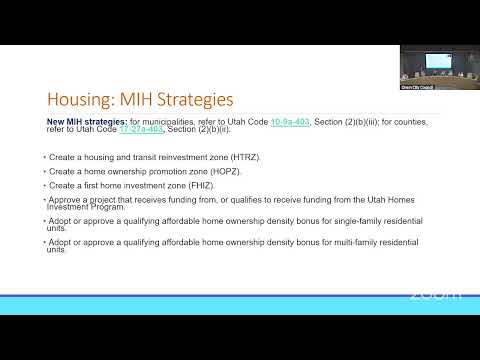
Staff said the city must file its annual report by Aug. 1 and that the state has added new options — described at the meeting as “super strategies” — that may reduce the number of strategies a municipality must adopt if it implements particular tools. Examples discussed at length included Housing Transit Reinvestment Zones (HTRZ) around FrontRunner stations, a Homeownership Promotion Zone and a First Home Investment Zone. The First Home Investment Zone, staff said, carries a deed‑restriction requirement in which 25% of homes in the overlay must remain owner‑occupied for at least 25 years.
Staff told commissioners that Orem already reports five adopted strategies including accessory dwelling units (ADUs), an affordable senior housing overlay, reduced impact fees for qualifying senior projects, and the HTRZ around the city’s FrontRunner station. Staff noted the city amended impact‑fee rules in recent years to reduce fees for affordable senior housing projects and will report that amendment as part of this year’s filing.
Division of Workforce Services (DWS) staff guidance and technical assistance were cited as the review path for Orem’s report. Staff said DWS has told cities they may swap adopted strategies year to year (for example, if a strategy is not being advanced) and that adopting some of the new state tools may make a municipality eligible for priority consideration by the Governor’s Office of Economic Opportunity (GOEO) when statewide funding competitions are evaluated.
Commissioners asked for more detail about how priority status translates into dollars or higher rates of approval for funding and where program dollars must be spent. Staff said some consequences are clear: failing to file the annual report carries a daily monetary penalty until the report is submitted, and longer‑term noncompliance in past years has affected eligibility for transportation funds. Staff said penalties vary by the specific deficiency and that precise dollar impacts would require further research.
No formal action was taken at the work session. Staff said they will continue technical review with DWS, gather specifics about GOEO priority funding and the rules for the new First Home and Homeownership Promotion overlays, and return with additional analysis for the commission as the general plan’s housing chapter is developed.