Get email alerts on the Local Governance topic
No spam. Unsubscribe anytime.
Hooper council rejects motion to transfer mayoral powers after contentious exchange
Summary
A motion to temporarily shift some mayoral powers to the city council failed after debate and a required unanimous roll-call vote did not pass. Council members and members of the public traded accusations about ordinance violations and governance before the vote.
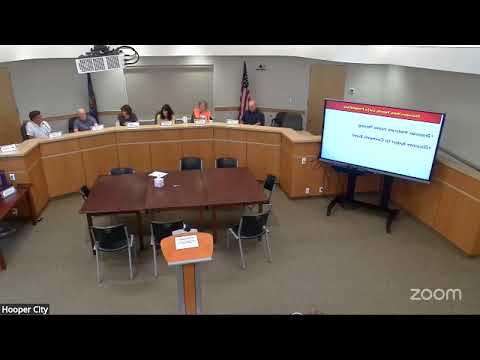
A motion to transfer certain mayoral powers to the Hooper City Council failed after council members declined to give a unanimous vote required to enact the change.
Proponents said the move was intended as a temporary reallocation of responsibility to restore accountability. Opponents said the proposal was unnecessary after a recent closed meeting and warned against escalating internal conflict.
The measure was introduced as a response to a long-running dispute over how the mayor has exercised authority. During public comment and council discussion, speakers accused the mayor of repeated violations of city and state law, citing a list of alleged violations circulated among citizens and officials. Supporters described the action as a short-term “reset” to restore checks and balances; opponents said the council should instead pursue cooperation after the recent closed-session meeting.
Council member Ryan D. Wilcox moved to shift the mayoral powers to the council with direction that the city attorney, Reed, return later with ordinance language. The motion required a unanimous roll-call because it would temporarily reassign duties away from the mayor. The roll call did not produce unanimous support and the motion did not carry.
Council members referenced a three-hour closed meeting held earlier this month and gave conflicting accounts of whether that meeting had resolved outstanding issues. One council speaker urged the council to “work together” and to move on; another said that inappropriate behavior persisted and argued the reset remained necessary. The mayor said she was willing to work with the council and disputed many of the accusations, saying the city’s insurance and legal processes had not produced findings of the widespread violations alleged by critics.
The council did not take additional formal action on governance at the meeting. Members and staff acknowledged there were ongoing tensions and said some follow-up work and clarifying ordinances would be discussed at future meetings.
The debate underscored divisions on the council and among residents over how to address alleged procedural and ethics concerns and how to balance transparency, legal process and operational continuity.
Minutes of the meeting and the city attorney’s advice were referenced repeatedly during the discussion; the council deferred any ordinance drafting or formal reallocation until legal counsel could prepare clear language for future consideration.
A roll call was held at the end of debate; because the motion required unanimity and that threshold was not met, the motion failed and no powers were transferred.
AI generated
The text on this page is AI generated. Summaries, highlights, analysis, and video transcripts are all produced from the original source material.
AI can make mistakes, so if you spot one, and we will fix it for everyone.
Note: the source content is unaltered by us. Any content source we link to, be it a video, an audio recording, or a document, is presented exactly as its publisher released it. That publisher is usually a government body, sometimes an individual official or another organisation.