Get Full Government Meeting Transcripts, Videos, & Alerts Forever!
Get email alerts on the Coastal Master Plan topic
No spam. Unsubscribe anytime.
CPRA opens first public solicitation for 2029 Coastal Master Plan; submissions accepted through Oct. 17
Summary
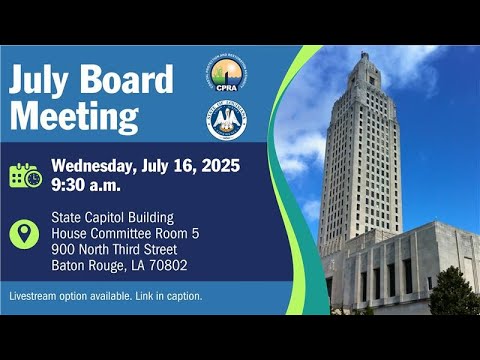
The Coastal Protection and Restoration Authority began the public project-solicitation period for the 2029 Coastal Master Plan at its July 16, 2025 board meeting, urging residents, local governments and practitioners to submit project ideas via a new online form and to participate in outreach events and technical workshops.
Coastal Protection and Restoration Authority Board members on July 16, 2025 opened the first public solicitation for the 2029 Coastal Master Plan and urged the public and practitioners to submit project ideas through an online form that will remain open through Oct. 17, 2025.
The solicitation is the first formal public intake for new candidate projects that CPRA staff will screen and evaluate for inclusion in the 50‑year planning horizon used by the master plan. "As of today CPRA is accepting new project ideas to be screened and evaluated for the '29 plan," said Katie Friar, who the meeting identified as heading CPRA's strategic planning section. Friar said projects that pass a desktop screening will be modeled and considered as candidate projects.
Why it matters: the master plan is the state—s primary 50‑year strategy for reducing land loss and storm‑surge flood risk in coastal Louisiana. CPRA officials described the update as a multi‑year, iterative process: model and data updates through the end of 2025; initial future‑without‑action model runs and a second solicitation in early 2026; iterative decision making in 2027; plan formulation in 2028; and presentation for legislative approval in 2029.
CPRA staff described multiple pathways for engagement, including regional work groups, advisory committees and public workshops. Friar urged submissions during the first solicitation because projects screened out in this round will receive feedback and have an opportunity to be revised and resubmitted during the second solicitation in early 2026. "If you want the chance to get feedback and resubmit, we strongly advise you to get in a project idea submission during this first period," she said.
What CPRA will consider: staff said candidate projects will be evaluated against the master plan—s two goals — land‑building/restoration and storm surge risk reduction — over a 50‑year horizon. Project types include restoration activities that increase elevation or promote vegetation, structural and nonstructural risk‑reduction actions (for example, floodproofing or levees), and programmatic activities CPRA already considers consistent with the plan (for example, oyster reef restoration, which CPRA staff said does not require additional master plan consistency review before project‑specific permitting or funding applications).
CPRA also announced expanded public resources for submitting projects: a new online submission form, project development booklets, an updated master plan data viewer (from the 2023 plan) and virtual office hours for applicants. Staff said the agency will post recordings of a public webinar and run in‑person workshops beginning the week after the meeting.
CPRA staff stressed the plan—s role as a planning and prioritization tool, not an automatic funding source. "It does not mean the agency has $50,000,000,000," Brian (presenting at the meeting) said, noting the master plan produces a statewide portfolio and that the annual plan remains CPRA—s funding document.
Board members asked about sequencing and prioritization. Katie Friar said sequencing is being reevaluated for the 2029 cycle and that staff intends to provide more information on timing and the relative value of earlier versus later construction for particular projects. "We want to be able to provide better information to help inform those types of decisions," she said.
Next steps: the solicitation remains open through Oct. 17, 2025; CPRA staff will continue model and data updates through the end of 2025; modeling and the second public solicitation are scheduled for early 2026. CPRA posted guidance, screening criteria and the master plan data viewer on its 2029 master plan webpage, and announced support materials and workshops to help nontechnical submitters.
Ending: CPRA staff encouraged a broad range of participants, saying they want to make the process accessible beyond coastal scientists and engineers. "We really mean it when we say we don't just want the coastal engineers, the coastal scientists, to participate...but we really want ideas from the general public as well," Friar said.