Get Full Government Meeting Transcripts, Videos, & Alerts Forever!
Get email alerts on the Certificate Of Appropriateness topic
No spam. Unsubscribe anytime.
Commission approves certificate of appropriateness for reuse of 906 Broadway church as event space
Summary
The Historic Preservation Commission approved a certificate of appropriateness allowing exterior and interior alterations at the former Our Lady of Guadalupe Church at 906 Broadway to enable reuse as a nighttime event venue, with conditions on interpretive signage and repair details.
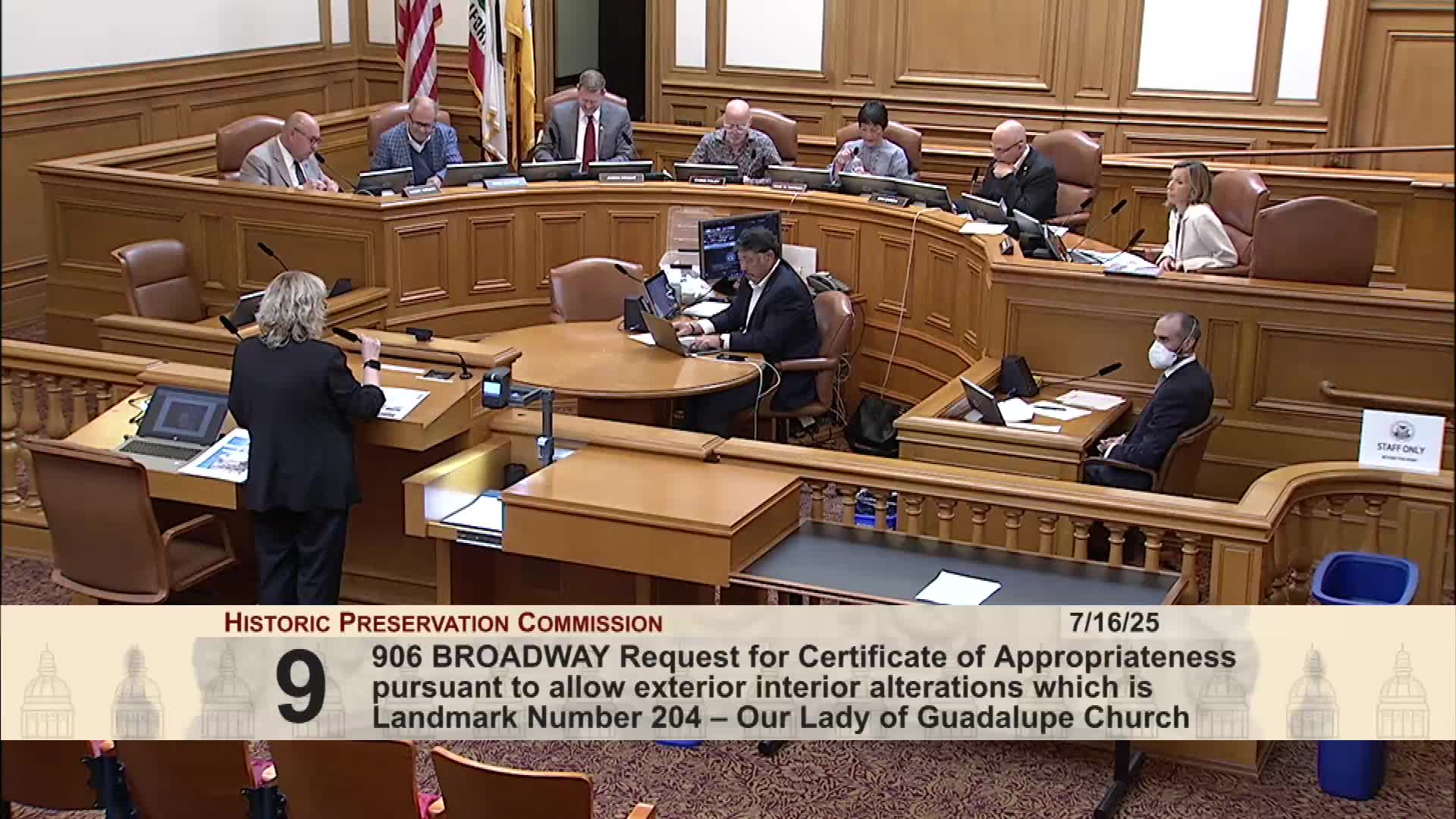
The San Francisco Historic Preservation Commission on Wednesday voted unanimously to approve a certificate of appropriateness allowing the vacant Our Lady of Guadalupe Church at 906 Broadway to be adapted for use as a nighttime event venue, subject to conditions.
Why it matters: the 1912 church is a San Francisco City landmark (No. 204). The proposed work includes a new enclosed, code-compliant exterior stair at a non-visible portion of the west façade to provide a second means of egress, a pass-through opening from the nave to the stair, and new basement-level doors and concrete steps. The project sponsor and architect said the design seeks the "lightest touch possible" to bring the landmark back into active use while meeting building and fire code requirements.
Staff recommended approval with conditions, noting that mosaic repairs at the front façade are being handled via a separate administrative certificate of appropriateness and a building permit to address enforcement issues is scheduled to begin in September. Michelle Langley, Planning Department staff, described the proposal and recommended approval with conditions to ensure compatibility with Article 10 and the Secretary of the Interior's Standards for Rehabilitation.
Project sponsor Noah Massimoire and architect Mary Davis of OpenScope said the stair and opening would be located where character-defining interior details are minimal. Commissioner Wright asked that the applicant include specifications for patching and repair of adjacent materials impacted by the opening; the commission added a condition requiring the project sponsor to work with staff on repair details.
Commissioners also added a condition asking the sponsor to install an interior interpretive panel that explains the building's history. Commissioner Foley praised the owners for taking on a complex rehabilitation and said, "I really applaud the project sponsor for taking this on and, and bringing it into compliance and dealing with all those ADA and actually bringing it back to life." The motion to approve, as amended with the conditions on interpretive signage and repair specifications, passed unanimously 6-0.
Next steps: the project also requires conditional use and variance approvals from the Planning Commission and Zoning Administrator (for nighttime entertainment use and extended hours). Those hearings were scheduled separately; staff will coordinate required details on repair specifications and the interpretive panel prior to issuance of final permits.
Ending: Commissioners expressed support for reactivating the landmark and emphasized minimizing impacts to character-defining features while bringing the property into code compliance and active use.