Get email alerts on the Floodplain Management topic
No spam. Unsubscribe anytime.
Board adopts Carson River Watershed regional floodplain management plan update
Summary
Carson City unanimously adopted the 2025 update to the Carson River Watershed regional floodplain management plan, a nonregulatory, regional strategy intended to reduce flood risk by preserving floodplains and coordinating cross-jurisdictional mitigation.
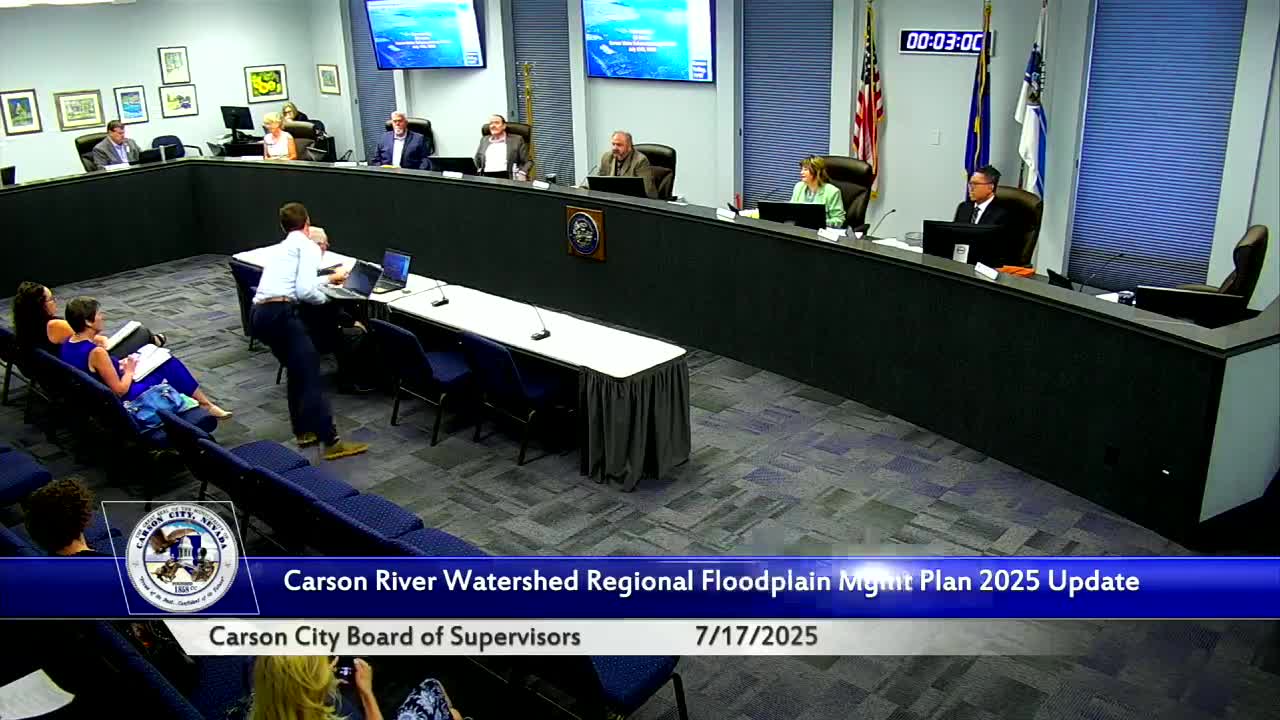
The Carson City Board of Supervisors unanimously adopted a 2025 update to the Carson River Watershed regional floodplain management plan on Wednesday, endorsing a regional, nonregulatory approach to reducing flood risk and preserving floodplain function across multiple counties.
Ed James of the Carson Water Subconservancy District told the board the plan is a regional document developed with input from Alpine County (CA), Douglas, Carson City, Lyon and Churchill counties. The plan urges preserving open floodplain corridors and addressing flood hazards across the watershed, including alluvial-fan hazards that gained focus in prior updates.
James said the plan is a resource — not a regulatory code — that local governments can use to incorporate mitigations into local policies and to guide flood-hazard awareness and project planning. He showed historic flood imagery, noted that flood damage can escalate when development encroaches on floodplain corridors, and said Carson City has already purchased open-space parcels along the river to reduce risk.
The plan includes eight mitigation strategies and about 49 suggested actions. James and staff noted recent local flood events and described grant work with FEMA to evaluate upstream drainage improvements. The Board thanked staff and specifically commended Debbie Dennerit of the Subconservancy District for her work on the update.
Supervisor Schutte moved to adopt Resolution 2025 R-20 to formally adopt the plan; the motion passed unanimously.
City staff said a few editorial corrections would be made to the final document before distribution. The board’s adoption signals local recognition of the plan and allows staff to reference the regional strategies in future permitting and planning discussions.
AI generated
The text on this page is AI generated. Summaries, highlights, analysis, and video transcripts are all produced from the original source material.
AI can make mistakes, so if you spot one, and we will fix it for everyone.
Note: the source content is unaltered by us. Any content source we link to, be it a video, an audio recording, or a document, is presented exactly as its publisher released it. That publisher is usually a government body, sometimes an individual official or another organisation.