Get Full Government Meeting Transcripts, Videos, & Alerts Forever!
Get email alerts on the School Governance topic
No spam. Unsubscribe anytime.
Kyrene board schedules retreats, debates scope of superintendent authority and when to issue formal statements
Summary
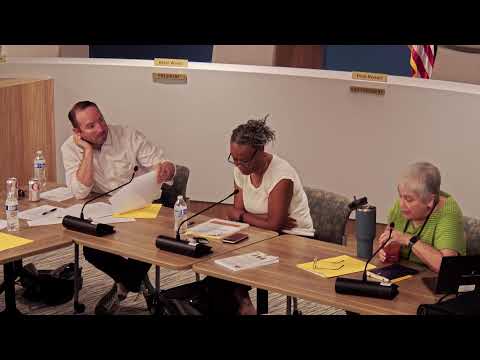
The Kyrene Elementary District governing board met July 21 for a retreat to set near-term calendar items and review how board responsibilities and superintendent authority are defined under Arizona law and district policy.
The Kyrene Elementary District governing board met July 21 for a retreat to set near-term calendar items and review how board responsibilities and superintendent authority are defined under Arizona law and district policy.
Board president Walsh opened the meeting by outlining logistics for the next five to six months and a schedule that includes a district data retreat on Aug. 12 and meetings of the long-range planning committee on July 30 and Aug. 27. The committee is expected to bring recommendations to the board in September; if those recommendations would change school boundaries, grade levels or openings the board discussed holding up to six community hearings—one in each of the district’s six middle school regions—during the October–November window after fall break.
Why it matters: the schedule and any hearings will shape when and how the board and district present potential boundary or program changes to families and staff, and they affect timing for the superintendent’s annual evaluation.
The board discussed scheduling options and constraints. Members proposed holding hearings weekly (examples offered included a six-week cadence, or two hearings per week), noted conflicts with existing board Tuesdays and school calendars, and agreed to collect unavailable dates in the suggested window (roughly Oct. 15–Nov. 20) so staff can propose a final hearing schedule. Board members flagged community engagement trade-offs — compressed schedules could reduce the time available for each hearing, while a staggered approach offers families more chances to attend.
Delegation of authority and curriculum review
A major portion of the retreat reviewed Arizona Revised Statutes (ARS) and two district policies that the board uses to delegate responsibilities to the superintendent. Julie Bacon, director of leadership development for the Arizona School Boards Association, summarized the legal framework and the policy materials the board had available for the discussion.
Bacon and other participants pointed the board to ARS 15-341 (the statute the retreat materials cite) as the source of the board’s enumerated duties and the statutory language permitting the governing board to delegate many operational functions to the superintendent or other staff. Board members raised questions about a handful of statutory phrases — notably the statute’s A(2) language excluding from schools “books, publications, papers, or audiovisual materials of a sectarian, partisan, or denominational character” — and asked whether the district has definitions or rubrics that guide curriculum and resource review.
Superintendent staff and board members described an existing curriculum review process that uses rubrics and public 60‑day reviews for resources, and noted that the district posts resource-review materials for community examination during adoption cycles. The board asked the superintendent to provide a memorandum identifying the next scheduled curriculum adoption or major contract expiration so members can track upcoming reviews.
On delegation specifics, board members noted that the statute explicitly reserves some nondelegable responsibilities to the board (for example, hiring, firing and evaluating the superintendent, adoption of policy and approval of the budget was cited during the discussion). Staff emphasized the district’s current policy language (policies identified in the meeting as 1.1.02 and 2.1.01) which vests day-to-day operational authority with the superintendent while referencing applicable law.
Evaluation timing and executive sessions
The board discussed timing for the superintendent’s evaluation. Members recalled past practice of holding the evaluation near the end of the calendar year and that it typically requires multiple executive sessions. Several members agreed to consider moving the formal evaluation into January (after winter break) to ensure the full board is in place; staff noted there is no statute preventing that shift but that scheduling would likely require three or four executive-session dates depending on the process the board selects.
Student well-being, MTSS and data review
Board members emphasized that district priorities are not limited to academic achievement. Several members asked for more information on intervention systems and safety nets — specifically, Multi-Tiered Systems of Support (MTSS) and how interventions (from Tier 1 through Tier 3) are monitored and tied to academic and social‑emotional indicators. Staff agreed to schedule an MTSS presentation for a future board meeting and to provide district MTSS materials and links in a board memo ahead of the presentation.
Communications, stakeholder language and declarations
The retreat included extensive discussion of the board and superintendent communications handbook and a question raised by a board member about whether the board should adopt a process for issuing “resolutions” or “declarations.” Staff noted Kyrene has historically issued largely noncontroversial proclamations (for example, community recognitions) but has avoided politically contentious statements; counsel and staff urged consideration of potential unintended consequences — extra staff time, community division, and operational impacts — if the board begins taking formal positions on topical statewide or national matters.
Several members argued in favor of using the board’s unity to make public statements on issues that directly affect students and district operations; others said public statements should be limited to issues that are germane to the district’s educational mission and should only be issued when the board speaks unanimously. Board members discussed alternatives, including using the regular board‑member statement portion of meetings or the budget and other routine agenda items as opportunities to call attention to funding or policy issues without adopting a formal resolution.
Other directions and next steps
- The board set a district data retreat for Aug. 12 and confirmed long-range planning committee meetings for July 30 and Aug. 27. - The long-range planning committee is expected to deliver recommendations in September; board members instructed staff to prepare for possible community hearings in the period after fall break and to collect unavailable dates from board members in the Oct. 15–Nov. 20 window. - Staff will provide a memo identifying the next scheduled curriculum adoption or contract expiration and will post MTSS materials and plan an MTSS presentation for the board. - Board members signaled openness to revisiting the wording and indexing of the policy manual and to consider clarifying certain policy terms (for example, how “adequate supervision” is interpreted operationally) if needed after the Aug. 12 data retreat.
The retreat closed with administrative reminders: the board’s next regularly scheduled meeting is July 22 (virtual) and staff repeated a district hiring notice that bus drivers are being recruited and should apply via the Kyrene website.
Ending
Board members left the retreat with a set of near‑term scheduling tasks for staff, a direction to circulate unavailable dates for possible October–November hearings, and requests for follow-up memos and presentations on curriculum timing and MTSS. No formal board votes or resolutions were recorded at the retreat.